
Lab-Grown Diamond Hoop Earrings Guide:
How to Choose the Right Pair
Lab-grown diamond hoop earrings combine the curved shape of a hoop with laboratory-grown diamonds set across part or all of the visible surface. They can range from small, close-fitting designs to wider hoops with more movement and face-up sparkle.
Choosing the right pair involves more than deciding whether the hoops look small or large. Diameter, width, setting style, diamond coverage, total weight, metal construction and closure all affect how the earrings appear and function.
This guide explains those hoop-specific details so that you can compare products accurately before purchasing.
Quick Summary
- The external and internal diameter
- The width and depth of the hoop
- Where the diamonds are positioned
- The setting used to secure the diamonds
- The closure and post construction
- The weight per earring or for the pair
- Whether carat weight applies per earring or to the complete pair
Quick answer: how should you choose diamond hoops?
Small, narrow hoops produce a more understated appearance. Wider or larger-diameter hoops create greater visibility and movement. Inside-out settings provide more visible diamonds from the front, while front-facing pavé hoops concentrate the diamonds on the outer front surface.
Terms such as "small", "medium" and "large" are relative. Always compare millimetre measurements and genuine on-ear photographs.
See also: Lab-grown diamond hoop earrings
What are lab-grown diamond hoop earrings?
Hoop earrings use a circular or curved structure that passes through the piercing and continues below or around the earlobe. Lab-grown diamond hoops incorporate laboratory-grown diamonds into that structure.
The diamonds may be placed:
- Across the front-facing outer surface.
- Along the outside of the complete hoop.
- On both the outer front and inner rear surfaces.
- In a short row on a small close-fitting hoop.
- Across a wider pavé surface.
Laboratory-grown diamonds have essentially the same crystal structure and nearly the same chemical, optical and physical properties as natural diamonds. Their origin is different because they are produced in a controlled laboratory environment rather than formed underground.
See also: What are lab-grown diamonds?
Explore Our Store
View all→Understanding diamond hoop measurements
Hoop dimensions should be presented in millimetres. Product labels alone do not communicate enough information.
External diameter
The external diameter measures the hoop from one outside edge to the opposite outside edge. It describes the complete visible size of the earring.
Internal diameter
The internal diameter measures the open space inside the hoop. This affects how closely the earring sits around the earlobe. Two hoops can share the same external diameter but have different internal space because one is thicker or wider.
Hoop width
Width describes the visible thickness of the hoop from the front. A wider hoop normally has more visual presence, even when its diameter is relatively small.
Hoop depth
Depth describes how thick the hoop is from front to back. This can affect its side profile, weight and how closely it sits beside the ear.
Drop from the piercing
The distance between the piercing and the bottom of the hoop helps shoppers understand how far the earring extends below the earlobe.
A useful product page should provide at least the external diameter, internal diameter, width and drop. It should also show the earrings on a real model without enlarging or digitally altering the product.
Small, medium or large hoops: what changes?
The visible effect of a hoop depends on both diameter and width.
| Hoop direction | Typical appearance | What to verify |
|---|---|---|
| Close-fitting | Compact shape near the earlobe | Internal diameter and available lobe space |
| Small hoop | Understated curve below the ear | External diameter, width and closure |
| Medium hoop | More noticeable shape and movement | Weight, diamond coverage and drop |
| Larger hoop | Stronger outline and greater movement | Weight per earring, construction and balance |
| Wide hoop | Bold surface area without necessarily having a large diameter | Width, depth and front-facing proportions |
These are descriptive categories, not standardised sizes. One brand's "small" hoop may be another brand's "medium".
See also: Lab-grown diamond earring size guide
Understanding diamond coverage
Not every diamond hoop displays its diamonds in the same way.
Front-facing diamond hoops
The diamonds are placed across the section of the hoop that faces forward. This concentrates the decorative detail where it is most likely to be visible. Ask for a side photograph because the diamond-covered section may represent only part of the complete hoop.
Outside-set diamond hoops
Diamonds follow the external surface of the hoop. Depending on the angle and diameter, stones toward the rear may be less visible from the front.
Inside-out diamond hoops
Inside-out hoops position diamonds on the outer front surface and the inner rear surface. This arrangement is designed to make more diamonds visible when the earring is viewed from the front. The phrase "inside-out" only applies when the product photography clearly demonstrates the stone placement.
Partially set hoops
A partially set hoop uses diamonds on only a selected section. This can reduce the number of stones while maintaining visible front-facing detail. Check whether the product's total carat weight includes all diamonds in both earrings.
Which diamond setting should you choose?
Pavé-set hoops
Pavé uses multiple small diamonds positioned closely along the metal surface. Small beads or sections of metal secure the stones. Pavé can create a continuous-looking area of sparkle, but shoppers should inspect close-up photographs for alignment and finishing.
Channel-set hoops
Channel-set diamonds sit between two metal edges. The setting creates a cleaner border with less visible metal between individual stones.
Prong-set hoops
Prongs hold each diamond at specific points. This can expose more of the stones, although the exact appearance depends on the number and thickness of the prongs.
Shared-prong hoops
Adjacent diamonds may share setting elements, reducing the amount of visible metal between them. The alignment and condition of the shared settings should be checked carefully.
No setting style is automatically best. The appropriate option depends on the desired appearance, hoop construction and maintenance expectations.
What does carat weight mean for diamond hoops?
Carat measures diamond weight rather than hoop size or visible diameter. For diamond hoop earrings, the displayed figure may describe:
- The diamonds in one earring.
- The diamonds in both earrings combined.
- All the diamonds across a multi-stone design.
- A central stone plus smaller accent stones.
The product page should clearly state whether the figure is per diamond, per earring or the total carat weight for the pair.
A higher total carat weight does not always create a more visible hoop. Stone placement, number of diamonds, hoop width and setting design also affect the face-up appearance. Do not compare two products by carat weight unless their weight descriptions use the same method.
How should diamond hoops fit?
The earring should pass through the piercing without requiring the wearer to force the post or closure. The internal diameter should provide enough space for the wearer's earlobe and piercing position.
Fit can be affected by:
- Earlobe thickness.
- Piercing height.
- Hoop internal diameter.
- Post length and curvature.
- Closure position.
- Width of the hoop.
- Weight per earring.
A product that fits closely on one person may leave more space on another. Genuine on-ear photographs are helpful, but measurements remain necessary because ears and piercing positions differ.
If a hoop causes persistent pain, pressure or irritation, remove it and consult a qualified piercer rather than trying to alter the closure yourself.
Which hoop closure is best?
Different hoop constructions use different closures.

| Closure | How it works | What to inspect |
|---|---|---|
| Hinged click closure | A hinged section closes around a post or locking point | Hinge movement, alignment and audible or tactile closure |
| Latch back | A curved or straight post secures into a rear latch | Post alignment and latch tension |
| Continuous hoop | A fine post passes into the opposite end of the hoop | Flexibility and ease of alignment |
| Post and butterfly back | A standard post uses a separate backing | Post material, backing size and fit |
The closure should align without excessive force. Product descriptions should identify the closure type instead of relying only on photography.
No closure type makes an earring suitable for sleeping, swimming or uninterrupted wear on its own.
Are huggies the same as hoop earrings?
Huggies are a close-fitting type of small hoop. They normally sit nearer to the earlobe and have a smaller internal diameter than more traditional hoops.
The distinction is based primarily on fit and proportion rather than the diamond material. A small earring may be marketed as either a hoop or a huggie depending on the brand, so measurements are more reliable than the label.
See also: Hoop vs huggie earrings
See also: What are huggie earrings?
Choosing the metal and finish
Metal colour changes the complete appearance of diamond hoops. White-toned metal creates a cooler appearance around colourless diamonds. Yellow-gold tones add warmth and contrast. Rose-gold tones produce a softer pink-toned finish.
I Want Jewels products may use 925 sterling silver with 14kt gold plating. Gold plating is a surface finish and is not equivalent to solid gold. Its appearance can change through friction and exposure to moisture, perfume, cosmetics and cleaning products.
Check whether the product page discloses:
- The base metal.
- The plating material and colour.
- The post material.
- The closure material.
- Care requirements.
- Whether every component uses the same metal.
A product is only hypoallergenic when the complete material construction and appropriate testing support that claim.
How to inspect hoop construction before buying
Look for clear photographs of:
- The front of both earrings.
- The side profile.
- The rear of the hoops.
- The open and closed fastening.
- The post and hinge.
- The diamond setting at close range.
- The earrings worn on a model.
Check whether:
- Both hoops appear symmetrical.
- The posts align with their closures.
- The hinges appear properly positioned.
- The diamond rows follow a consistent line.
- The stated dimensions match the images.
- The carat wording is unambiguous.
- The product weight is supplied where possible.
- The metal and finish are disclosed.
- Returns, care and repair information are available.
A large lifestyle image does not replace these product details.
Lab-grown diamond hoop buying checklist
Before purchasing, confirm:
- What are the external and internal diameters?
- What is the width and depth of each hoop?
- What is the drop from the piercing?
- Where are the diamonds positioned?
- What setting secures the diamonds?
- Is the carat weight per earring or for the pair?
- What closure does the hoop use?
- What is the weight per earring?
- What are the base metal and finish?
- Are the post and closure materials disclosed?
- Can you see front, side, rear and on-ear photographs?
- Are returns, care and repair terms available?
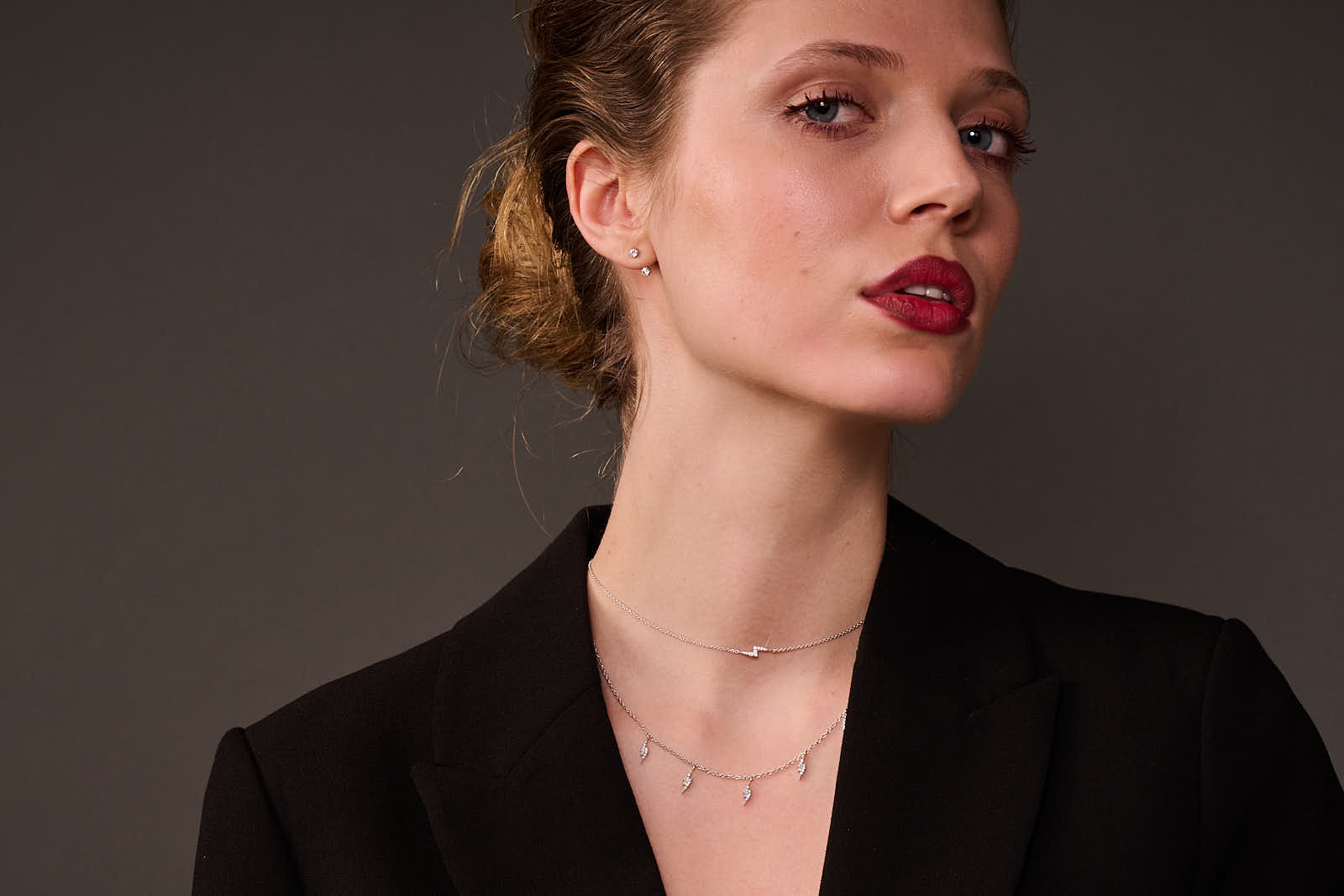
See also: Lab-grown diamond earrings buying guide
Styling diamond hoops
Diamond hoops can be worn alone or used as the most visible element in a multi-piercing arrangement. The diameter and width should be balanced against other earrings rather than placing several similarly sized pieces together.
See also: How to stack earrings
See also: Stud vs hoop earrings
How to care for lab-grown diamond hoops
Handle the earrings by their metal edges rather than repeatedly touching the diamond-covered surface.
After wearing:
- Wipe the metal and diamonds gently with a soft, clean cloth.
- Check that the posts remain aligned.
- Open and close the fastenings carefully.
- Look for visible movement in the hinge or latch.
- Store each hoop separately to reduce scratching.
- Keep plated surfaces away from perfume and harsh chemicals.
Do not force a misaligned post into its closure. Do not use an ultrasonic cleaner unless the manufacturer confirms that it is appropriate for the complete earring, including the setting, hinge and finish.
See also: How to clean lab-grown diamond earrings
Choose diamond hoops by measurement and construction
The best lab-grown diamond hoop earrings are not determined by diameter or carat weight alone. Their visible appearance comes from the combination of hoop size, width, diamond coverage, setting, metal and closure.
Compare actual measurements, complete product photographs and clearly stated materials before purchasing. This provides a more reliable assessment than labels such as "small", "medium" or "everyday hoop".
Explore Our Store
View all→Got Questions?
Frequently Asked Questions
Ready to Shop?
Diamond hoops are not defined by diameter or carat weight alone. Their appearance comes from hoop size, width, diamond coverage, setting, metal and closure together.
Explore I Want Jewels lab-grown diamond hoop earrings and check each product page for its external and internal diameter, width, drop, closure, materials and care information before choosing a pair.
Continue Reading
More From Lab-Grown Diamond Guides
Are Lab-Grown Diamonds Real Diamonds?
Yes, lab-grown diamonds are real diamonds. Learn how they compare to natural diamonds, fake diamonds, cubic zirconia and moissanite before buying.

Lab-Grown vs Natural Diamonds: What Is the Difference?
Compare lab grown and natural diamonds in simple language. Learn the difference in origin, price, sparkle, value and jewellery use before buying.
Are Lab-Grown Diamonds Worth It?
Find out if lab grown diamonds are worth buying, how they compare to natural diamonds, and when lab grown diamond jewellery makes sense.