
Lab-Grown Diamond Earring Size Guide:
Millimetres, Carat Weight and Fit
The most reliable way to compare lab-grown diamond earring sizes is to use millimetre measurements, carat weight and genuine on-ear images together.
Carat tells you how much a diamond weighs. It does not directly tell you how wide the diamond will appear or how large the complete earring will look. A setting, metal border, cluster, halo or decorative shape can make an earring appear wider than the diamond itself.
This guide explains how to compare diamond studs, huggies, hoops and drop earrings using measurements that provide a more accurate idea of their on-ear appearance.
Quick Summary
- Diamond width and height in millimetres
- Complete setting width, height and depth
- Carat weight per diamond and total for the pair
- Earring weight per ear
- Post length and backing type
- Hoop internal and external diameter
- Genuine on-ear images photographed at a consistent scale
Quick answer: what size diamond earrings should you choose?
For round solitaire studs, approximately 3–4 mm creates a more understated face-up appearance, approximately 4–5 mm provides more visible classic sparkle, and approximately 5–6.5 mm creates a progressively stronger stud look.
These are visual ranges, not universal recommendations. Earlobe size, piercing position, setting design and personal style change how the same measurement looks on different people.
See also: Lab-grown diamond earrings
Carat weight is not the same as visible size
A metric carat is a unit of weight equal to 200 milligrams. The Gemological Institute of America explains that carat measures weight rather than physical size.
Two diamonds with the same carat weight can have different face-up measurements because of differences in:
- Shape.
- Cut proportions.
- Depth.
- Girdle thickness.
- Facet arrangement.
- Setting style.
A deeper diamond may carry more of its weight below the visible surface. A shallower diamond may have a wider face-up outline, although proportions also affect its optical performance.
When appearance matters, compare the diamond's millimetre measurements rather than relying only on carat weight.
Explore Our Store
View all→Approximate round diamond carat-to-millimetre chart
The following table provides approximate face-up diameters for reasonably proportioned round brilliant diamonds.
| Carat weight per diamond | Approximate diameter | Approximate total for a matched pair | General visual direction |
|---|---|---|---|
| 0.10 ct each | About 3.0 mm | 0.20 ctw | Very understated |
| 0.15 ct each | About 3.4 mm | 0.30 ctw | Small and subtle |
| 0.20 ct each | About 3.8 mm | 0.40 ctw | Visible but restrained |
| 0.25 ct each | About 4.1 mm | 0.50 ctw | Classic small stud |
| 0.33 ct each | About 4.5 mm | 0.66 ctw | More noticeable |
| 0.50 ct each | About 5.1 mm | 1.00 ctw | Visible classic stud |
| 0.75 ct each | About 5.8 mm | 1.50 ctw | Stronger face-up presence |
| 1.00 ct each | About 6.4–6.5 mm | 2.00 ctw | Large, clearly visible stud |
These measurements are illustrative, not product specifications. Actual diamonds can be wider or narrower depending on their proportions.
The total-pair examples assume two matched solitaire earrings containing one diamond each. They do not apply automatically to clusters, halos, pavé hoops or multi-stone designs.
Total carat weight versus carat weight per ear
This is one of the most important distinctions when buying diamond earrings.
0.50 carat total weight
For a matched solitaire pair, 0.50 ctw for the pair divided by 2 earrings is approximately 0.25 ct per diamond. A proportioned round diamond weighing approximately 0.25 ct may measure around 4.1 mm across.
1.00 carat total weight
For a matched solitaire pair, 1.00 ctw for the pair divided by 2 earrings is approximately 0.50 ct per diamond. A proportioned round diamond weighing approximately 0.50 ct may measure around 5.1 mm across.
1.00 carat per ear
If each earring contains a one-carat centre diamond, 1.00 ct per diamond across 2 earrings is approximately 2.00 ctw for the pair. A proportioned one-carat round diamond may measure approximately 6.4–6.5 mm across.
A "one-carat pair" and "one carat per ear" therefore produce very different on-ear appearances.
What does CTW mean?
CTW, TCW and ct tw commonly refer to total carat weight. In earrings, that total may include:
- Both principal diamonds.
- Every diamond in both earrings.
- Centre stones and accent stones.
- All diamonds in a cluster.
- Every stone across a pair of hoops.
The product page should clearly explain what is included. A shopper should not have to guess whether 1.00 ctw refers to each earring or the complete pair.
Diamond size versus complete earring size
The diamond's width and the earring's complete width are not always the same.
Prong-set solitaire
A fine prong setting normally adds relatively little to the face-up outline, although the prongs remain visible.
Bezel-set solitaire
A bezel surrounds the diamond with a metal border. A 4.1 mm diamond may therefore produce a complete earring that measures wider than 4.1 mm.
Halo or cluster
Smaller diamonds placed around a centre stone can create a much larger overall outline. The centre diamond's carat weight alone does not describe the complete size.
Decorative or motif earring
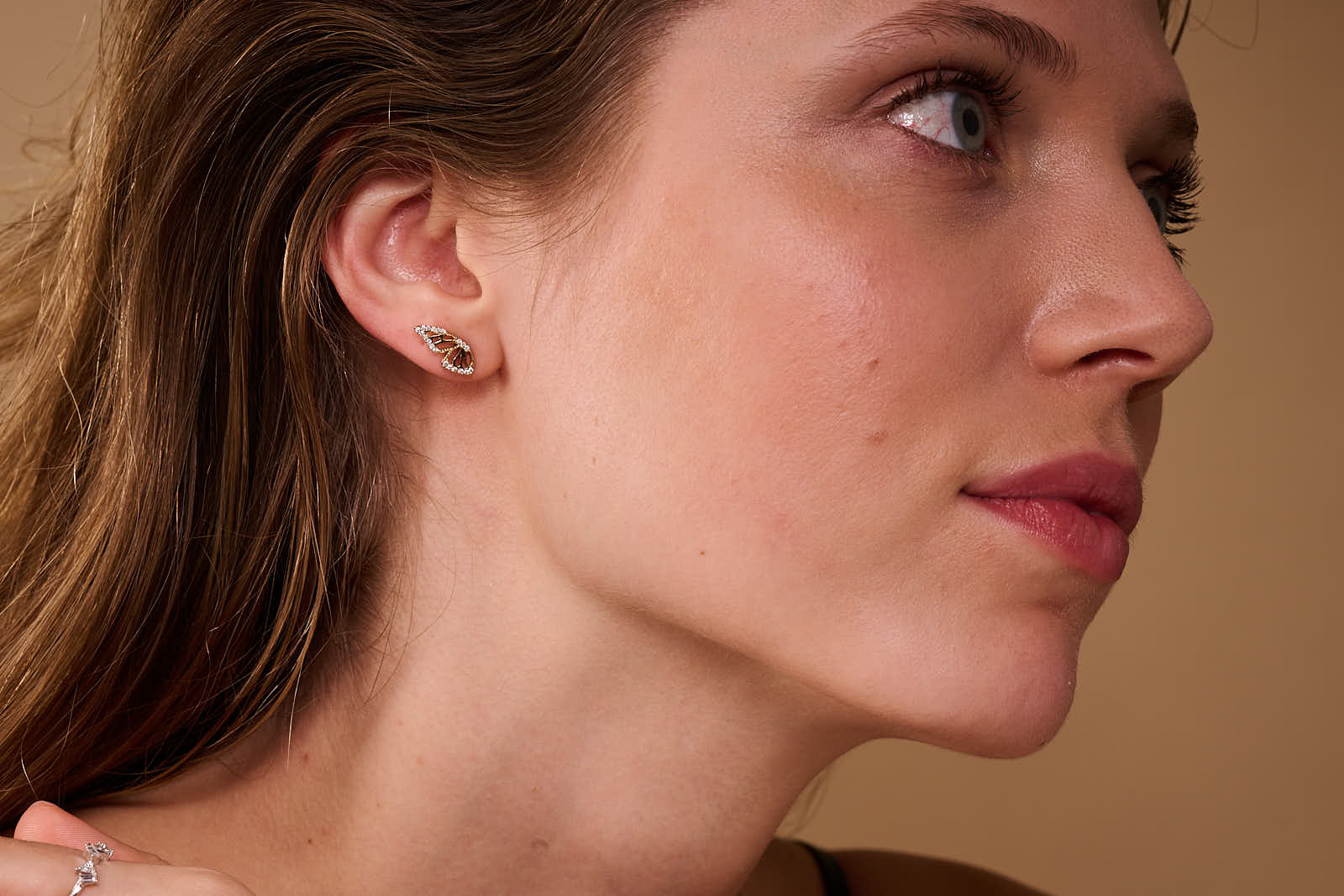
Butterfly, floral, geometric and curved designs may be considerably wider or taller than their individual diamonds.
Product pages should therefore provide two separate measurements: the diamond face-up measurement and the complete earring face-up measurement.
Round, oval and other diamond shapes
Round diamonds can be described with one approximate diameter when the stone is symmetrical. Other shapes require at least two measurements.
| Shape | Measurements needed |
|---|---|
| Round | Average diameter |
| Oval | Length × width |
| Pear | Length × width |
| Marquise | Length × width |
| Emerald | Length × width |
| Radiant | Length × width |
| Cushion | Length × width |
| Princess | Length × width |
| Heart | Length × width |
Two diamonds of equal weight but different shapes may have very different outlines. An elongated oval, pear or marquise may look longer than a round diamond of the same weight, while its width may be narrower.
Never convert a round-diamond diameter directly into an assumed measurement for another shape.
How to measure diamond stud earrings
For studs, the product page should disclose:
| Measurement | What it describes |
|---|---|
| Diamond width and height | The visible dimensions of the diamond |
| Complete setting width and height | The total front-facing earring size |
| Setting depth | How far the earring projects from the ear |
| Post length | The usable length passing through the piercing |
| Backing dimensions | The size of the supporting back |
| Weight per earring | How much each complete earring weighs |
| Carat weight | Per diamond and total for the pair |
Setting depth is particularly important. Two studs with the same face-up width may sit differently if one has a higher basket or more projecting setting.
See also: Lab-grown diamond stud earrings guide
How to measure huggie earrings
For huggies, the internal diameter often matters more than the external diameter. The product page should show:
- Internal diameter.
- External diameter.
- Hoop width.
- Hoop depth.
- Distance from post to lower inner edge.
- Complete drop from the piercing.
- Weight per earring.
- Closure type.
A huggie described as "small" may fit closely on one earlobe but leave more space on another because piercing positions and earlobe thickness vary.
See also: What are huggie earrings?
How to measure hoop earrings
For traditional hoops, check:
- External diameter.
- Internal diameter.
- Front-facing width.
- Front-to-back depth.
- Drop from the piercing.
- Diamond-covered section.
- Weight per earring.
- Post and closure measurements.
Diameter determines the overall outline, while width and diamond coverage affect how substantial the hoop appears. A thin 25 mm hoop and a wide 25 mm hoop will not create the same visual effect.
See also: Lab-grown diamond hoop earrings guide
How to measure drop earrings
For drop earrings, carat weight may provide very little information about the earring's complete visual size. Check:
- Total length from the piercing.
- Length of the decorative drop.
- Maximum width.
- Setting dimensions.
- Number of moving sections.
- Weight per earring.
- Post or hook length.
- Closure type.
A long, narrow drop may look more noticeable than a wider stud even when it contains less total diamond weight.
See also: Lab-grown diamond drop earrings guide
How different stud sizes may look
For round solitaire-style studs, these approximate face-up ranges can help organise the options.
| Approximate face-up diameter | Visual description | Questions to ask |
|---|---|---|
| Below 3.0 mm | Very fine point of sparkle | Is the product intended for a main or secondary piercing? |
| 3.0–3.9 mm | Small and understated | Is the visibility sufficient in on-ear photography? |
| 4.0–4.9 mm | Classic and clearly visible | Does the setting increase the total outline? |
| 5.0–5.9 mm | More noticeable stud | Is the setting balanced with the backing? |
| 6.0 mm and above | Strong face-up presence | What is the weight per earring and setting depth? |
These are not strict style rules. The same diameter can look different depending on the wearer's ear and the design surrounding the diamond.
Is a one-carat pair of diamond earrings large?
A one-carat-total matched solitaire pair usually means approximately 0.50 ct per ear. A proportioned round diamond of that weight may measure approximately 5.1 mm.
This creates a clearly visible stud, but it is not the same as wearing a one-carat diamond on each ear.
A pair containing one carat per ear would have approximately two carats total. Each proportioned round diamond may measure approximately 6.4–6.5 mm.
Always confirm the exact wording and product measurements instead of judging from "1 ct" alone.
Does earlobe size change how earrings look?
Yes. The same earring can appear different depending on the wearer.
- Earlobe width and height.
- Attached or detached lobes.
- Piercing position.
- Distance from the piercing to the lower edge.
- Number and placement of other piercings.
- The angle at which the piercing was made.
- Whether the setting sits flat or tilts.
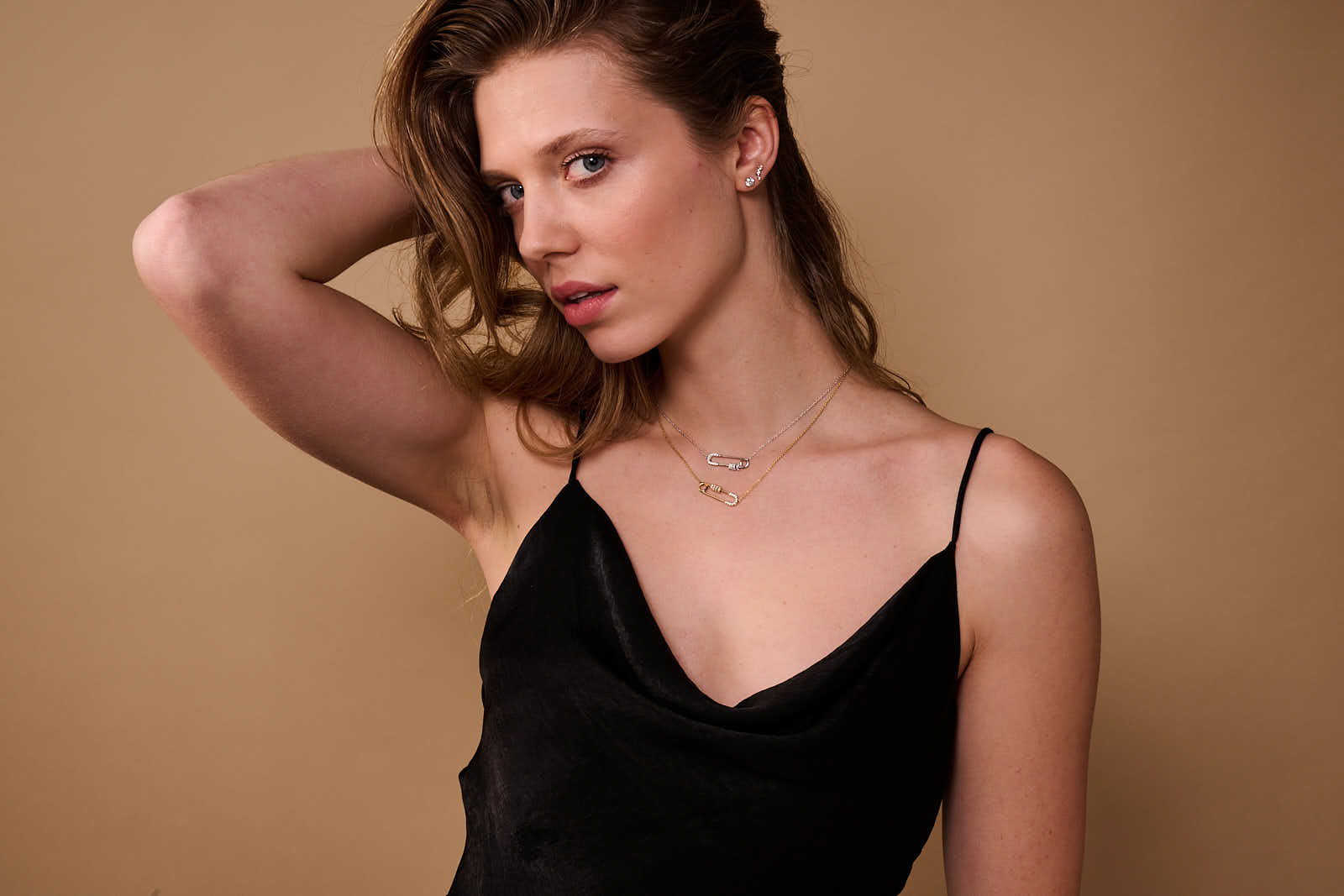
This is why a single model image cannot represent every wearer. Measurements provide the objective information. Try-on images provide visual context. Both are necessary.
How try-on images should be used
Try-on images should help shoppers compare products rather than simply promote them. A useful size comparison should:
- Use the same model.
- Use the same ear and piercing.
- Use the same camera distance and lens.
- Keep the head angle consistent.
- Use the same crop and image dimensions.
- Use the same lighting.
- Display the exact millimetre measurement.
- Display carat weight per ear and total for the pair.
- Avoid digitally enlarging or reducing the earrings.
- State when an image is illustrative rather than exact.
For example, a controlled stud comparison could show 3.0 mm at approximately 0.10 ct per ear, 4.1 mm at approximately 0.25 ct per ear, 5.1 mm at approximately 0.50 ct per ear, and 6.4–6.5 mm at approximately 1.00 ct per ear.
These should be four separate photographs of correctly sized products or calibrated samples—not one earring digitally resized four times.
How to choose between two close sizes
When two sizes appear similar, compare:
- The difference in millimetres.
- The complete setting width.
- Carat weight per ear.
- Setting depth.
- Weight per earring.
- Backing size.
- Try-on photographs.
- How the earrings will sit with existing piercings.
A difference of 0.5–1 mm may sound small, but it can be visible when the earrings are worn directly on the earlobe.
However, a higher carat weight does not guarantee a larger visible outline. Always use the reported dimensions.
Common earring-size mistakes
Choosing by carat weight alone
Carat is weight, not visible width. Check millimetres and the complete setting.
Confusing total carat weight with per-ear weight
A one-carat-total pair is not the same as one carat on each ear.
Treating "small" and "medium" as standard sizes
These labels are not standardised across brands.
Ignoring the setting
A bezel, halo, cluster or decorative motif can significantly increase the complete face-up dimensions.
Comparing edited product images
Product photographs may use different crops or magnification. Compare measurements and controlled try-on images.
Ignoring earring weight
Face-up size does not reveal how much the complete earring weighs.
Using a printed or screen chart without calibration
Printers and screens can resize graphics. A print-at-home chart needs a measurement test line, and an on-screen tool needs user calibration.
Final size checklist
Before ordering, confirm:
- Diamond carat weight per ear.
- Total carat weight for the pair.
- Diamond width and height in millimetres.
- Complete earring width and height.
- Setting depth.
- Weight per earring.
- Post length.
- Backing or closure type.
- Internal and external diameter for hoops or huggies.
- Total drop length for hanging earrings.
- Genuine controlled try-on images.
- Whether any size chart is illustrative or based on exact product data.
See also: Lab-grown diamond earrings buying guide
Choose measurements before labels
The right lab-grown diamond earring size cannot be identified from "small", "medium" or "one carat" alone.
Compare the diamond's millimetre dimensions, complete setting size, carat weight per ear, total carat weight, setting depth and earring weight. Then use controlled try-on photographs to understand how those measurements may appear when worn.
Explore Our Store
View all→Got Questions?
Frequently Asked Questions
Ready to Shop?
The right earring size cannot be identified from "small", "medium" or "one carat" alone. Compare millimetre dimensions, complete setting size, carat weight per ear, setting depth and earring weight.
Explore I Want Jewels lab-grown diamond earrings and check each product page for its diamond and complete earring measurements, carat wording, setting depth and weight before choosing a size.
Continue Reading
More From Lab-Grown Diamond Guides
Are Lab-Grown Diamonds Real Diamonds?
Yes, lab-grown diamonds are real diamonds. Learn how they compare to natural diamonds, fake diamonds, cubic zirconia and moissanite before buying.
Lab-Grown vs Natural Diamonds: What Is the Difference?
Compare lab grown and natural diamonds in simple language. Learn the difference in origin, price, sparkle, value and jewellery use before buying.
Are Lab-Grown Diamonds Worth It?
Find out if lab grown diamonds are worth buying, how they compare to natural diamonds, and when lab grown diamond jewellery makes sense.