

How to Stack Earrings:
A Step-by-Step Ear Stack Guide
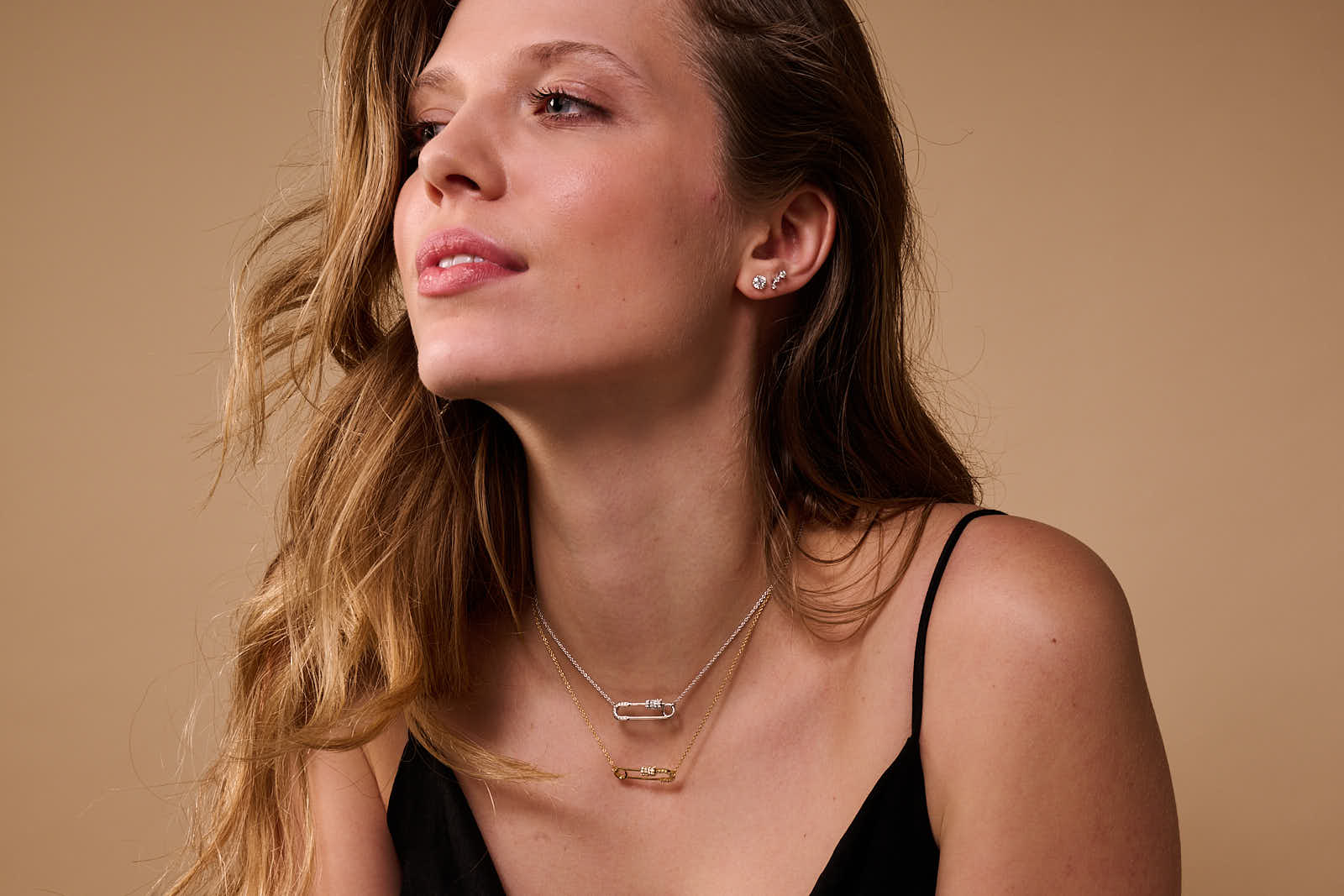
An ear stack is a combination of earrings styled across two or more piercings. A successful stack does not depend on wearing as many earrings as possible. It depends on creating a clear relationship between size, shape, sparkle, metal and spacing.
The simplest approach is to choose one focal earring, add a quieter supporting piece and leave enough visual space for every earring to be seen. Studs, huggies and small hoops are useful building blocks, while drops or more decorative designs can become the focal point.
This guide explains how to stack earrings with two or three piercings, how to combine different earring styles and how to prevent a stack from looking crowded.
Quick Summary
- Choose one focal earring
- Add a smaller or quieter supporting earring
- Repeat one element — metal colour, diamond detail or shape
- Vary the size so the earrings do not compete
- Check the spacing from the front and side
- Test the stack with hair, glasses and headphones
- A two-piece stack can look as intentional as four
The short answer: how do you stack earrings?
Follow this basic ear-stacking formula:
- Choose one focal earring.
- Add a smaller or quieter supporting earring.
- Repeat one element, such as metal colour, diamond detail or shape.
- Vary the size of the earrings so they do not compete.
- Check the spacing from the front and side.
- Test the complete stack with your hair, glasses and headphones.
A two-piece stack can look just as intentional as a three- or four-piece combination. The aim is balance, not quantity.
This styling guide is intended for healed piercings. Do not force jewellery into a piercing or change jewellery in a healing piercing without guidance from a qualified piercer. Piercing angles, spacing and anatomy differ from person to person. Professional piercing guidance is that jewellery changes during healing should be handled by a qualified piercer, and that unsuitable size, weight or style can cause problems.
What is an ear stack?
An ear stack is a planned arrangement of earrings worn across multiple piercings. It might contain:
- Two differently sized studs
- A stud with a huggie
- A hoop with a smaller stud
- A decorative focal earring with one subtle supporting piece
- Three small earrings connected by metal, shape or sparkle
The earrings do not have to match exactly. They need a shared visual feature that makes the combination appear deliberate.
See also: Diamond ear stack ideas
Explore Our Store
View all→The four parts of a balanced ear stack
| Element | Purpose | Possible earring |
|---|---|---|
| Focal piece | Attracts the most attention | Medium stud, hoop, drop or decorative earring |
| Supporting piece | Connects the focal earring to the rest of the stack | Huggie, small hoop or smaller stud |
| Finishing detail | Adds a quiet final point | Small stud or minimalist earring |
| Breathing room | Keeps the earrings visually separate | Natural space between the piercings |
Not every stack needs all four components. With two piercings, the focal and supporting pieces may be enough.
How to build an ear stack step by step
1. Count your healed piercings
Begin with the number and placement of your healed piercings. Do not assume that every first, second or third piercing follows the same spacing. Look at the distance between each piercing, whether they follow a straight or curved line, the amount of visible lobe around each earring, whether hoops or huggies sit independently without touching, and the direction in which studs naturally face.
2. Choose one focal earring
The focal earring should be the piece that receives the most attention. This could be the largest earring, but it could also be a smaller piece with a distinctive shape or stronger diamond detail. Possible focal pieces include a medium diamond stud, a pavé hoop, a geometric earring, a butterfly design, a drop earring or a bold decorative earring.
3. Decide where the visual weight should sit
Many people place the most noticeable earring in the lowest lobe piercing, but this is a styling option rather than a fixed rule. A lower piercing can usually carry the focal piece, with progressively quieter pieces above it. However, a huggie in the second piercing or a distinctive upper-lobe stud can also become the focus when the spacing works.
4. Vary the scale
Wearing several earrings of exactly the same size can make the stack appear flat or crowded. Introduce a visible difference between the focal and supporting pieces — for example a medium stud with a small stud, a huggie with a small solitaire stud, a small hoop with a quieter diamond detail, or a decorative earring with a plain supporting stud.
5. Repeat one visual element
Repeating one feature helps separate earrings look like part of the same composition. You could repeat the same metal colour, brilliant-cut diamond details, rounded shapes, geometric lines, a particular colour or a similar level of sparkle.
A useful principle is: repeat one element and vary another. Two earrings can share the same metal finish while having different shapes, or share a round diamond detail while differing in size.
6. Check the spacing
Each earring should have enough space to be recognised independently. Crowding can occur when two hoops overlap, a large stud covers a neighbouring piercing, a drop earring catches beneath a huggie, decorative edges touch throughout the day, or earring backs compete behind the ear.
Use product measurements and real on-ear photographs instead of relying only on close-up product images. There is no single millimetre measurement that works for every ear.
7. Test the stack in real conditions
A combination can look balanced in a mirror but behave differently throughout the day. Check how the earrings interact with loose and tied-back hair, glasses, headphones and earbuds, high collars and scarves, telephone use and movement when walking.
If the earrings touch, pull, rotate excessively or catch repeatedly, change the combination or placement.
See also: Lab-grown diamond earring size guide
How to stack earrings with two piercings
With two piercings, create contrast between the earrings while keeping one shared feature.
Stud and huggie
A stud provides a concentrated point of sparkle, while a huggie adds a curved shape. Keep the metal finish consistent for a simple combination, or use related diamond details to connect the pieces.
Medium stud and small stud
Choose two studs with a clear size difference. The larger stud can act as the focal piece, while the smaller one creates a quieter finishing point.
Hoop and stud
Let the hoop create the outline and movement. Use a smaller stud as support so both earrings remain visible.
Decorative earring and plain stud
When the focal earring has a distinctive shape, pair it with a restrained stud. Avoid adding another equally detailed piece.
See also: Stud vs huggie earrings
How to stack earrings with three piercings
A three-piercing stack can follow this structure:
- Focal piece: the most noticeable earring
- Bridge piece: connects the focal earring with the upper detail
- Finishing piece: the smallest or quietest earring
One example is a medium stud, a small huggie and a smaller stud. Another is a hoop, a solitaire stud and a minimalist upper-lobe detail.
Avoid automatically filling every position with sparkle. A plain metal shape between two diamond pieces can give the eye somewhere to rest.
If the third piercing sits very close to the second, use actual earring dimensions before buying. A small product photograph does not show how much space an earring will occupy on your ear.
How to combine different earring types
Studs
Studs add a concentrated point of light without introducing another circular outline. They can be used as the focal earring or as the smallest supporting piece, depending on their size.
Huggies
Huggies introduce shape while remaining close to the lobe. Their suitability depends on the internal diameter, closure, piercing position and individual anatomy. No huggie is automatically comfortable or suitable for every piercing — compare its measurements with the intended placement.
Hoops
Hoops create a stronger outline and may occupy more visual space than studs. When a hoop is the focal piece, use smaller supporting earrings around it.
Drop earrings
A drop earring will usually become the focal point because it extends below the lobe and introduces movement. Pair it with one or two quiet studs rather than another large hoop or drop.
Decorative shapes
Butterfly, floral and geometric earrings add personality to a stack. Repeat their metal or diamond detail elsewhere, but avoid combining several unrelated motifs in the same ear.
See also: Hoop vs huggie earrings
See also: How to style butterfly earrings
Can you mix metals in an ear stack?
Yes. A mixed-metal stack can look intentional when the contrast is repeated.
Instead of using one isolated white or silver-toned earring among several yellow-gold pieces, repeat both finishes across the stack or use a transitional piece that contains related tones.
For a quieter result, keep one metal colour throughout and create variation through size and shape.
Should both ears have the same stack?
They can match, but they do not have to.
A symmetrical arrangement uses the same earrings in corresponding positions on both ears. This produces a more traditional, uniform result.
An asymmetrical arrangement might use a three-piece stack on one ear and a simpler stud or huggie on the other. To keep it cohesive, repeat at least one feature across both ears, such as the metal finish, diamond shape or focal design.
Asymmetry should look deliberate rather than accidental.
Common ear-stacking mistakes
Making every earring a focal piece
Several large, highly detailed pieces can compete with one another. Select one focal earring and make the rest progressively quieter.
Choosing from product photographs alone
Product close-ups are useful for showing details but can make small earrings appear much larger. Check millimetre measurements and on-ear photographs.
Assuming piercing positions are universal
Two people can have different spacing, angles and usable lobe area. A combination shown on one model may sit differently on another person.
Ignoring closures and earring backs
Crowding can happen behind the ear as well as at the front. Check that posts, butterfly backs and hoop closures do not interfere with neighbouring earrings.
Mixing too many unrelated ideas
Combining different metals, shapes, sizes and motifs simultaneously can make the stack lose its structure. Repeat one or two features across the arrangement.
Forgetting real-life wear
Hair, glasses, clothing and headphones can change how an ear stack feels and moves. Test the complete combination before treating it as an everyday stack.
Caring for earrings worn in a stack
Multiple earrings can collect cosmetics, hair products and natural oils, particularly when the pieces sit close together.
Follow the care instructions supplied with each product. For 925 sterling silver earrings with 14kt gold plating:
- Handle the earrings with clean, dry hands.
- Avoid direct exposure to perfumes, lotions and hairspray.
- Remove them before showering, swimming and exercise.
- Wipe them gently after wear.
- Store pieces separately to reduce friction and scratching.
- Do not use harsh chemicals or abrasive brushes.
See also: How to clean lab-grown diamond earrings
Final ear-stack checklist
Before wearing or purchasing a combination, ask:
- Are all the intended piercings fully healed?
- Which earring is the focal piece?
- Is there a noticeable difference in scale?
- What feature connects the earrings?
- Can each piece be seen separately?
- Have I checked the actual measurements?
- Do the closures and backs have enough room?
- Will the stack interact with my hair or glasses?
- Does the asymmetry or symmetry look intentional?
- Can each earring also be worn separately?
If the combination feels crowded, remove one piece before replacing every earring. A simpler stack often makes the focal design easier to see.
Explore Our Store
View all→Got Questions?
Frequently Asked Questions
Ready to Shop?
Ready to build your stack? Start with one focal earring and one quieter supporting piece, then add further details only when the spacing allows.
Explore I Want Jewels lab-grown diamond earrings and check each product page for its dimensions, weight, closure and whether it is sold as a pair or a single earring before combining pieces in the same ear.
Continue Reading
More From Earring Styling Guides
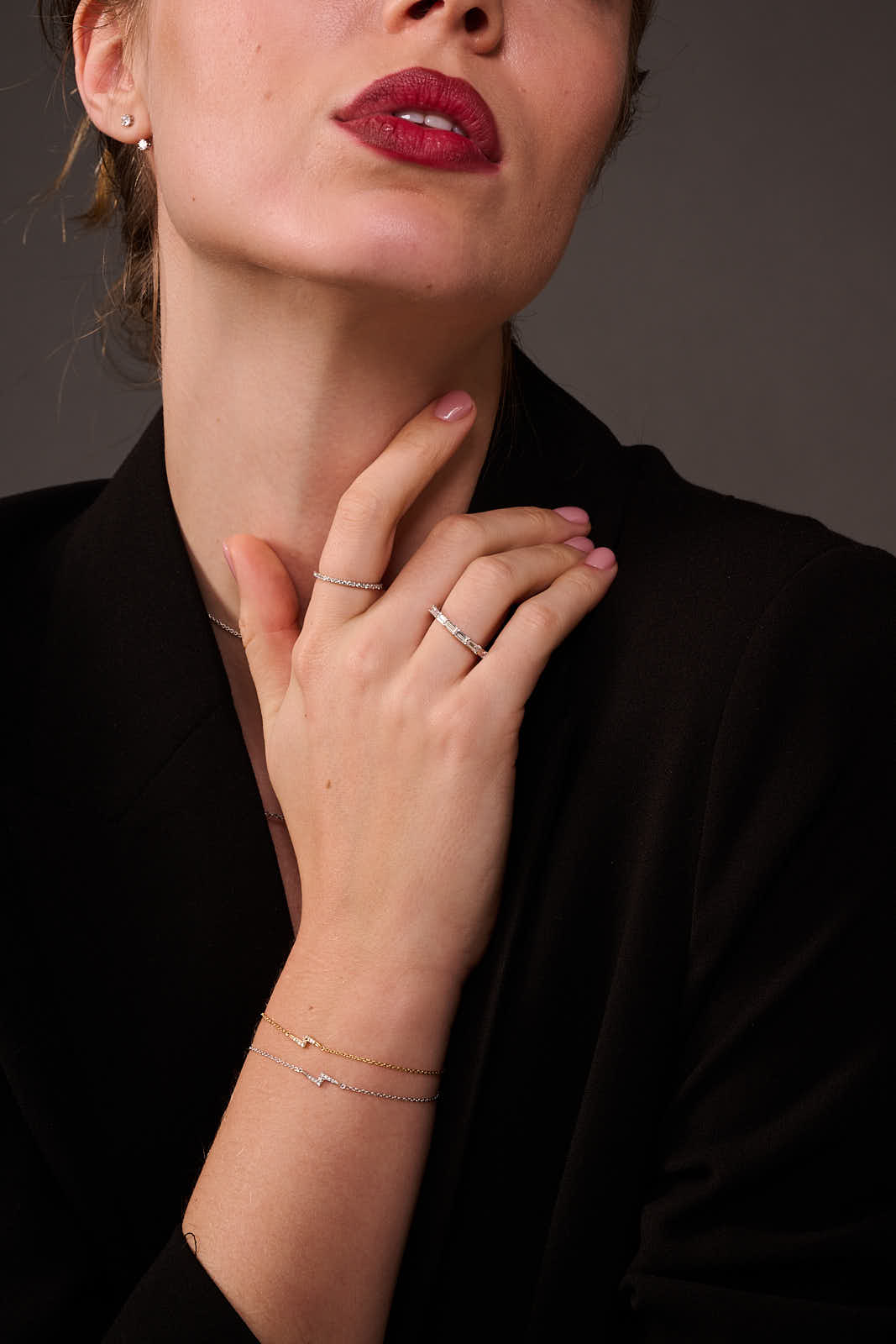
Diamond Ear Stack Ideas: 15 Curated Looks
Fifteen diamond ear stack ideas for two and three piercings, covering minimalist, everyday, workwear, wedding guest and evening combinations.

Minimalist Earrings Guide: Styles & Buying Tips
Learn how to choose minimalist earrings by style, size, metal, closure and sparkle. Compare studs, huggies, slim hoops and subtle diamond designs.

Stud vs Huggie Earrings: Key Differences
Compare stud and huggie earrings by shape, fit, backing, movement and styling. Learn which design suits a single piercing, gift or ear stack.