

Lab-Grown Diamonds vs Cubic Zirconia:
What Is the Difference?
Lab-grown diamonds and cubic zirconia can both be cut into bright, colourless stones, but they are fundamentally different materials.
A laboratory-grown diamond is diamond material created using a controlled technological process. It consists of crystallised carbon and has essentially the same chemical, physical and optical properties as a natural diamond. Cubic zirconia, usually shortened to CZ, is a manufactured form of zirconium dioxide. It is used as a diamond simulant because it can imitate some of a diamond's appearance, but it is not a diamond.
Neither choice is automatically right for every person. Cubic zirconia offers considerable sparkle at a much lower price. Laboratory-grown diamonds offer the material properties, hardness and optical character of diamond. Your decision should depend on your budget, how often you intend to wear the jewellery and whether owning a diamond matters to you.
Quick Summary
- A laboratory-grown diamond is a diamond with a laboratory origin
- Cubic zirconia is a different manufactured material used to look diamond-like
- Diamond scores 10 on the Mohs scale; cubic zirconia around 8–8.5
- Cubic zirconia generally costs considerably less
- Both sparkle, but they interact with light differently
- CZ can be an appropriate choice for lower-cost or trend-led jewellery
- Choose diamond when you specifically want diamond, or greater scratch resistance
Quick answer
The essential difference is the material.
A laboratory-grown diamond is a diamond with a laboratory origin. Cubic zirconia is a different manufactured material used to create a diamond-like appearance. Both can sparkle, but they are not the same substance and they do not wear in the same way.
See also: What are lab-grown diamonds?
Lab-grown diamond and cubic zirconia comparison
| Feature | Laboratory-grown diamond | Cubic zirconia |
|---|---|---|
| Material | Crystallised carbon | Manufactured zirconium dioxide |
| Classification | Diamond with a laboratory origin | Diamond simulant |
| Diamond? | Yes, when accurately identified as laboratory-grown | No |
| Creation | Commonly produced using HPHT or CVD technology | Manufactured by stabilising and crystallising zirconium dioxide |
| Mohs hardness | 10 | Approximately 8–8.5 |
| Scratch resistance | Extremely high, although not indestructible | Good, but more likely to scratch through prolonged wear |
| Light performance | Diamond brilliance, fire and scintillation | Often displays strong rainbow-coloured fire |
| Density | Lower than CZ | Denser and heavier at equivalent dimensions |
| Price | More expensive than CZ | Usually considerably less expensive |
| Everyday wear | Well suited when properly set and cared for | Suitable, but surface wear may become more visible over time |
| Identification | Label, documentation and professional testing | Label and professional testing |
| Best suited to | Buyers who specifically want diamond jewellery | Buyers prioritising affordability and visual sparkle |
The Mohs scale measures resistance to scratching. It does not measure every type of durability. A diamond can still chip if struck at a vulnerable angle, and the setting and metal may require repair even when the diamond remains undamaged.
Explore Our Store
View all→What is a laboratory-grown diamond?
A laboratory-grown diamond is produced using technology that recreates the conditions necessary for diamond crystal growth. Two widely used production methods are:
- High Pressure High Temperature: HPHT uses high pressure and high temperature to grow diamond material.
- Chemical Vapour Deposition: CVD introduces carbon-rich gas into a controlled chamber and deposits carbon onto a diamond seed.
The finished stone is then cut and polished. The laboratory origin should always be disclosed clearly wherever the stone is described or sold.
A laboratory-grown diamond should not be confused with a diamond simulant. Cubic zirconia and moissanite resemble aspects of a diamond's appearance, but they have different chemical compositions and physical properties.
See also: Are lab-grown diamonds real diamonds?
What is cubic zirconia?
Cubic zirconia is the cubic crystalline form of zirconium dioxide. The colourless version is widely used in jewellery as a diamond simulant.
Calling CZ a simulant does not mean it is automatically poor quality or deceptive. It means the material can imitate aspects of a diamond's appearance without being diamond. Problems arise only when cubic zirconia is incorrectly represented or sold as diamond.
Cubic zirconia should also not be confused with zircon. Zircon is a naturally occurring mineral, while the CZ used in jewellery is a manufactured material with a different composition.
Is cubic zirconia a fake diamond?
Cubic zirconia is not a diamond. The most accurate description is diamond simulant.
If a product is clearly described as containing cubic zirconia, there is nothing inherently misleading about it. It can be a valid choice for someone who wants a colourless, sparkling stone at an accessible price.
The word "fake" is less useful because it confuses material identity with product honesty. A properly disclosed CZ earring is not pretending to be something else. A problem exists when a seller describes or prices cubic zirconia as though it were diamond.
Are laboratory-grown diamonds fake?
No. Laboratory-grown diamonds are diamonds created by a technological process rather than through geological formation in the earth.
However, the laboratory origin must remain clear. Product titles, descriptions, packaging, receipts and advertising should consistently use a qualifying term such as "laboratory-grown diamond".
Laboratory-grown and natural diamonds share essentially the same material properties, but they differ in origin. Specialist equipment and trained gemologists may be required to distinguish a laboratory-grown diamond from a natural one reliably.
See also: Lab-grown vs natural diamonds
Do laboratory-grown diamonds and cubic zirconia look different?
Both stones can look colourless and highly polished, particularly when they are small and well cut. Their optical properties are different, however.
Diamond's appearance combines:
- Brightness from reflected white light
- Fire from the separation of light into spectral colours
- Scintillation from flashes created as the stone, wearer or light moves
Cubic zirconia has greater dispersion than diamond and may display more rainbow-coloured flashes. Whether this looks attractive is a matter of personal preference. The result also depends heavily on the cut, stone size, setting and lighting.
Descriptions such as "glassy" or "artificial-looking" are subjective rather than universal facts. High-quality CZ can look attractive, especially in smaller sizes. It simply does not have the same optical properties as diamond.
Online photographs are not a reliable way to identify a stone. Photography, lighting and editing can make different stones look similar.
Which is more durable?
Laboratory-grown diamond is more resistant to scratching because diamond scores 10 on the Mohs hardness scale. Cubic zirconia scores approximately 8–8.5.
This means CZ is more likely to develop scratches, softened facet edges or surface wear over an extended period. Oils and cosmetic residue can also reduce visible sparkle, although this type of buildup may be removable through appropriate cleaning.
Diamond's hardness does not make the complete earring indestructible. Diamond can chip, and the surrounding metal, plating, post, back and setting may wear or become damaged.
For earrings, durability depends on:
- The stone
- The security of the setting
- The earring metal and finish
- How frequently the earrings are worn
- Exposure to water, cosmetics and hair products
- Cleaning and storage habits
Which costs more?
Cubic zirconia normally costs considerably less than laboratory-grown diamond because the materials, production processes and markets are different.
The final jewellery price does not depend on the centre stone alone. It may also include:
- Stone size and quality
- Cut and setting complexity
- Metal and plating
- Design and manufacturing
- Brand, packaging and service
- Testing or grading documentation
- Warranty and returns support
A lower price does not make CZ a poor decision, and a higher price does not automatically make every laboratory-grown diamond product superior. Compare the complete piece, including its metal, construction, stone disclosure and aftercare.
Laboratory-grown diamond prices can change over time. Neither laboratory-grown diamonds nor cubic zirconia should be treated as a guaranteed financial investment or as certain to retain resale value.
See also: Lab-grown diamond earrings price guide
Which is better for earrings?
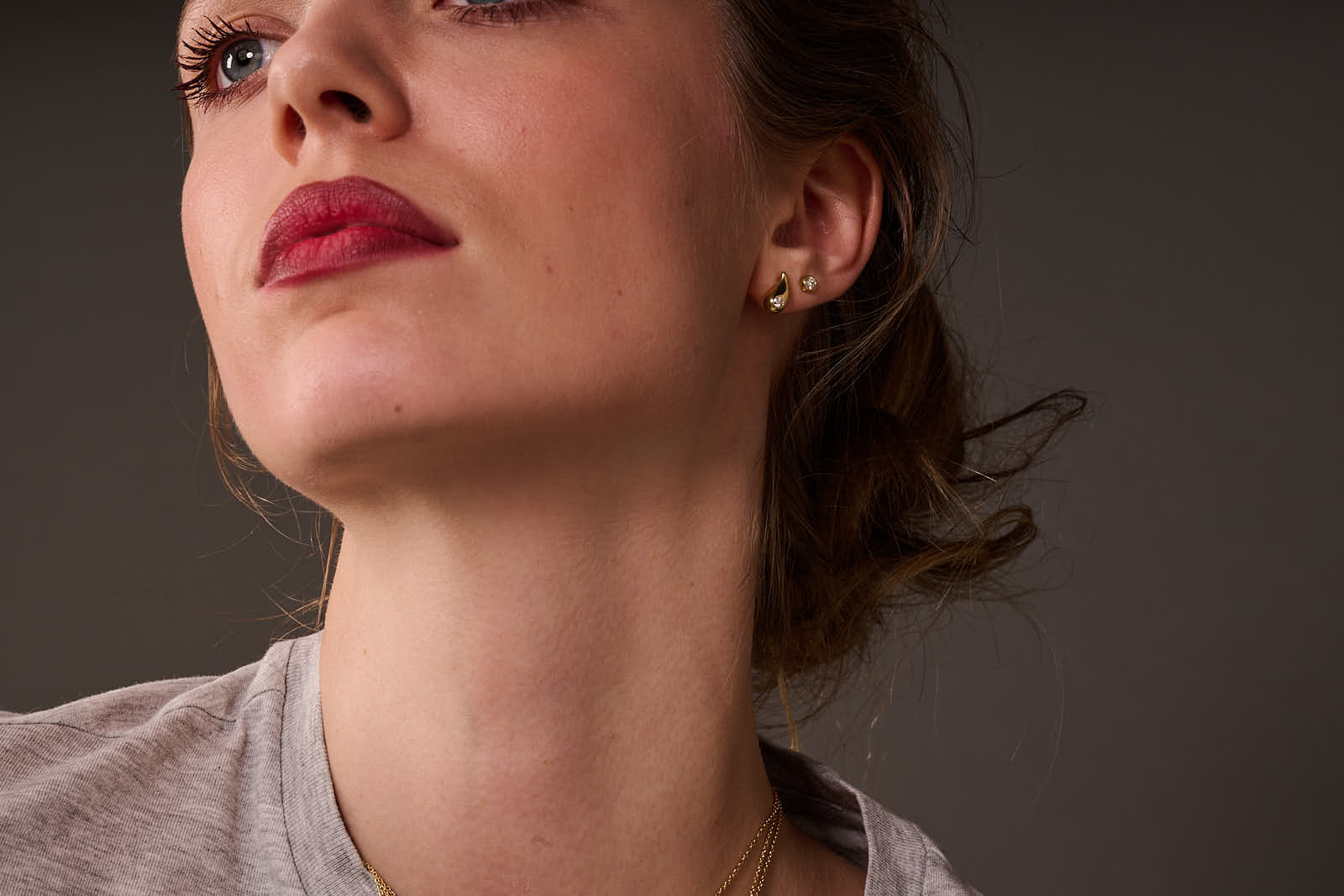
Laboratory-grown diamond earrings may be the better choice if:
- You specifically want diamond rather than a diamond simulant.
- You plan to wear the earrings regularly.
- Scratch resistance is important to you.
- The jewellery marks a meaningful event.
- You want the optical properties associated with diamond.
Cubic zirconia earrings may be the better choice if:
- You want the lowest possible purchase price.
- You enjoy strong rainbow-coloured fire.
- You are experimenting with a new size or style.
- The earrings are for occasional or trend-led wear.
- Owning diamond is not important to you.
The best choice is the one that matches the wearer's priorities. CZ is not limited to one-night use; properly made and cared-for CZ jewellery can be worn many times. It is simply more likely than diamond to show surface wear over time.
Laboratory-grown diamond vs cubic zirconia studs
Stud earrings are often worn regularly, making scratch resistance and secure settings important.
Small CZ studs can provide an affordable way to test whether you enjoy a particular stone diameter or visual presence. Laboratory-grown diamond studs are more appropriate when the buyer wants diamond material and expects the pair to form a long-term part of their jewellery collection.
When comparing studs, check:
- Total carat weight versus per-ear carat weight
- Stone diameter in millimetres
- Metal and plating
- Setting type
- Post and earring-back design
- Whether the stone is laboratory-grown diamond or CZ
- Returns, warranty and care instructions
See also: Lab-grown diamond stud earrings guide
See also: Lab-grown diamond earring size guide
Which is better for a gift?
A jewellery gift does not have to contain diamond to be thoughtful. The right choice depends on the occasion, the recipient's preferences and the buyer's budget.
Choose laboratory-grown diamond when the recipient has expressed a preference for diamond or the material is part of the meaning of the gift. Choose cubic zirconia when the recipient prioritises design, affordability or fashion rather than stone identity.
The product description should state the material clearly so that both the buyer and recipient know what they are receiving.
See also: Lab-grown diamond earrings for gifts
Can you tell CZ from a laboratory-grown diamond at home?
Visual checks are not sufficiently reliable to authenticate a stone. Online "fog tests", scratch tests, water tests and similar home methods can produce incorrect conclusions or damage the jewellery.
A basic thermal diamond tester may separate some CZ from diamond, but testers vary and are not complete proof of stone identity or origin. Separating a laboratory-grown diamond from a natural diamond requires more specialised screening.
For greater confidence:
- Buy from a retailer that discloses the stone clearly.
- Check the product specification and receipt.
- Ask what documentation accompanies the jewellery.
- Use a qualified gemologist or reputable laboratory when independent verification is necessary.
- Never perform a scratch test on finished jewellery.
What should you check before purchasing?
Before choosing either laboratory-grown diamond or cubic zirconia jewellery, check the following.
Stone disclosure
The product should state clearly whether it contains laboratory-grown diamond, cubic zirconia, natural diamond, moissanite or another stone.
Stone measurements
Check both carat weight and physical dimensions. Cubic zirconia is denser than diamond, so equal carat weights do not necessarily represent equal dimensions. Some CZ jewellery may use "diamond-equivalent weight", which should be identified clearly.
Metal and finish
Determine whether the piece is solid gold, gold-plated sterling silver, unplated sterling silver or another material. The setting and finish influence comfort, care and longevity.
Total carat weight
For earrings, total carat weight may refer to the combined weight of both earrings. Confirm whether the stated weight applies to the pair or each individual earring.
Returns and aftercare
Review the returns policy, warranty and cleaning instructions. These are important regardless of which stone you choose.
Documentation
Not every small diamond used in an earring will have an individual laboratory report. The retailer should still provide an accurate product specification and stone disclosure.
How should the stones be cleaned?
Both CZ and laboratory-grown diamond can collect oils and cosmetic residue. The correct cleaning method must account for the entire piece, including its metal, plating and setting.
Use the product's care instructions. Avoid toothpaste, abrasive powders, bleach and aggressive scrubbing. If the earring has a plated finish, a cleaning method that is safe for the stone may still damage the metal.
See also: How to clean lab-grown diamond earrings
The final decision
Choose laboratory-grown diamond when you specifically want diamond material, high scratch resistance and jewellery intended for frequent wear. Choose cubic zirconia when price and accessible sparkle matter more than owning a diamond.
The decision should not be based on claims that one stone is "real" and the other is "worthless". They are different materials serving different needs. What matters is accurate disclosure, appropriate pricing and choosing a well-made piece that suits how you intend to wear it.
See also: Lab-grown diamonds vs moissanite
Explore Our Store
View all→Got Questions?
Frequently Asked Questions
Ready to Shop?
Choose laboratory-grown diamond when you specifically want diamond material, high scratch resistance and jewellery for frequent wear. Choose cubic zirconia when price and accessible sparkle matter more than owning a diamond.
Explore I Want Jewels laboratory-grown diamond earrings and check each product page for its stone disclosure, dimensions, metal construction, setting and care instructions before comparing on price alone.
Continue Reading
More From Lab-Grown Diamond Guides
Are Lab-Grown Diamonds Real Diamonds?
Yes, lab-grown diamonds are real diamonds. Learn how they compare to natural diamonds, fake diamonds, cubic zirconia and moissanite before buying.

Lab-Grown vs Natural Diamonds: What Is the Difference?
Compare lab grown and natural diamonds in simple language. Learn the difference in origin, price, sparkle, value and jewellery use before buying.
Are Lab-Grown Diamonds Worth It?
Find out if lab grown diamonds are worth buying, how they compare to natural diamonds, and when lab grown diamond jewellery makes sense.