
How to Style Huggie Earrings
Wear Them Alone, With Studs or in an Ear Stack
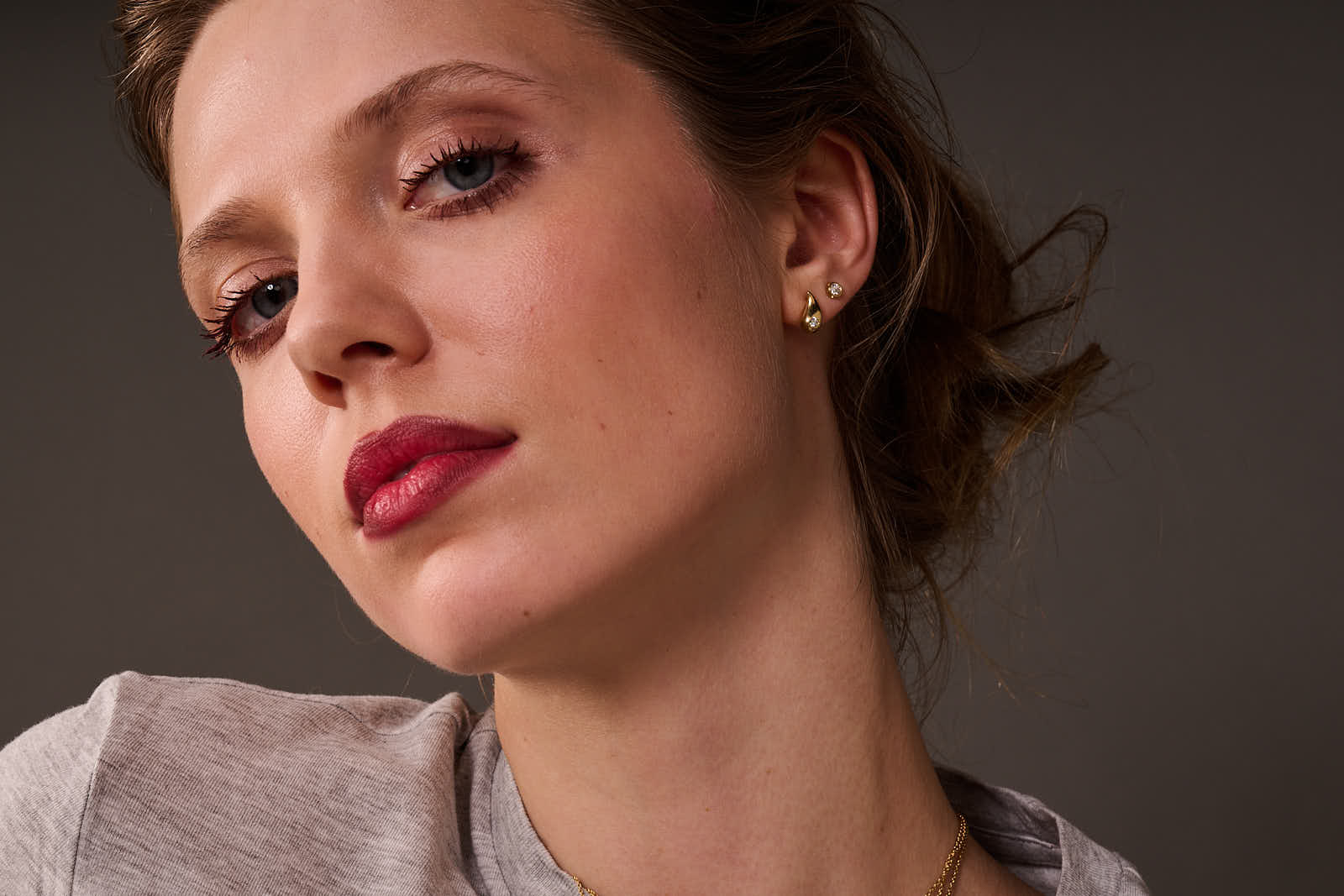
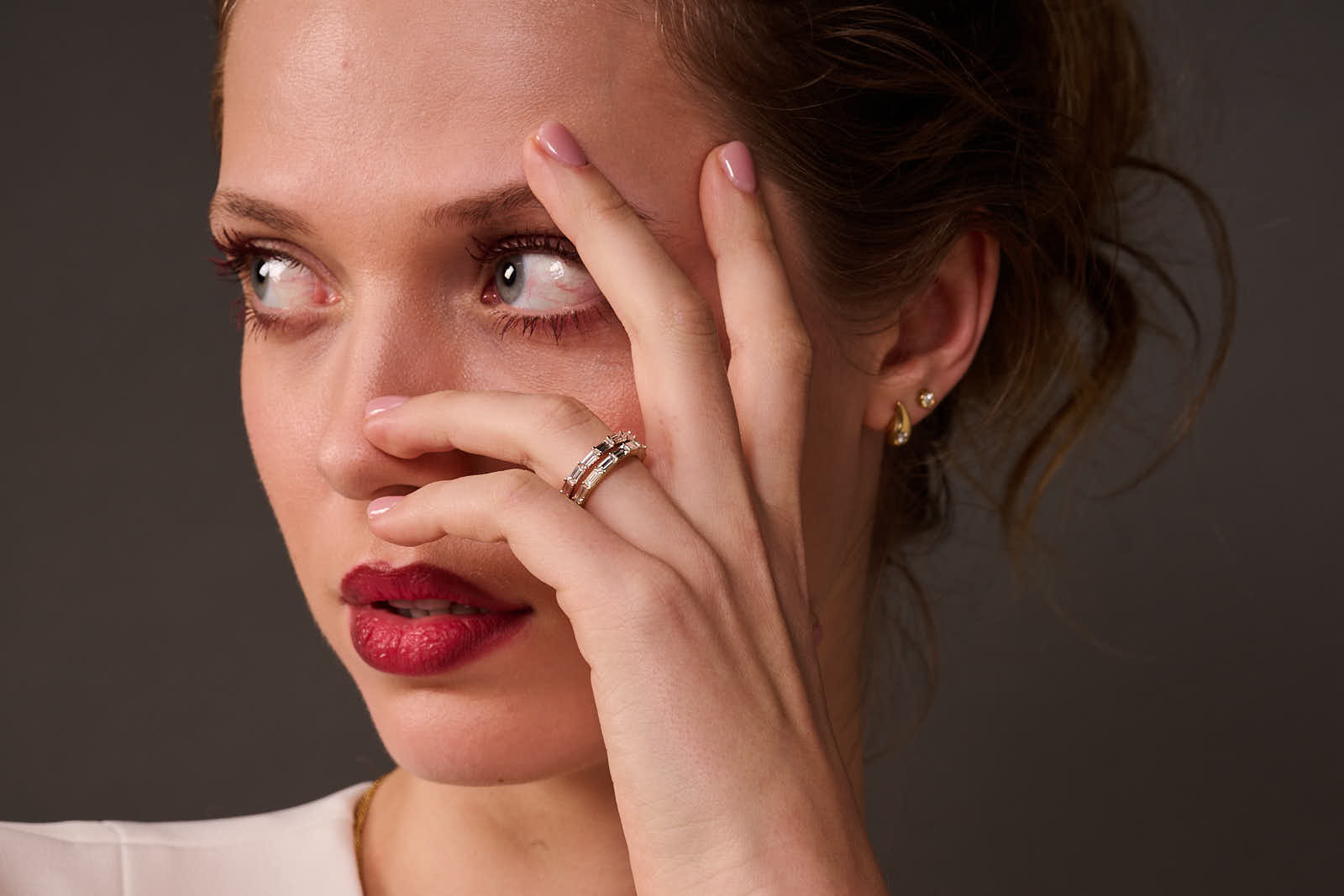
Huggie earrings can be worn alone as a compact curved detail, paired with studs for contrast or incorporated into an ear stack. The most successful styling begins with the huggie's actual proportions: inner diameter, outer diameter, width, diamond coverage and the amount of space it leaves around the lobe.
For a restrained look, wear one matched pair without additional earrings. For a two-piercing arrangement, combine one huggie with a smaller stud while leaving sufficient space between them. For a fuller stack, choose one focal element and allow the remaining earrings to support it.
Huggies do not have to be treated as purely casual or minimalist. A slim plain-metal huggie, a wider polished design and a diamond-set huggie will each create a different result.
Quick Summary
- Wear a matched pair alone for a clean curved outline
- Pair a huggie with a smaller stud to contrast a curve with a point
- Choose one focal earring and let the rest support it
- Check inner diameter, width and spacing before combining earrings
- Repeat one metal colour to connect a mixed-metal look
- Let hairstyle guide how visible the huggie will be
- Build styling around verified measurements, not the product name
Huggie styling ideas at a glance
| Styling goal | Huggie direction | Supporting jewellery |
|---|---|---|
| Clean single-piercing look | One matched pair of huggies | No additional earrings required |
| Minimal two-piercing look | Huggie plus small stud | Keep the stud visibly smaller |
| Diamond-focused look | Diamond-set huggie | Plain-metal or restrained supporting stud |
| Metal-focused look | Plain polished huggie | Diamond stud for contrast |
| Hoop-led stack | Huggie used above a larger hoop | Small stud if space allows |
| Work styling | Proportionate huggie with controlled dimensions | Optional small stud |
| Detailed outfit | Slim or minimally set huggie | Keep other jewellery restrained |
| Simple evening outfit | Diamond or wider huggie | Coordinate with one necklace or bracelet |
| Mixed-metal look | Huggie in one metal colour | Repeat that colour elsewhere |
| Asymmetric styling | Different but related earrings across both ears | Repeat one shared material or shape |
These are styling directions rather than fixed rules. The wearer's piercing placement and the dimensions of each earring determine whether a combination physically works.
Understand the huggie's shape before styling it
A huggie is a small hoop-style earring designed to sit relatively close around the lobe or another suitable healed piercing. It creates a curved line instead of the front-facing point produced by a stud.
However, product labels are not standardised. One huggie may sit tightly around the lower edge of the lobe, while another may leave a more visible gap. This difference changes how the earring should be styled.
Before building a look, check:
- Inner diameter
- Outer diameter
- Hoop width or thickness
- Weight per earring
- Diamond or stone coverage
- Metal colour
- Closure type
- Space between the huggie and lobe
- Whether it is sold as a pair or single
See also: What are huggie earrings?
Explore Our Store
View all→How to wear huggie earrings alone
The simplest way to style huggies is as a matched pair in the first lobe piercings.
This approach keeps attention on the earring's curve, surface and diamond detail. It is particularly useful when:
- The huggie has a wider profile
- The design contains several diamonds
- The outfit already includes other jewellery
- The wearer has one piercing in each ear
- A compact, balanced appearance is preferred
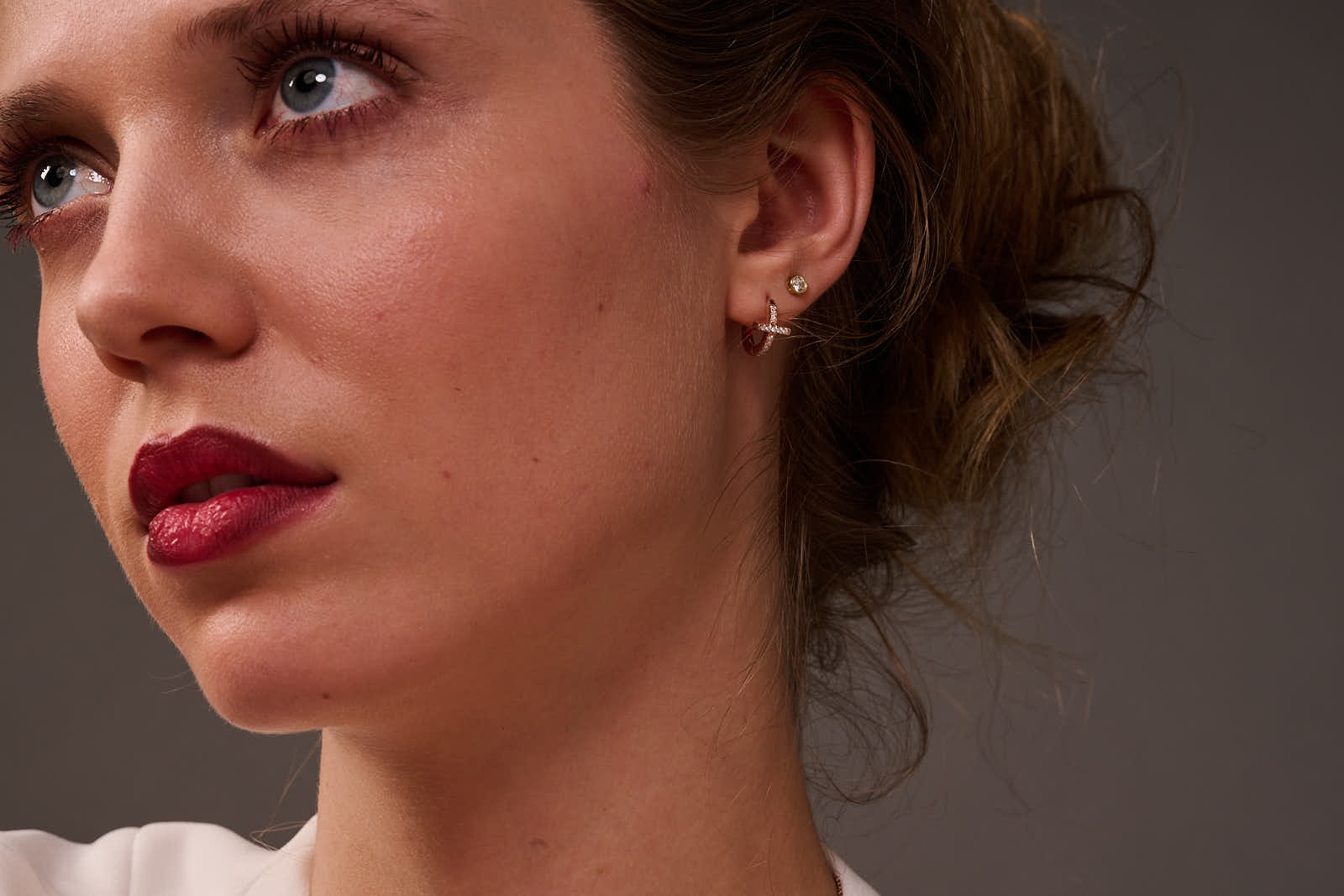
A plain-metal huggie creates a clean outline around the lobe. A diamond-set huggie adds detail along the curve. A sculptural huggie can function as the main design element without needing other earrings around it.
When wearing huggies alone, consider coordinating them with one other jewellery element, such as a ring, bracelet or restrained necklace. The pieces do not have to be part of a matching set, but repeating the same metal colour can connect the look.
How to style huggie earrings with studs
Huggies and studs provide useful contrast because they introduce different silhouettes. The huggie creates a curve. The stud creates a point, motif or cluster. Together, they can make a two-piercing arrangement look more varied than two identical earrings.
Possible combinations include:
- Diamond huggie with a small plain-metal stud
- Plain-metal huggie with a diamond stud
- Slim huggie with a geometric stud
- Diamond huggie with a smaller diamond solitaire
- Wider huggie with a restrained supporting stud
The supporting stud should not automatically be placed above the huggie. Its position depends on the wearer's piercings. If the stud is in an upper lobe piercing, check that its setting does not touch or overlap the huggie.
See also: Stud vs huggie earrings
How to style huggies in a two-piercing ear
Huggie in the first piercing, stud in the second
This creates a curved base with a smaller point above it. It works when the huggie has enough presence to act as the lower focal element.
Stud in the first piercing, huggie in the second
This arrangement places the front-facing stone or motif lower on the lobe and adds a curve above it. The huggie's inner diameter must suit the second piercing's position.
Two graduated huggies
Two huggies can work together when their diameters or widths are visibly different. Place the larger or wider design in the position with more available space.
Plain huggie with diamond huggie
This creates contrast through surface detail rather than shape. Keep the metal colour consistent if you want the combination to feel more unified.
No arrangement works without checking the distance between the piercings and the exterior dimensions of both earrings.
How to build a huggie ear stack
A balanced huggie stack normally contains a clear focal point and smaller supporting elements. Start by identifying the earring that should carry the most visual weight. This might be:
- A wider huggie
- A diamond-set huggie
- A conventional hoop
- A larger stud
- A geometric or motif earring
The remaining pieces should generally use less width, fewer diamonds or a simpler silhouette. One possible stack structure is:
- First lobe: diamond huggie
- Second lobe: small diamond or plain-metal stud
- Additional healed piercing: smaller supporting piece, if the spacing allows
Another structure is:
- First lobe: small conventional hoop
- Second lobe: close-fitting huggie
- Additional healed piercing: small stud
These are visual formulas, not universal placement rules.
See also: How to stack earrings
See also: Diamond ear stack ideas
How to mix huggies with hoop earrings
Huggies are a type of small hoop, but they can still be combined with a more conventional hoop. Use differences in scale to make the combination intentional:
- Medium hoop with a smaller huggie
- Slim hoop with a wider huggie
- Diamond hoop with plain-metal huggie
- Plain hoop with diamond huggie
- Rounded hoop with a geometric huggie
Avoid using multiple earrings of almost the same diameter when they overlap physically or look accidentally mismatched. Either keep the designs closely coordinated or create a clear difference in size, width or surface detail.
See also: Hoop vs huggie earrings
How to choose the focal huggie
Not every huggie needs to be a supporting piece. A huggie can lead the look when it has enough visual presence. A focal huggie may have:
- Greater width
- More visible diamond coverage
- A sculptural profile
- A distinctive geometric shape
- A different texture
- A contrasting metal colour
- A detachable charm, when the product is designed for one
When the huggie is the focal point, use smaller or simpler supporting earrings. If the other earring is already a large motif, hoop or drop design, the huggie may work better as the supporting element.
How to style plain-metal huggies
Plain-metal huggies emphasise shape and surface rather than stones. They can be worn:
- Alone for a clean curved outline
- With a diamond stud for contrast
- Beside a textured or geometric stud
- As a quieter element in a diamond-heavy stack
- With a matching metal necklace or bracelet
- As one part of a controlled mixed-metal combination
A polished surface reflects more light, while a wider profile creates greater visible metal coverage. Product photographs should accurately show the finish rather than relying only on terms such as subtle or bold.
How to style diamond huggie earrings
Diamond huggies position stones along a curve rather than concentrating them in one front-facing setting. When styling them, consider:
- How far the diamonds continue around the hoop
- Whether the stones are visible mainly from the front or side
- Diamond count
- Total carat weight
- Setting width
- Whether the huggie is being worn alone or in a stack
If the huggie has significant diamond coverage, pair it with a smaller plain-metal or restrained diamond stud. If the diamonds are limited to a narrow front section, the huggie may work alongside a more visible stud.
A higher total carat weight does not always create more visible sparkle. Stone size, setting, placement and viewing angle all affect appearance.
Styling huggies by metal colour
Yellow-gold huggies
Yellow-gold-coloured huggies create a warm metal outline. They can be coordinated with yellow-gold-coloured rings, warm-toned necklace chains, cream, brown, burgundy, green or black outfits, diamond studs with the same metal finish, or mixed-metal jewellery containing a repeated yellow-gold element.
The outfit does not have to contain warm colours. Yellow-gold-coloured huggies can also provide contrast against black, white or navy. A product is only 14kt gold plated when that finish has been verified for the exact SKU.
White or silver-coloured huggies
White or silver-coloured huggies can create a brighter, cooler outline. They can be paired with white or silver-coloured watches, diamond studs with a matching finish, black, white, grey, navy or jewel-toned outfits, minimalist monochrome clothing, or mixed-metal pieces containing a repeated white-metal element.
"White gold" and "silver" are not interchangeable. A white-coloured finish does not necessarily mean the product is made from white gold.
Rose-gold huggies
Rose-gold-coloured huggies add a softer warm-metal element. They can be worn with blush, cream, champagne or neutral outfits, rose-gold-coloured rings or bracelets, clear diamond or restrained motif studs, or mixed-metal arrangements containing a repeated rose-gold detail.
Check the actual base metal and finish. "Rose gold" may describe solid rose gold, plated jewellery or only a colour option.
Can you mix metal colours with huggies?
Yes. Mixed-metal styling works best when the combination looks repeated rather than accidental. For example:
- Yellow-gold huggie with a white-metal stud and a two-tone necklace
- White-metal huggie with a yellow-gold stud and mixed-metal watch
- Rose-gold huggie with a white-metal stud and ring containing both colours
For a two-ear arrangement, you can repeat each colour on both sides or use one shared piece—such as a mixed-metal necklace—to connect the earrings.
How to style huggies with everyday outfits
For simple shirts, knitwear, denim or restrained dresses, huggies can add a curved detail without requiring a full ear stack. Possible approaches include:
- Plain huggies worn alone
- Diamond huggies with no necklace
- Plain huggie and small stud combination
- Two graduated huggies
- Huggie paired with a restrained pendant
"Everyday" is not a comfort guarantee. Actual suitability depends on fit, weight, closure and materials.
How to style huggies for work
Workplace expectations vary, so focus on scale and coordination rather than treating huggies as universally office-appropriate. For a restrained work look:
- Choose a proportionate huggie with clearly stated dimensions.
- Keep an ear stack compact.
- Coordinate the metal with a watch, ring or necklace.
- Use a smaller stud as a supporting piece.
A wider or diamond-heavy huggie may become more visible, particularly when worn with pulled-back hair. Whether that is suitable depends on the individual workplace and the wearer's preferred look.
How to style huggies with evening outfits
Huggies can support an evening outfit when the intended look does not require the length or movement of a drop earring.
For a simple black dress, a diamond-set huggie can add curved detail close to the ear. With satin, sequins or heavy embellishment, consider a slimmer or plain-metal huggie to prevent the jewellery from competing with the fabric.
For an open neckline, huggies can be coordinated with a necklace. For a detailed neckline, consider wearing the huggies without a necklace.
How hairstyle affects huggie styling
| Hairstyle | Styling effect |
|---|---|
| Hair tucked behind the ears | Shows the full curve and ear stack |
| Low bun | Makes the huggies clearly visible |
| Ponytail | Exposes the ear and surrounding space |
| Short hair | Keeps the huggie visible from several angles |
| Hair worn down | May partially conceal smaller huggies |
| Half-up hairstyle | Shows part of the stack while retaining softer framing |
Do not choose a larger huggie only because hair may cover a smaller one. Check the product's weight and proportions before increasing the scale.
Huggie styling mistakes to avoid
Treating every huggie as the same size
The label does not guarantee a close fit. Compare the inner diameter and on-ear images.
Making every earring a focal point
A stack is easier to read when one element has greater visual importance.
Ignoring physical spacing
Earrings that touch or overlap can look crowded and may scratch one another.
Mixing unconnected designs
Mixed metals, stones and shapes can work, but repeat at least one feature to connect them.
Using product category as a comfort claim
The word "huggie" does not guarantee that an earring will feel comfortable or fit every lobe.
Overloading a detailed outfit
If the clothing already contains sequins, metallic fabric, heavy embroidery or a complex neckline, consider a cleaner huggie arrangement.
Huggie styling checklist
Before finalising the look, ask:
- Does the inner diameter suit the piercing?
- Is the huggie the focal piece or a supporting piece?
- Do the earrings have sufficient physical space?
- Is there a clear difference between the main and supporting earrings?
- Is the metal colour repeated elsewhere?
- Does the diamond detail compete with the outfit?
- Will the hairstyle show the huggie?
- Are the dimensions and weight published?
- Is the closure accurately described?
- Is the product genuinely a huggie?
- Would a stud, conventional hoop or drop create the intended effect more effectively?
Final answer
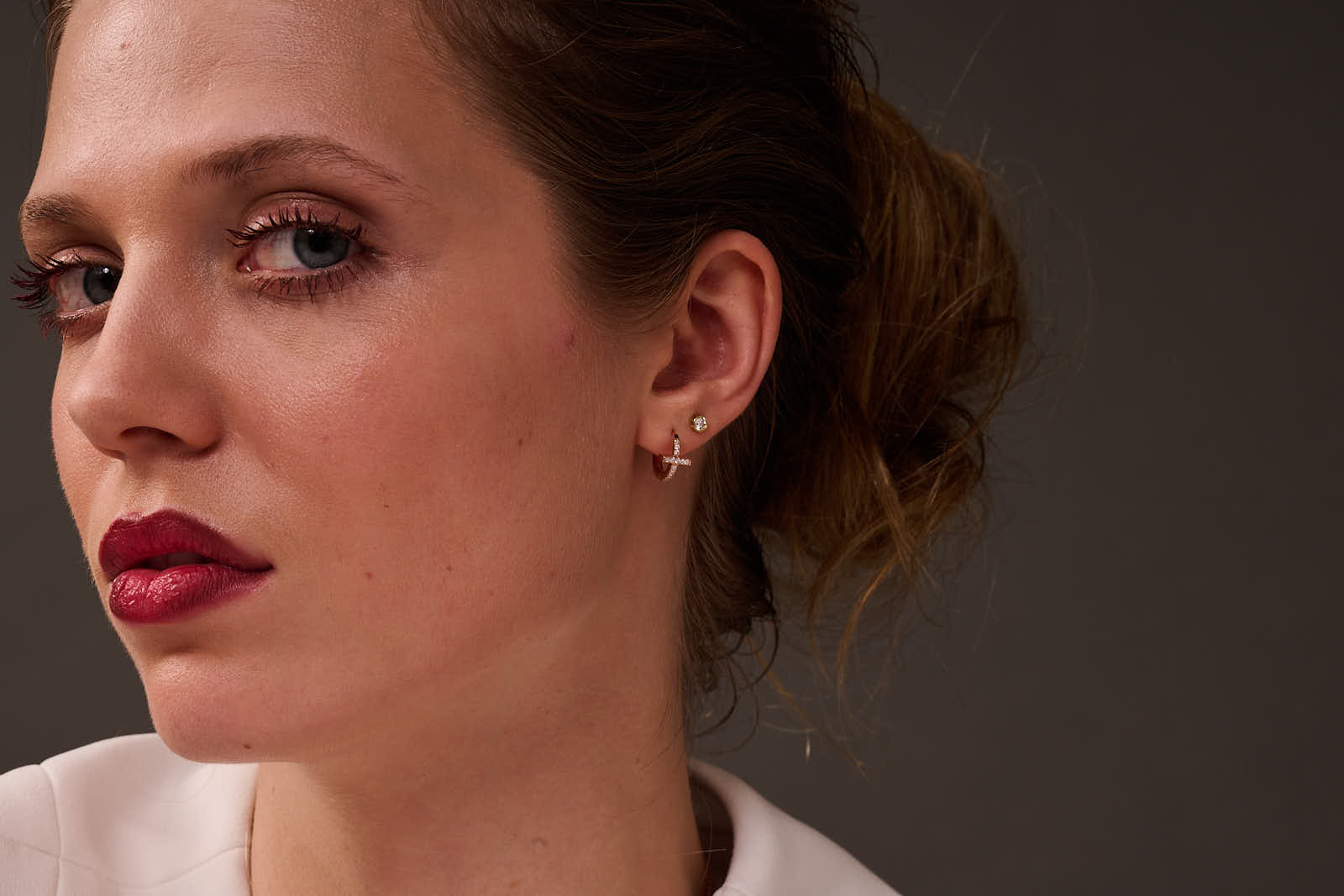
Wear huggie earrings alone when you want the curved design to stand on its own. Pair them with a smaller stud when you want contrast between a curve and a point. In a larger ear stack, choose one focal earring and use the huggie either as that focal curve or as a supporting element.
Build the styling around verified measurements, spacing and surface detail. The product name alone cannot determine how the huggie will look or fit.
Explore Our Store
View all→Got Questions?
Frequently Asked Questions
Ready to Shop?
Wear huggies alone for a clean curved outline, pair them with a smaller stud for contrast, or use one as the focal curve in a balanced ear stack. Build the look around verified measurements and spacing rather than the product name.
Browse I Want Jewels demi-fine lab-grown diamond earrings and check each product page for its stated dimensions, weight, closure and diamond information before combining pieces in the same ear.
Continue Reading
More From Earring Styling Guides
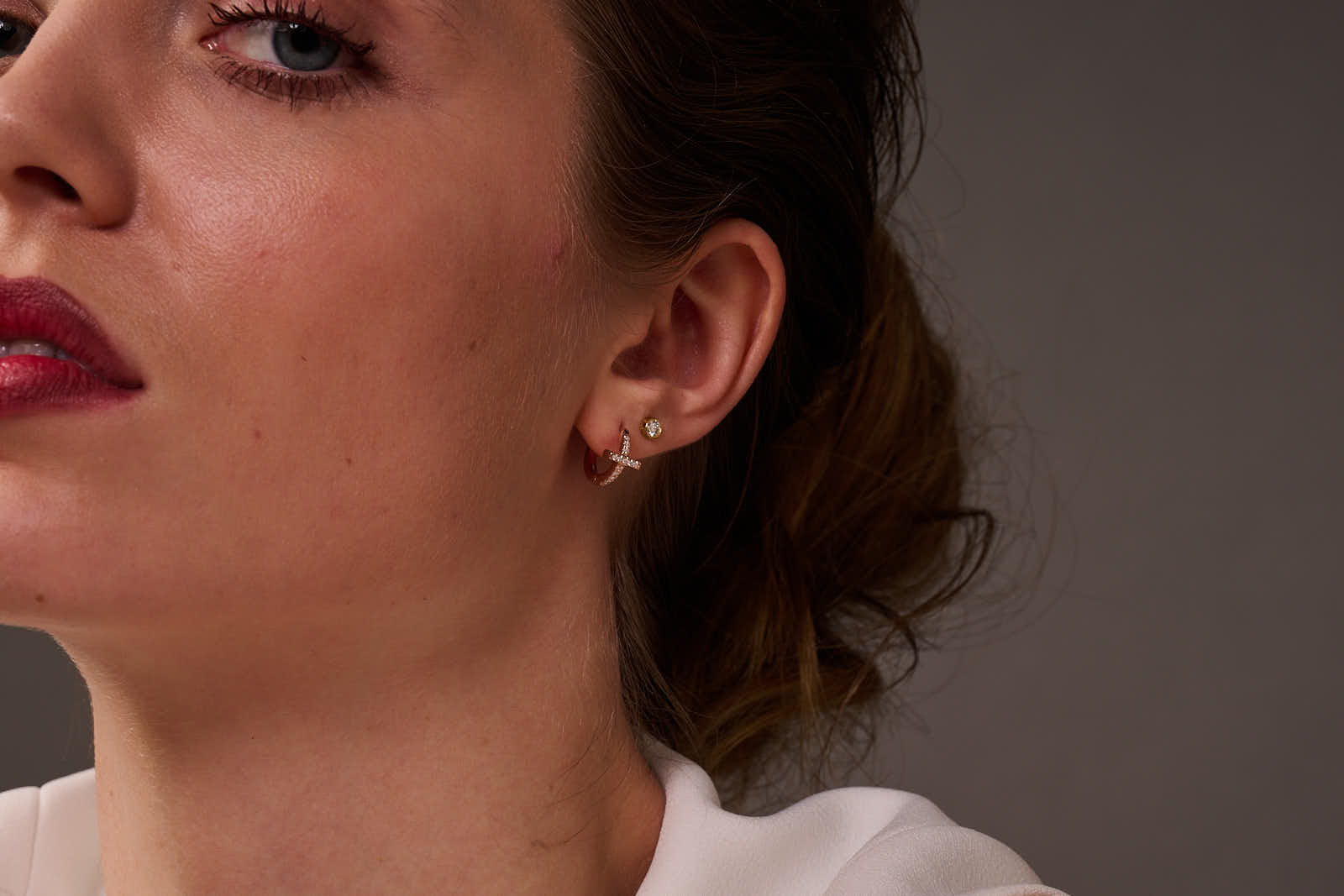
How to Stack Earrings: Complete Ear Stack Guide
Learn how to stack earrings step by step: choose a focal piece, vary the scale, repeat one feature and check spacing across two or three piercings.
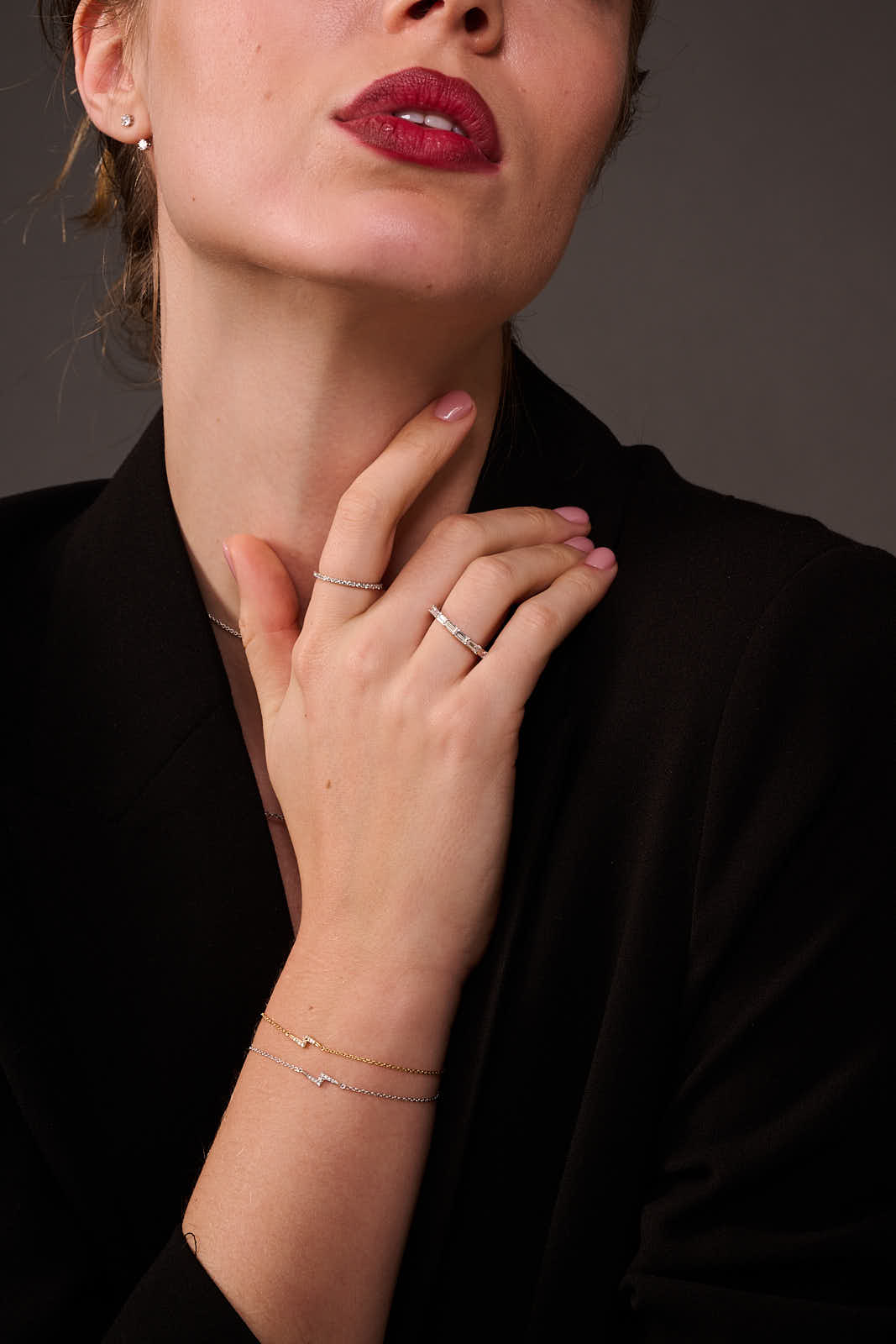
Diamond Ear Stack Ideas: 15 Curated Looks
Fifteen diamond ear stack ideas for two and three piercings, covering minimalist, everyday, workwear, wedding guest and evening combinations.
Minimalist Earrings Guide: Styles & Buying Tips
Learn how to choose minimalist earrings by style, size, metal, closure and sparkle. Compare studs, huggies, slim hoops and subtle diamond designs.