

Stud vs Huggie Earrings:
What Is the Difference?
Studs and huggies are both compact earring styles, but they create different shapes and use different fastening systems.
A stud places the visible design on the front of the ear and normally uses a post with a separate or integrated backing. A huggie curves around the lobe like a small hoop and is designed to sit relatively close to the ear.
Choose studs when you want a defined point, motif or stone on the front of the lobe. Consider huggies when you want a curved outline around the lobe or a compact hoop within an ear stack. Neither style is automatically more comfortable, secure or suitable for everyday wear — the answer depends on its dimensions, weight, materials, closure and fit.
Quick Summary
- A stud creates a point on the front of the lobe; a huggie creates a curve around it
- Studs use posts and backings; huggies commonly use hinged or click closures
- For studs, check face dimensions, post length and projection
- For huggies, inner diameter is the measurement that decides fit
- Neither is inherently better for everyday wear, gifts or sensitive ears
- The two shapes complement each other well inside one ear stack
Stud vs huggie earrings at a glance
| Feature | Stud earrings | Huggie earrings |
|---|---|---|
| Basic shape | A front-facing design mounted on a post | A small hoop designed to curve around the lobe |
| Visual effect | Creates a point, motif or cluster | Creates a curved outline |
| Fastening | Butterfly, screw, push, flat or other backing | Commonly hinged or click closure |
| Position | Visible design sits on the front of the ear | Ring curves beneath and around the lobe |
| Movement | Usually limited, depending on size and construction | Usually limited when correctly fitted |
| Important measurement | Face dimensions, post length and projection | Inner diameter, outer diameter and thickness |
| Fit sensitivity | Post and backing must suit the wearer | Inner diameter must accommodate the lobe |
| Ear-stack role | Creates a point of detail | Introduces a curved shape |
| Gift consideration | Style and backing still need checking | Requires more information about preferred fit |
| Diamond presentation | One stone, cluster or decorative setting | Stones can follow part of the hoop's curve |
What are stud earrings?
A stud earring normally consists of a visible front element attached to a post that passes through the piercing. A backing holds the earring in position behind the ear.
Although diamond solitaire studs are a familiar example, not every stud consists of one round stone. Stud earrings may feature:
- A single stone
- A cluster of smaller stones
- A geometric shape
- A floral or symbolic motif
- A bar or curved design
- A decorative front with an earring jacket
The defining feature is the post-based construction and front-facing appearance, not the number of stones.
See also: Lab-grown diamond stud earrings guide
Explore Our Store
View all→What are huggie earrings?
A huggie is a small hoop-style earring designed to sit closely around the lobe or another suitable healed piercing.
Unlike a stud, which concentrates the design on the front of the ear, a huggie creates a curve. The bottom and side of the earring are usually visible, producing more of an outline around the lobe.
The name does not guarantee an exact fit. Whether a huggie actually sits close to the ear depends on its inner diameter, the wearer's piercing position and the thickness of the relevant part of the ear.
See also: What are huggie earrings?
What is the main difference between studs and huggies?
The main difference is the silhouette.
A stud creates a point or shape on the front of the ear. A huggie creates a curved line that continues below and around the lobe.
This difference affects how each design appears:
- A small solitaire stud produces a concentrated point of light
- A motif stud gives the front of the ear a recognisable shape
- A plain huggie adds a clean metal curve
- A diamond-set huggie spreads detail along part of the curve
The size of the individual product still matters. A large cluster stud may be more prominent than a slim huggie, while a wide or heavily set huggie may be more noticeable than a small stud.
How studs and huggies fasten
Stud backings
Common stud options include butterfly or friction backs, screw backs, flat backs, push-fit systems and guardian-style backs.
A backing should sit securely without being forced too tightly against the ear. Product pages should state the backing type instead of merely describing the earring as "secure".
Huggie closures
Huggies commonly use hinged click closures, latch closures, hinged posts, or continuous and segment-style construction.
The mechanism should align correctly and close as intended. A click sound alone is not a guarantee that every closure will remain secure in every situation.
Check how the closure works before purchasing, particularly if the wearer has difficulty operating small mechanisms.
How to compare stud and huggie measurements
"Small", "medium" and "close-fitting" are not sufficiently precise descriptions. Product measurements allow shoppers to understand how an earring is likely to look and fit.
Stud measurements to check
- Width of the visible front
- Height of the visible front
- Depth or projection from the lobe
- Post length
- Post thickness
- Weight per earring
- Backing dimensions
- Individual and total carat weight where applicable
A stud can have a relatively small face but project noticeably from the lobe because of its basket or setting.
Huggie measurements to check
- Inner diameter
- Outer diameter
- Hoop thickness
- Post length and thickness
- Weight per earring
- Closure type
- Space available inside the closed hoop
Inner diameter is particularly important. A huggie that is too small may press against the ear, while one with a larger inner diameter may leave more space than expected.
Are studs or huggies more comfortable?
Neither style is universally more comfortable.
Stud comfort can be influenced by the weight of the front setting, post length and thickness, backing size, how tightly the backing is positioned, whether the setting projects from the ear, and the surface condition and materials.
Huggie comfort can be influenced by the inner diameter, hoop thickness, weight, piercing position, closure alignment, space between the hoop and lobe, and the surface condition and materials.
A stud backing positioned too tightly may create pressure. A huggie with insufficient internal space may also press or pinch. Conversely, a correctly sized and appropriately weighted example of either design may feel unobtrusive.
The Association of Professional Piercers explains that size, material, quality, style, weight and finish all help determine whether jewellery is appropriate for regular wear. It also advises against forcing jewellery into a piercing.
Which is better for everyday wear?
Studs and huggies can both be considered for regular wear, provided the individual product fits properly and its materials and construction suit the wearer.
Consider studs if you prefer a front-facing point or motif, a conventional post-and-backing system, minimal outline beneath the lobe, one concentrated area of diamond detail, or a simple addition to an existing outfit.
Consider huggies if you prefer a curved outline around the lobe, a small hoop-style silhouette, a shape that can connect visually with other earrings, diamond or metal detail following a curve, or a hoop without the diameter of a larger design.
Which is better for a single piercing?
Both styles work visually in a single lobe piercing.
A stud can create a restrained focal point. A solitaire or cluster may provide visible detail without producing an outline below the lobe.
A huggie can give a single piercing more shape by continuing around the lower edge of the ear. Its visibility will depend on the diameter, width and embellishment.
Choose according to the visual result rather than assuming that studs are only for beginners or huggies are only for multiple piercings.
Which is better for an ear stack?
Studs and huggies can complement one another because they introduce different shapes. One possible arrangement is:
- First lobe piercing: a huggie or visually stronger stud
- Second lobe piercing: a smaller stud
- Additional healed piercing: another suitably measured supporting piece
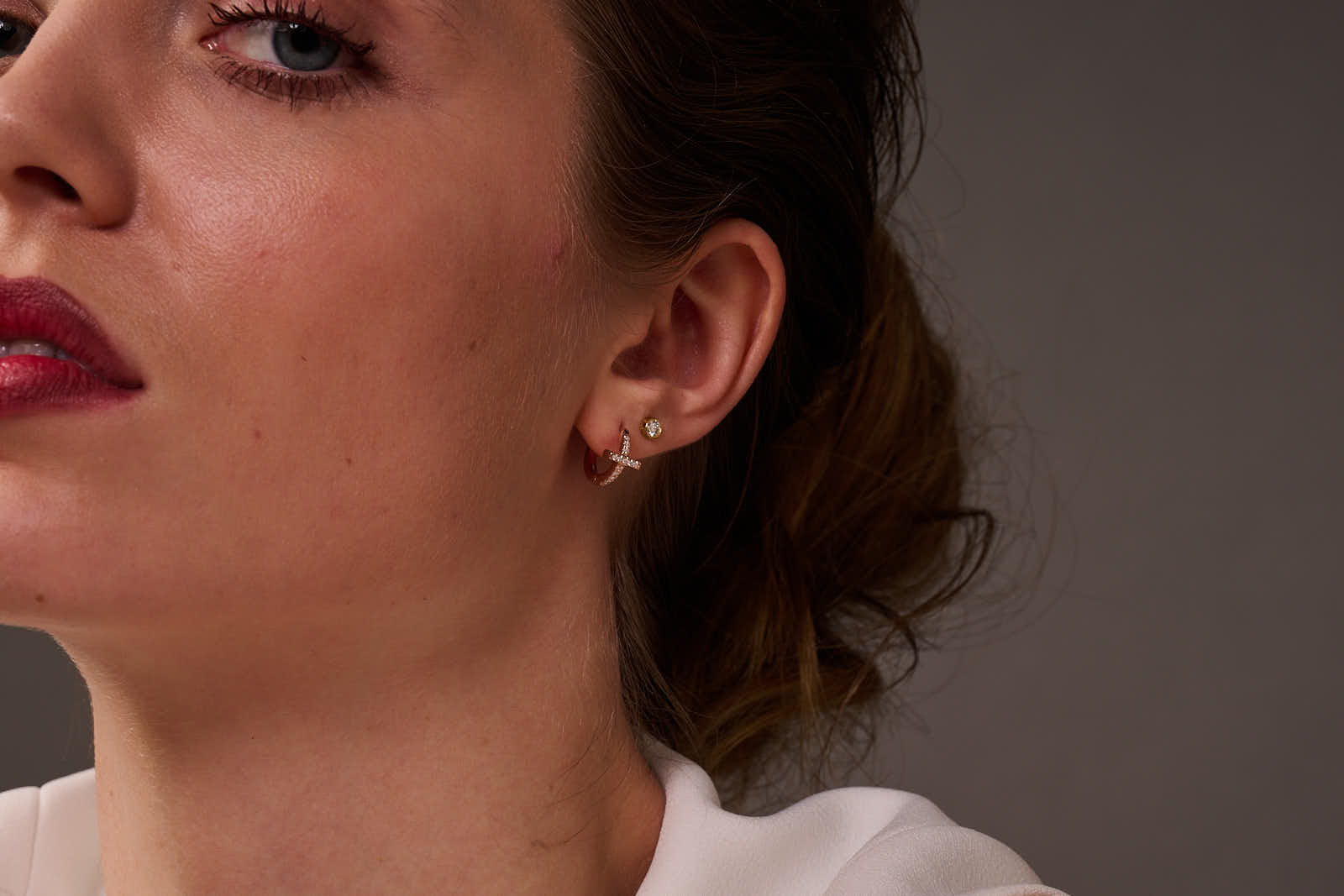
Another arrangement could use a diamond stud in the first lobe and a close-fitting huggie in the second. This produces a point of diamond detail followed by a curved shape.
Do not assume that every huggie will fit a second or upper-lobe piercing. The inner diameter must suit that specific piercing position.
See also: How to stack earrings
See also: Diamond ear stack ideas
Studs vs huggies with glasses, headphones and long hair
How an earring interacts with other items depends more on its dimensions than its category.
A stud with a long post may feel noticeable behind the ear when wearing headphones. A large backing may also interact with the arms of glasses, depending on the piercing position.
A huggie sits around the lobe but may still interact with headphones if its diameter or thickness extends into the contact area. Hair can catch on decorative settings or closure gaps in either style.
Before a product is described as suitable for travel, work or headphones, the actual product should be tested and its dimensions published. That claim cannot be made from the words "stud" or "huggie" alone.
Diamond studs vs diamond huggies
Diamond studs concentrate the diamonds in a front-facing setting. Diamond huggies position diamonds along part of a curved structure.
Before comparing diamond versions, verify:
- Whether the stones are genuine lab-grown diamonds
- Number of diamonds
- Individual or total carat weight
- Whether carat weight refers to one earring or the pair
- Diamond dimensions where available
- Setting style
- Metal and finish
- Weight per earring
- Whether the product is sold as a pair or single
A larger total carat weight does not automatically mean that an earring will look larger from the front. Stone distribution, setting and earring dimensions all affect its visible appearance.
Are studs or huggies better for sensitive ears?
Earring style alone does not determine suitability for sensitive ears. Important factors include:
- Complete metal composition
- Plating and coating details
- Condition of the surface
- Post material
- Backing material
- Individual allergies or sensitivities
- Cleanliness and fit
Sterling-silver and gold-plated earrings should not be described as hypoallergenic as a category. Where nickel testing or another compliance standard applies to a particular product, the verified test or standard should be stated accurately on that product page.
Anyone experiencing persistent irritation should stop wearing the product and seek appropriate professional advice.
Are studs or huggies better as gifts?
Studs may be easier to select when the recipient already wears post earrings, but they are not automatically a risk-free gift. Size, setting height, backing type, metal preference and personal style still matter.
Huggies can make a considered gift when you know the recipient's preferred diameter or have seen them wear close-fitting hoops. Fit is more difficult to estimate when their piercing position and lobe measurements are unknown.
Before purchasing either style as a gift, check the earring dimensions, materials and finish, backing or closure type, whether the recipient wears similar earrings, whether the item is sold as a pair, the returns and exchanges policy, and the care requirements.
Can you wear studs and huggies together?
Yes. Their different silhouettes can create useful contrast in a multi-piercing arrangement.
A stud provides a point, while a huggie provides a curve. You can repeat a shared feature — such as metal colour, diamond detail or geometric lines — to make the combination feel connected.
Possible approaches include:
- Diamond stud with a plain-metal huggie
- Small stud with a diamond-set huggie
- Motif stud with a slim, undecorated huggie
- Graduated studs followed by one close-fitting huggie
Keep enough physical space between the pieces. Earrings should not press against, overlap or damage each other.
Stud or huggie: which should you choose?
| Your priority | Consider | Verify before purchasing |
|---|---|---|
| A front-facing point of diamond detail | Stud | Face dimensions and carat presentation |
| A curved outline around the lobe | Huggie | Inner and outer diameter |
| A post-and-backing closure | Stud | Post length and backing type |
| A hinged hoop-style closure | Huggie | Closure mechanism and alignment |
| A supporting point in an ear stack | Small stud | Available space and setting width |
| A curved element in an ear stack | Huggie | Piercing position and inner diameter |
| A gift for someone who wears studs | Stud | Preferred size, metal and backing |
| A gift for someone who wears small hoops | Huggie | Preferred diameter and returns |
| Sensitive ears | Either, conditionally | Complete materials and individual sensitivity |
The better choice is the product that provides the appearance you want and suits the wearer's measurements — not whichever category is described as universally superior.
How to care for studs and huggies
Handle earrings with clean, dry hands. Wipe the surface gently after wearing with a suitable soft cloth.
For studs, clean around the post and backing, avoid forcing the backing too tightly, and store the pair together without allowing the posts to scratch other jewellery.
For huggies, clean around the hinge and inner curve, open and close the mechanism gently, and do not force a closure that appears misaligned.
Keep plated jewellery away from unnecessary exposure to water, perfumes, cosmetics and cleaning chemicals. Follow the product-specific instructions supplied by I Want Jewels.
See also: How to care for gold-plated jewellery
Explore Our Store
View all→Got Questions?
Frequently Asked Questions
Ready to Shop?
Choose studs when you want a front-facing stone, motif or point of detail. Choose huggies when you want a compact curved outline around the lobe.
For an ear stack, the two styles can work together: a stud adds a point and a huggie adds a curve. In every case, compare measurements, weight, materials and closure information before purchasing.
Continue Reading
More From Earring Styling Guides
How to Stack Earrings: Complete Ear Stack Guide
Learn how to stack earrings step by step: choose a focal piece, vary the scale, repeat one feature and check spacing across two or three piercings.
Diamond Ear Stack Ideas: 15 Curated Looks
Fifteen diamond ear stack ideas for two and three piercings, covering minimalist, everyday, workwear, wedding guest and evening combinations.
Minimalist Earrings Guide: Styles & Buying Tips
Learn how to choose minimalist earrings by style, size, metal, closure and sparkle. Compare studs, huggies, slim hoops and subtle diamond designs.