

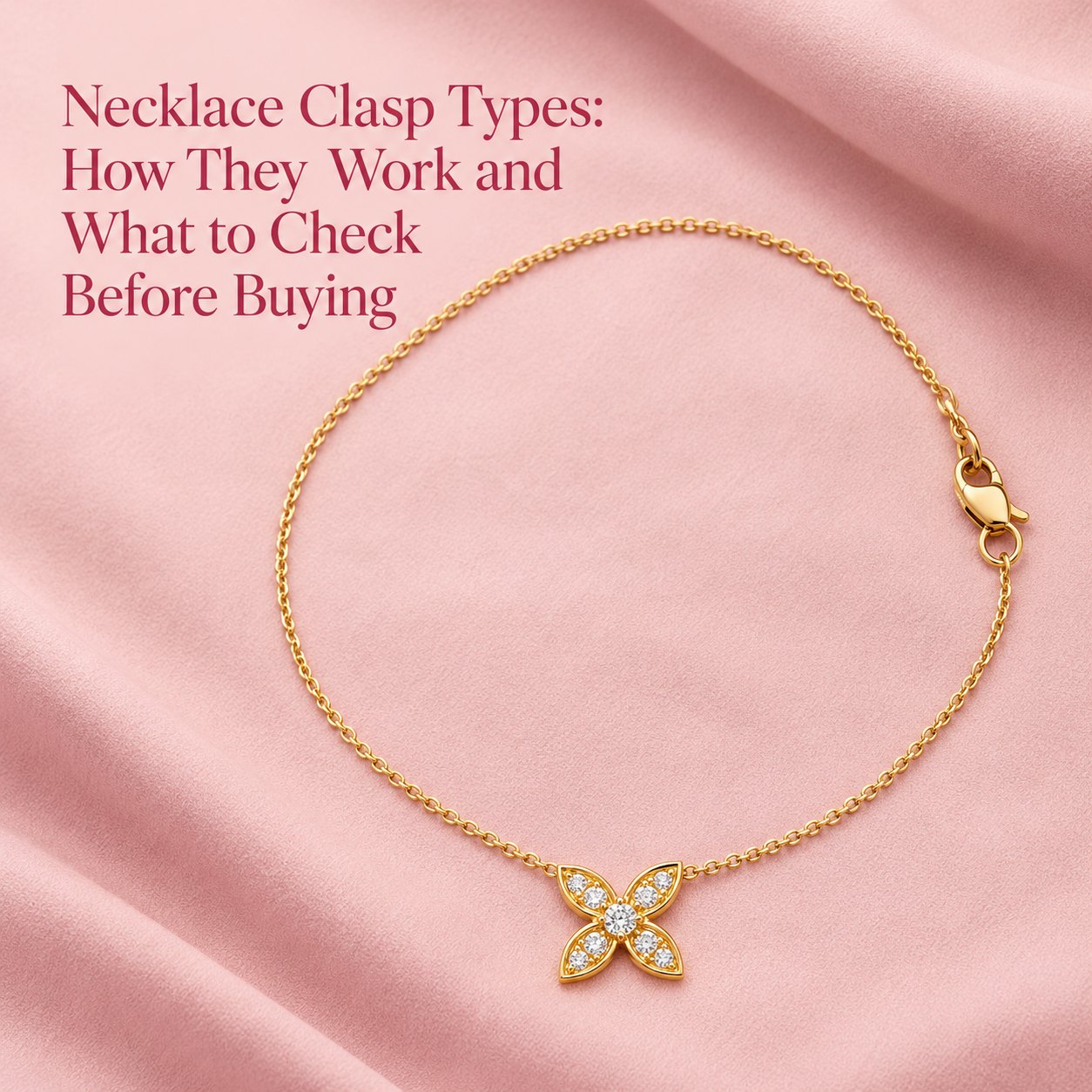
Necklace Clasp Types:
How They Work and What to Check Before Buying
Compare necklace clasp types, including lobster and spring ring clasps. See how they open and what to check for easy, secure fastening before you buy.
Quick Summary
- Necklace clasp types at a glance
- 1. Lobster clasp
- 2. Spring ring clasp
- Lobster clasp vs spring ring: what is the difference?
- 3. Toggle clasp
- 4. Barrel clasp
- 5. Magnetic clasp
Quick answer
A lobster clasp opens when you press its small lever, then releases when you let go. A spring ring clasp opens by pulling back a tiny lever that moves part of the ring. Both connect to a small ring at the other end of the necklace. When comparing them, check how easy the mechanism is to operate, whether the clasp opening fits over the end ring, and whether it closes fully after fastening.
Necklace clasp types at a glance
| Clasp type | How it opens | What to check |
|---|---|---|
| Lobster clasp | Press a lever to open a small spring-loaded gate | Lever access, gate opening and full closure |
| Spring ring clasp | Pull a tiny lever to open a section of the circular ring | Whether the lever is easy to grip and the end ring fits |
| Toggle clasp | Pass a bar through a ring | Bar length, ring opening and how the clasp sits when worn |
| Barrel clasp | Connect two parts that screw, twist or lock together, depending on the design | How the parts connect and whether they feel secure |
| Magnetic clasp | Bring the two magnetic ends together | Magnet strength and whether the clasp suits the necklace’s weight |
| S-hook clasp | Hook one open end through a ring or loop | Whether the hook is fully engaged and stays in position |
Explore Our Store
View all→1. Lobster clasp
A lobster clasp has a spring-loaded gate. Pressing the small lever opens the gate; releasing it lets the gate close again.
How to fasten it: hold the clasp body, press the lever to open the gate, place the necklace’s end ring inside the opening, then release the lever. Check that the gate has returned to its closed position.
What to check before buying:
- Can you reach and press the lever comfortably?
- Is the opening wide enough for the necklace’s end ring?
- Does the gate close fully when you release it?
The clasp’s overall size can affect how easy it is to handle. A small clasp may look discreet, but the lever can be harder to operate if you have limited finger dexterity or are fastening the necklace without help.
2. Spring ring clasp
A spring ring clasp is circular, with a small sliding lever that retracts part of the ring. Pulling the lever opens a gap; releasing it lets the section return.
How to fasten it: hold the ring clasp steady, pull back the lever, guide the necklace’s end ring into the opening, then release the lever.
What to check before buying:
- Is the lever large enough for you to grip?
- Can you hold the clasp steady while opening it?
- Does the opening give enough room for the end ring?
A spring ring can be quite small. That may make it less convenient to fasten on yourself, even when its mechanism is working correctly.
Lobster clasp vs spring ring: what is the difference?
Both clasps use a spring mechanism and attach to a ring at the other end of the necklace. A lobster clasp has a lever-operated gate in a shaped body. A spring ring uses a circular body with a small sliding lever.
The best one for you depends on the actual clasp’s size and how easy its lever is to use. A larger lobster clasp may be easier to handle than a tiny spring ring, but the clasp type alone does not tell you how large or convenient a particular product will be. Check close-up photographs or the product specifications.
3. Toggle clasp
A toggle clasp has a bar at one end and a ring at the other. To fasten it, you pass the bar through the ring and position it across the opening.
What to check: the bar should be long enough to pass through the ring and sit securely across it. Consider where the clasp will rest when worn, since a toggle can become a visible design feature.
4. Barrel clasp
A barrel clasp connects two shaped ends, often by twisting or fitting one part into the other. The exact mechanism varies by design.
What to check: how the two parts connect, whether you can operate them comfortably and whether the clasp remains closed during normal movement. If the product page does not show the mechanism clearly, look for a close-up or ask the seller.
5. Magnetic clasp
A magnetic clasp joins through attraction between two magnetic ends. Some designs also include a mechanical feature to help hold the connection.
What to check: whether the clasp is intended for the necklace’s weight and design, how firmly it stays together and whether there is any additional locking mechanism. Do not assume every magnetic clasp has the same holding strength.
6. S-hook clasp
An S-hook clasp has a curved hook at each end. One side connects to a ring or loop; the other side connects to the necklace’s opposite end.
What to check: make sure the hook is fully engaged with its loop and does not sit in a position where it can slip free. Check the product’s fastening instructions, since hook shapes and closures vary.
What does clasp opening size mean?
The clasp opening is the clear space available when the clasp is open. It needs to be wide enough for the necklace’s end ring to pass through.
There is no single opening size that suits every necklace. The end ring’s outside diameter and thickness matter, as does the clasp’s design. A useful product photograph should show the clasp open beside the end ring, ideally at the same scale.
Before buying, check:
- The opening: Is there enough clear space to insert the end ring?
- The lever: Can you grip and move it without straining?
- The closure: Does the gate or moving part return fully to its closed position?
- The connection: Does the end ring sit inside the clasp rather than catching on its edge?
How to fasten a necklace clasp yourself
- Place the necklace around your neck, with the clasp at the front where you can see it.
- Hold the clasp steady between your fingers.
- Open its lever, gate or connecting mechanism.
- Guide the opposite end ring into the opening.
- Release or close the mechanism.
- Check visually and gently confirm that the ring is held securely.
- Turn the necklace around so the clasp rests at the back.
If the clasp is difficult to reach, fasten it at the front first and then rotate the necklace carefully. Avoid pulling hard on a delicate chain while turning it.
What I Want Jewels lists about its necklace clasps
The current necklace collection describes its necklaces as having secure clasps, but the product information reviewed for this guide does not consistently name the clasp type or provide the clasp opening size. So it would be inaccurate to label an individual necklace as having a lobster or spring ring clasp without checking the actual product.
For each necklace, add a close-up photograph of the clasp open and closed, identify the clasp type only after confirming it, and include opening dimensions if they are available. Browse the necklace collection to see the current designs.
Explore Our Store
View all→Got Questions?
Frequently Asked Questions
Ready to Shop?
Find a piece you’ll love wearing
Compare necklace clasp types, including lobster and spring ring clasps. See how they open and what to check for easy, secure fastening before you buy.
Continue Reading
More From Necklace Guides
Necklace Length Guide: What 40, 45 and 50 cm Look Like When Worn
See how 40, 45 and 50 cm necklace lengths sit, how to measure your fit, and what to check before choosing a lab-grown diamond necklace.
Types of Necklace Chains: A Visual Guide to Their Differences
Learn how cable, curb, box, rope, snake and other necklace chains look and differ. Explore chain styles and lab-grown diamond necklaces from I Want Jewels.
Necklace Chain Thickness: Comparing Fine and More Substantial Chains
Compare fine and more substantial necklace chains by width, pendant fit and visual balance. Learn how to read millimetre measurements before buying.