
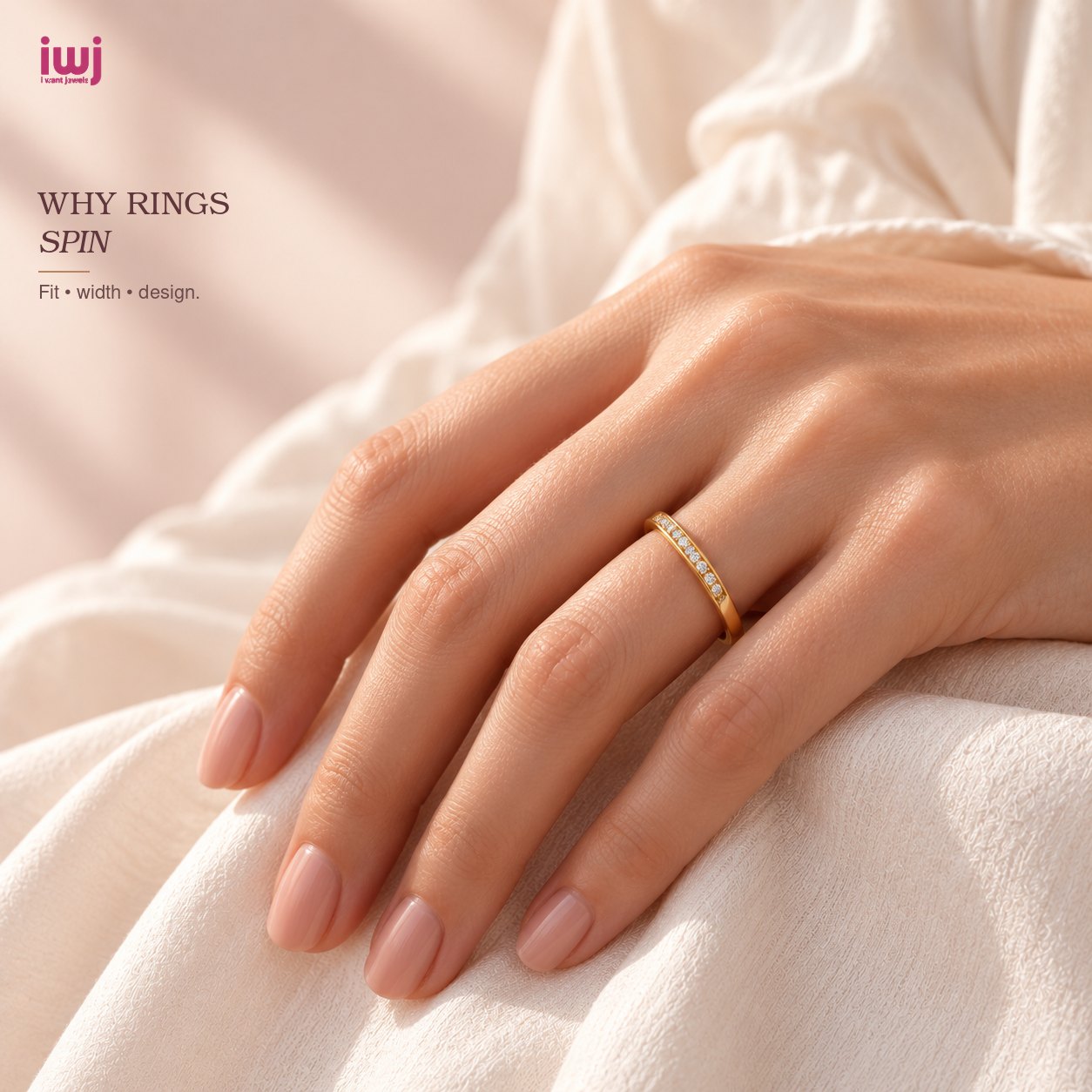
Why Does Your Ring Keep Spinning? Fit and Design Checks
Find out why a ring spins on your finger. Check the fit, setting and finger shape, and learn which solutions to discuss with a jeweller.
Why does a ring keep spinning?
A ring can spin because it is loose on the finger, its setting is top-heavy, or the finger is wider at the knuckle than where the ring sits. Temperature and normal changes in finger size can also affect the fit.
First, check how the ring fits; then consider its design. A ring that spins is not always solved by choosing a smaller size. It still needs to pass comfortably over the knuckle and fit securely where you wear it. Use the Size Guide on the relevant ring product page, and ask a jeweller to assess persistent spinning or a top-heavy setting.
What could be causing the ring to spin?
| What you notice | Possible cause to check |
|---|---|
| The ring moves easily around your finger | It may be too loose where it sits. |
| The ring passes the knuckle but feels loose below it | Your knuckle and finger may be different widths. |
| The stone or decorative top repeatedly turns underneath your finger | The setting may be top-heavy or unevenly balanced. |
| The ring fits differently at different times | Finger size can vary with temperature and other normal conditions. |
| The ring spins more during activity | Hand movement or contact with clothing and objects may be moving it. |
These are possible explanations, not a diagnosis. A jeweller can check the ring’s fit and construction.
Check the fit without repeating the size chart
Use the ring’s existing product-page Size Guide for measuring instructions. This article focuses on why a ring spins, not on size conversions.
When assessing fit, note:
- Whether the ring passes over the knuckle comfortably.
- Whether it feels secure at the point where you wear it.
- Whether it moves freely or only turns when the setting shifts.
- Whether it fits differently at another time of day or in another temperature.
Do not choose a much tighter size simply to stop the ring rotating. The ring should still pass over the knuckle without force and feel comfortable during normal wear.
When the setting is top-heavy
A large or raised setting can shift the ring’s balance. If the upper part is heavier than the band, gravity may draw it towards the underside of the finger. The band can fit reasonably well and the setting can still rotate.
A jeweller can assess whether the setting and band are balanced for that ring. Possible adjustments depend on the design, materials and construction; not every ring is suitable for the same fix.
What can help?
If the ring seems loose
Use the product-page Size Guide as a starting point, then consider a professional fitting. A jeweller can assess the fit over the knuckle and at the base of the finger before recommending a resize.
If the knuckle is wider than the finger
A standard resize may not solve the difference between the two areas. Ask a jeweller whether a fitting aid, such as sizing beads or another suitable insert, is appropriate for your ring.
If the setting appears top-heavy
Ask a jeweller to inspect the setting and band together. They can explain whether the design can be stabilised without affecting the ring’s structure or comfort.
If the spinning is temporary
Notice whether the ring turns only during particular activities or conditions. If it feels insecure, remove it and keep it somewhere safe until you can check the fit.
What not to do
- Do not force the ring over your knuckle or wear it if it feels uncomfortably tight.
- Do not bend, cut or reshape the band at home.
- Do not apply glue, tape or other adhesive inside the ring.
- Do not add beads or inserts yourself.
- Do not assume every spinning ring needs to be resized smaller.
A jeweller should check the ring before any permanent change, especially if it has stones, a detailed setting or a plated finish.
Explore Our Store
View all→Frequently Asked Questions
More Articles
- Best Earrings for a Girls' Night Out
- Geometric Earrings vs Classic Hoop Earrings: Which Is Right for You?
- What Is a Tennis Bracelet? Meaning, Cost & Buying Guide
- Lab Grown vs Natural Diamond Tennis Bracelet
- How Much Does a Tennis Bracelet Cost in 2026?
- Are Lab Grown Diamond Tennis Bracelets a Good Investment?
- Tennis Bracelet Size Guide — How to Measure Your Wrist