
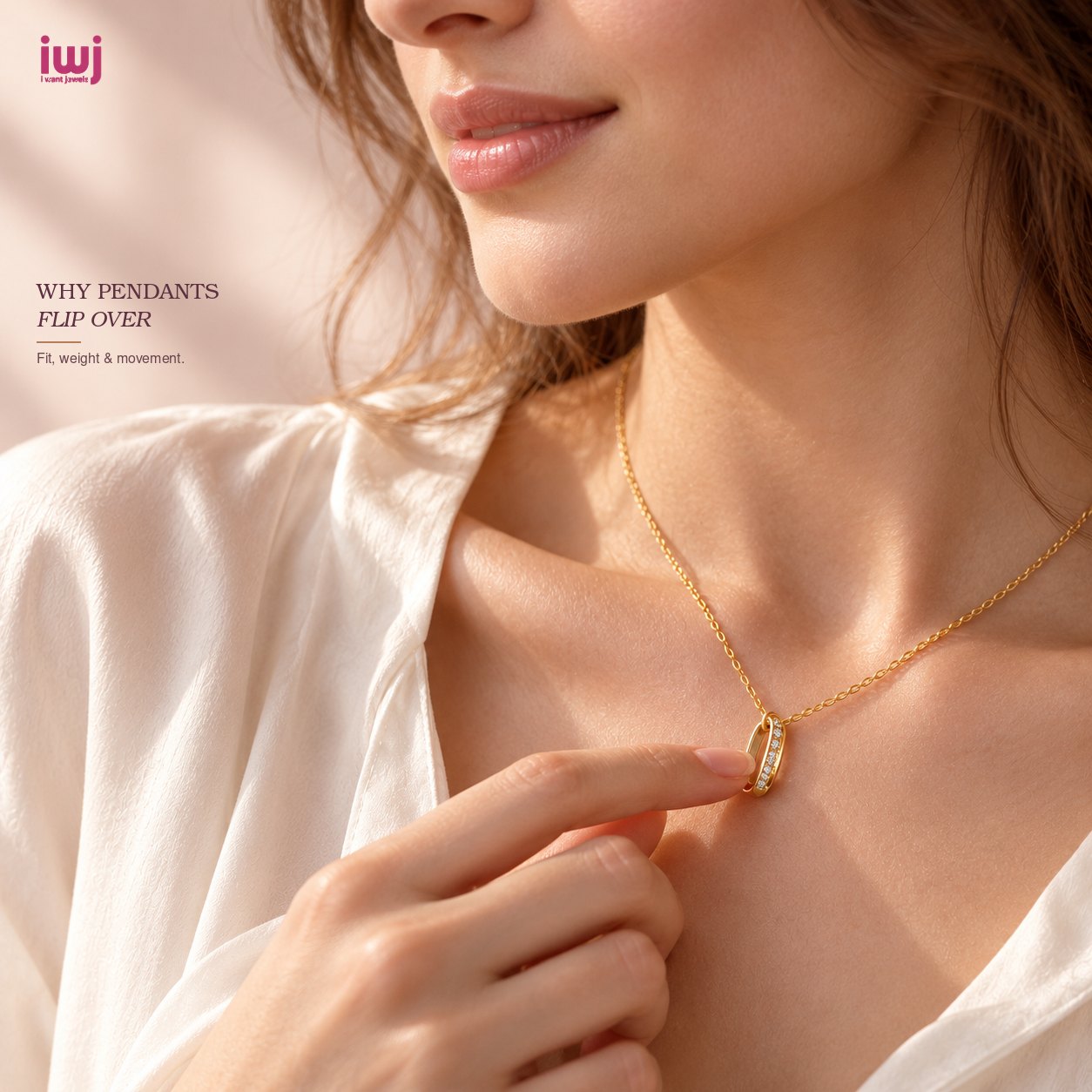
Why Does Your Pendant Keep Flipping Over?
Find out why a pendant turns over or hangs sideways. Check the chain, bail and pendant balance, and learn which fixes are safe to try.
Why does a pendant keep flipping over?
A pendant can flip because the chain is twisted, the attachment gives it room to rotate, or the pendant’s weight is not balanced beneath the point where it hangs. Movement from clothing, hair or everyday activity can also turn it.
Start by laying the necklace flat and checking whether the chain is twisted or caught. If the pendant keeps turning after you have straightened the chain, try it on a compatible chain only if it fits the pendant’s bail correctly. If the problem continues—or the bail looks bent or loose—ask a jeweller to inspect it instead of bending or modifying it yourself.
What kind of turning are you seeing?
| What happens | Possible cause to check |
|---|---|
| The pendant shows its back after you move | The pendant may rotate freely on its attachment, or its weight may favour the back. |
| The pendant turns sideways | The bail or connector may allow too much rotation, or the chain may be twisted. |
| The pendant tips forward | Its weight may sit forward of the hanging point. |
| The whole necklace shifts around | The chain may be moving over clothing or skin, or the fit may not suit the wearer. |
| It happens only with one chain | The chain and pendant attachment may not work well together. |
These are clues, not a diagnosis. A jeweller can assess the attachment and pendant balance in person.
Check the chain first
Take the necklace off and place it flat on a clean surface. Open the clasp and check the full chain for twists, knots or links caught around the pendant. Let it lie naturally before putting it back on.
When worn, notice whether the chain twists or slides as you move. The chain’s thickness and structure can affect how the pendant moves, but a heavier chain is not automatically the right fix. It must fit the bail and be suitable for the pendant’s weight.
Check the bail and attachment
The bail is the loop or fitting that connects the pendant to the chain. Check visually for:
- A bail or jump ring that appears bent, loose or partly open.
- A chain that catches or moves unevenly through the bail.
- A pendant that rotates freely around its attachment.
- An attachment point that appears off-centre or misaligned.
Do not try to bend, squeeze or solder the bail yourself. Small changes to an attachment can affect how securely the pendant hangs.
Pendant balance can affect how it hangs
A pendant hangs from its attachment point. If its weight is unevenly distributed around that point, it may settle at an angle or turn so the heavier part hangs lower. A raised or asymmetrical design may behave differently from a flat, balanced pendant.
Some pendants are designed to be reversible, so seeing either side may be intentional. Check the product description or ask the maker if you are unsure.
Safe checks to try at home
- Lay the necklace flat. Use a clean, dry surface with good light.
- Open the clasp and untwist the chain. Do not pull hard on the pendant or chain.
- Check the bail visually. Stop if it appears bent, loose or open.
- Try the necklace again. Wear it with the chain sitting flat, then note whether the pendant turns as you move.
- If you test another chain, check the fit first. It should pass through the bail smoothly without catching or excessive looseness.
- Stop if it keeps flipping. Repeated turning may need a jeweller’s assessment of the pendant or attachment.
The gold-plated jewellery care guide recommends gentle handling and avoiding rough friction. Treat plated chains and pendants carefully while checking them.
What not to do
- Do not bend the bail or jump ring with household pliers.
- Do not add glue, tape or adhesive to the pendant or chain.
- Do not attach a counterweight or extra charm as a permanent fix without professional advice.
- Do not force a thicker chain through a tight bail.
- Do not pull the chain sharply to turn the pendant back.
- Do not use a pendant that has a visibly open connector until it has been inspected.
These approaches can damage the finish, distort the attachment or make the pendant less secure.
When to ask a jeweller
Ask a jeweller to inspect the necklace if the pendant flips repeatedly despite the chain lying flat, the attachment is bent or loose, the pendant tips forward, or the chain does not pass smoothly through the bail. A jeweller can assess whether a change to the attachment or chain pairing is suitable for that particular piece.
Stop wearing it if the bail is open, a link is damaged, or the pendant feels at risk of coming off.
Explore Our Store
View all→Frequently Asked Questions
More Articles
- Best Earrings for a Girls' Night Out
- Geometric Earrings vs Classic Hoop Earrings: Which Is Right for You?
- What Is a Tennis Bracelet? Meaning, Cost & Buying Guide
- Lab Grown vs Natural Diamond Tennis Bracelet
- How Much Does a Tennis Bracelet Cost in 2026?
- Are Lab Grown Diamond Tennis Bracelets a Good Investment?
- Tennis Bracelet Size Guide — How to Measure Your Wrist