
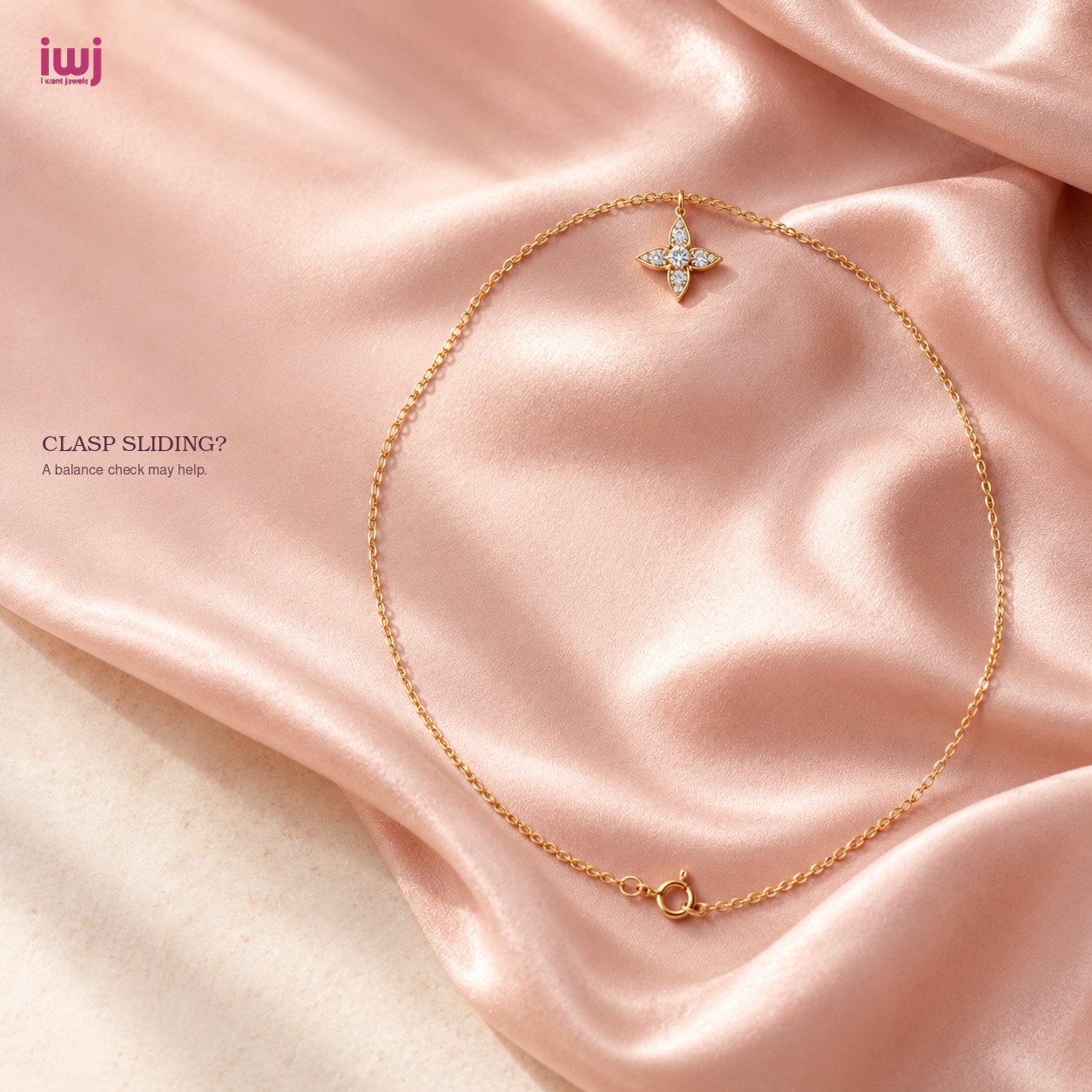
Why Does Your Necklace Clasp Keep Moving to the Front?
Find out why a necklace clasp slides to the front. Check chain weight, necklace fit and movement, and learn which adjustments are safe to try.
Why does a necklace clasp keep moving to the front?
A clasp may move from the back of your neck because the necklace shifts as you move, or because the clasp assembly is relatively heavy for the chain. Necklace length, chain movement, clothing and other layered pieces can affect how it sits.
Start by laying the necklace flat and checking for a twist. Then wear it on its own and see whether it still moves. If it does, the clasp and chain may not be well balanced. A jeweller can assess whether a different clasp, chain or professionally fitted counterweight is suitable.
Common causes and what to check
| What you notice | What to check |
|---|---|
| The clasp moves on a very fine chain | The clasp assembly may be relatively heavy compared with the chain. |
| It moves more when worn with other necklaces | The chains may be pulling or sliding against one another. |
| It shifts as you move or change clothes | The chain may be catching on clothing or moving over the skin. |
| It moves at one particular length | Try another available length and check that it sits comfortably. |
| It happens with one necklace but not others | The clasp, chain and front pendant may have a different balance. |
Some movement is normal during wear. If the clasp repeatedly travels around to the front, check the necklace rather than constantly pulling it back into place.
Safe checks to try at home
- Take the necklace off and lay it flat. Open the clasp and let the chain settle naturally.
- Check for a twist or tangle. Gently straighten the chain without pulling on the clasp or pendant.
- Put it on by itself. Remove layered necklaces for the test so they cannot move against one another.
- Place the clasp at the back of your neck. Check that the chain sits evenly on both sides.
- Try another listed length, if available. Make sure it remains comfortable and does not feel tight.
- Move normally for a few minutes. Notice whether the clasp shifts immediately, gradually or only when it catches on clothing.
- Stop if you see damage. A loose ring, bent clasp or stretched link should be assessed before further wear.
What can help?
Check the fit
If the necklace has more than one fastening position, try another length and see whether it stays in place more comfortably. Avoid shortening it so much that it feels tight or presses against your neck.
Test it without layers
If you wear several chains together, test the necklace on its own. Different lengths and chain styles can rub or pull against one another.
Ask a jeweller to check the clasp and chain
If the clasp keeps moving, ask a jeweller to check whether the clasp assembly is too heavy for the chain or whether the chain and front pendant are balanced. They can advise whether a compatible lighter clasp, different chain or professionally fitted counterweight makes sense for that necklace.
Do not add a weight or change the clasp yourself. The chain must still be secure, and added parts can affect the necklace’s finish and fit.
What not to do
- Do not glue or tape the clasp to your skin or clothing.
- Do not attach a charm or counterweight with household tools.
- Do not bend the clasp or jump ring.
- Do not force a different chain through the existing clasp or pendant.
- Do not keep wearing a necklace with a visibly open or damaged connector.
For plated jewellery, avoid rough handling and follow the care instructions for the piece. See the gold-plated jewellery care guide.
Choosing a chain and length
Chain structure and length affect how a necklace sits, but there is no single length or chain type that prevents every clasp from moving. Check the full necklace on the wearer, including the clasp, chain, pendant and any layers.
When comparing necklaces, check:
- The listed chain length and available adjustment points.
- Whether the product is designed to be worn alone or layered.
- How the clasp sits relative to the chain.
- Whether the chain and pendant move comfortably together.
- The product’s materials and care instructions.
Browse the necklace collection and check each product page for its listed size and construction.
Explore Our Store
View all→Frequently Asked Questions
More Articles
- Best Earrings for a Girls' Night Out
- Geometric Earrings vs Classic Hoop Earrings: Which Is Right for You?
- What Is a Tennis Bracelet? Meaning, Cost & Buying Guide
- Lab Grown vs Natural Diamond Tennis Bracelet
- How Much Does a Tennis Bracelet Cost in 2026?
- Are Lab Grown Diamond Tennis Bracelets a Good Investment?
- Tennis Bracelet Size Guide — How to Measure Your Wrist