
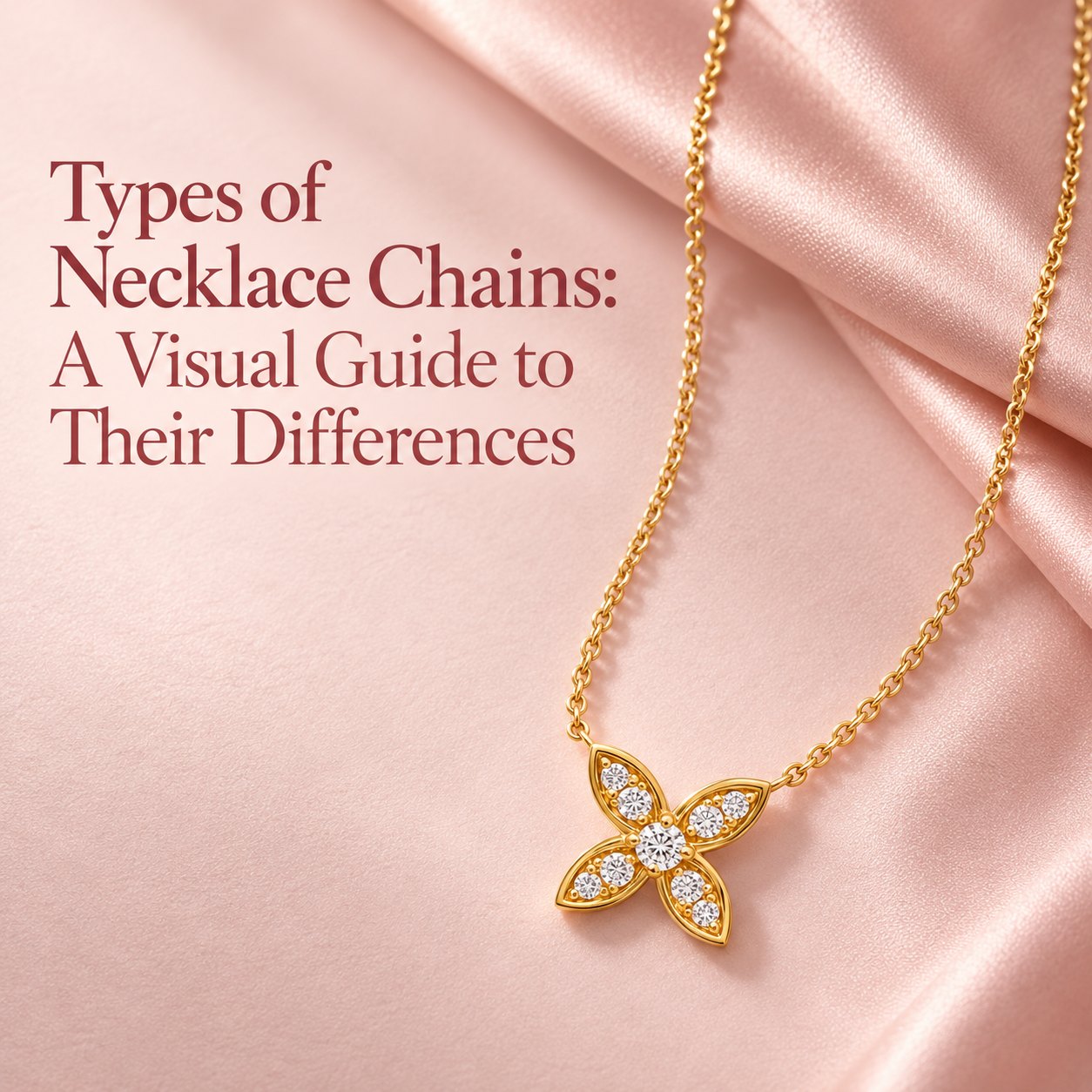
Types of Necklace Chains: A Visual Guide to Their Differences
Learn how cable, curb, box, rope, snake and other necklace chains look and differ. Explore chain styles and lab-grown diamond necklaces from I Want Jewels.
Explore Our Store
View all→Quick answer
Necklace chains differ in the shape and connection of their links. Cable chains have simple oval links, curb chains have flattened interlocking links, and box chains use square links for a smooth, defined look. Rope chains twist links together to create a textured appearance, while snake chains have closely joined links that form a smooth surface. The right style depends on the look you want and whether the chain will be worn alone or with a pendant.
Necklace chain styles at a glance
| Chain style | How it looks | Common reason to choose it |
|---|---|---|
| Cable | Individual round or oval links joined in a simple line | A classic, versatile look |
| Curb | Interlocking links that lie relatively flat | A bolder chain with visible links |
| Box | Small square links that form a neat, structured line | A clean, geometric appearance |
| Rope | Links twisted together in a spiral pattern | A textured chain that catches the light |
| Snake | Closely connected links with a smooth, flexible surface | A sleek look worn on its own |
| Figaro | A repeating pattern of short links and longer links | A distinctive, patterned chain |
| Paperclip | Elongated oval links | A modern, open-link appearance |
| Wheat | Interwoven links that create a braided look | A detailed, textured finish |
1. Cable chain
A cable chain is made from a series of simple round or oval links joined one after another. The links are usually easy to see, giving the chain a familiar, classic appearance.
What to look for: individual links with open space between them.Often chosen for: everyday wear and simple pendants.
2. Curb chain
A curb chain is formed from interlocking links that are twisted or shaped to lie flatter against the body. The links may be narrow and delicate or wider and more noticeable.
What to look for: linked shapes that sit close together and form a flatter surface.Often chosen for: a chain that has visible texture and can make a stronger statement.
3. Box chain
A box chain uses small, square-shaped links connected to create a smooth, structured line. From a distance, it can appear more solid than a cable chain.
What to look for: a neat, squared profile rather than clearly separated oval links.Often chosen for: a clean geometric look.
4. Rope chain
A rope chain is made by twisting or braiding links together so the chain resembles a small rope. Its textured surface can reflect light from several angles.
What to look for: a spiral or braided pattern running along the chain.Often chosen for: wearing alone when you want the chain itself to be part of the look.
5. Snake chain
A snake chain has closely connected links that create a smooth, flexible surface. It has little visible space between the links, so it looks more like a continuous line than a row of separate loops.
What to look for: a smooth, rounded or slightly flattened surface with a close-set pattern.Often chosen for: a sleek look, especially without a large pendant.
6. Figaro chain
A Figaro chain has a repeating pattern of smaller links followed by a longer link. The pattern makes it easy to distinguish from chains with identical links throughout.
What to look for: a regular sequence, often two or three short links followed by one longer link.Often chosen for: a patterned chain with a recognisable rhythm.
7. Paperclip chain
A paperclip chain uses elongated oval links connected in a repeated open-link pattern. The shape can look modern and graphic, especially when the links are larger.
What to look for: long, narrow links with visible openings.Often chosen for: a contemporary chain that can be worn alone or styled in layers.
8. Wheat chain
A wheat chain uses interwoven links that create a braided or woven appearance. The connected pattern gives it more detail than a simple cable chain.
What to look for: small links woven together in a repeating, textured pattern.Often chosen for: a more decorative chain with a woven finish.
Chain style versus necklace design
The chain style describes how the links are constructed. It is different from the necklace’s overall design.
For example, a necklace can have a fine chain with a solitaire pendant, a Y-shaped drop, or several diamonds placed along the neckline. Those describe the necklace’s design and diamond placement. They do not, by themselves, identify whether the chain is cable, box, curb or another link style.
How to identify a chain in a product photo
- Zoom in on a section away from the pendant. The pendant or diamond setting can hide the chain links.
- Look for open space between links. Oval openings may indicate a cable chain; longer openings may indicate a paperclip style.
- Check the surface. A smooth, nearly continuous line may indicate a snake chain, while a braided texture may indicate a rope or wheat chain.
- Use the product specifications as confirmation. A photo can suggest a style, but the product description or maker should confirm the chain construction.
What chain construction is specified on I Want Jewels necklaces?
I Want Jewels’ current necklace listings show several different necklace designs, including pendants and necklaces with diamonds positioned along the chain. However, the product descriptions reviewed for this guide do not consistently identify the chain-link construction by name. That means it would be inaccurate to label those products as cable, box, curb or another specific chain type without confirmation.
For example, the Aurora Sette Necklace is described as a seven-diamond necklace, with diamonds placed along the chain. The product page gives its chain size, but does not name the chain-link pattern. The Serafina Necklace is listed as an 18-inch necklace with a geometric centre design; its listing also does not specify a named chain construction.
To make this guide specific to the collection, photograph the actual chain links in close-up and confirm each chain type with the product or manufacturing team before assigning labels. Until then, describe the visible product design accurately—for example, “fine chain,” “diamonds spaced along the chain,” or “pendant necklace”—and avoid naming an unverified link pattern.
Browse the necklace collection to see the current designs.
How to choose a chain style
Think about how the necklace will be worn:
- For a pendant: choose a chain that complements the pendant’s size and shape. Check that the clasp and chain are suitable for that specific pendant.
- For wearing alone: a rope, curb or paperclip chain can make the chain itself more visible.
- For a smooth, minimal look: consider a snake-style chain, if that construction is confirmed on the product.
- For layering: compare the chain’s thickness, length and overall visual weight with the other necklaces.
- For a gift: check the listed necklace length and the recipient’s usual style, as well as the chain’s appearance.
The product page should provide the actual length and materials. If the link style is not specified, ask the seller rather than relying only on a distant product image.
Explore Our Store
View all→Frequently Asked Questions
More Articles
- Best Earrings for a Girls' Night Out
- Geometric Earrings vs Classic Hoop Earrings: Which Is Right for You?
- What Is a Tennis Bracelet? Meaning, Cost & Buying Guide
- Lab Grown vs Natural Diamond Tennis Bracelet
- How Much Does a Tennis Bracelet Cost in 2026?
- Are Lab Grown Diamond Tennis Bracelets a Good Investment?
- Tennis Bracelet Size Guide — How to Measure Your Wrist