
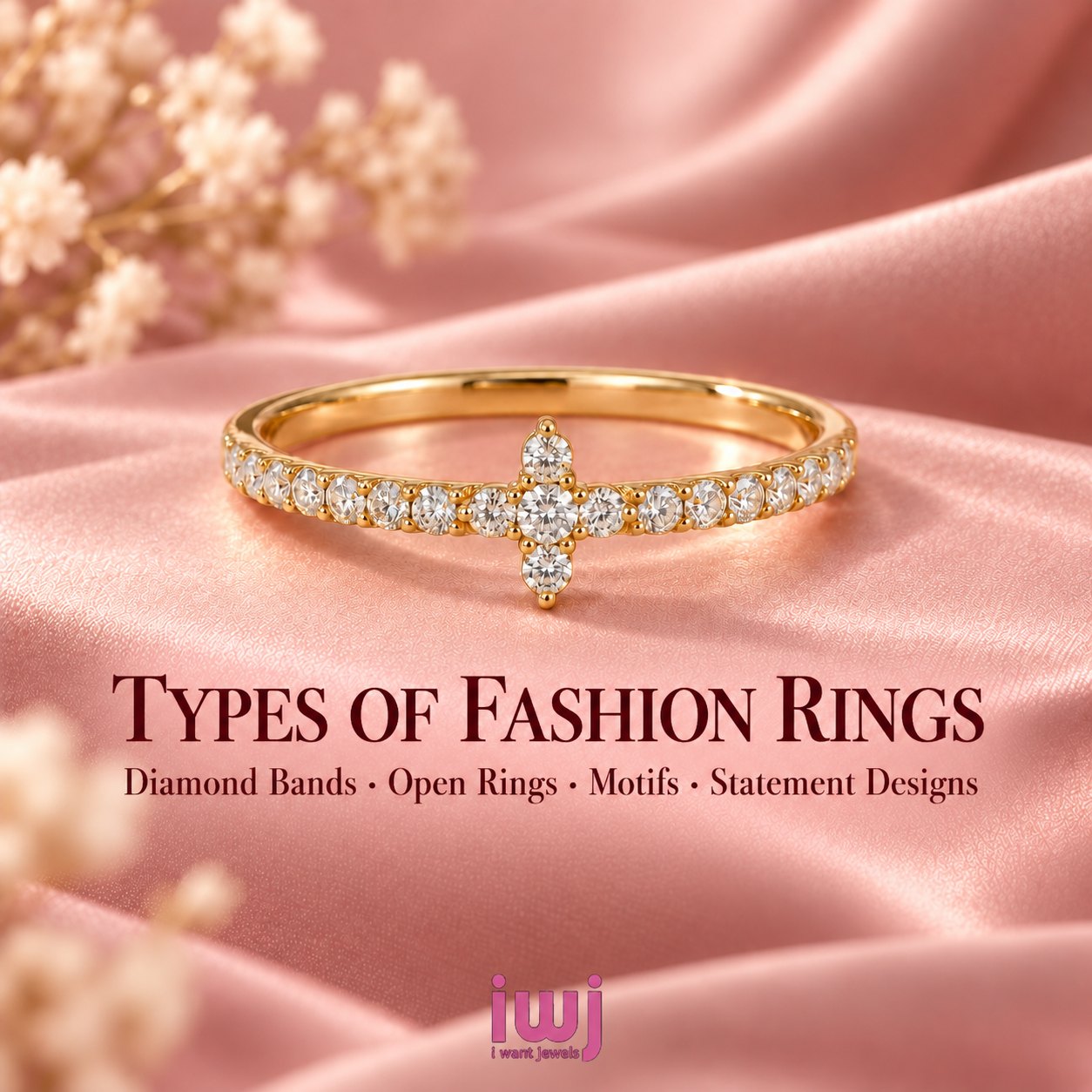
Types of Fashion Rings: Diamond Bands, Open Rings, Motifs and Statement Designs
Compare fashion ring styles, from diamond bands and open rings to motif and statement designs. See how each profile looks and find a style that suits you.
Explore Our Store
View all→Quick answer
Fashion rings come in many profiles, from slim diamond bands to open rings, symbolic motifs and larger statement designs. A band usually follows the shape of the finger; an open ring leaves a gap between its ends; a motif ring centres on a recognisable shape or symbol; and a statement ring has a more prominent design or wider visual coverage. Choose by the profile you enjoy wearing, how much of the finger you want the ring to cover, and whether you want it for everyday outfits or occasional styling.
Compare fashion ring styles at a glance
| Ring style | Profile and coverage | Overall look | I Want Jewels example |
|---|---|---|---|
| Diamond band | Follows the finger; coverage depends on the band’s width and stone setting | A defined line of sparkle | Browse the ring collection |
| Open ring | Leaves a visible gap between the ends | Modern and distinctive | Attraverso Ring |
| Motif ring | Centres attention on a recognisable shape or symbol | Personal and expressive | Attraverso Ring, with a cross motif |
| Sculptural or wave ring | Uses a shaped band instead of a straight profile | Fluid and contemporary | Ondina Ring |
| Statement ring | Often has a larger setting, wider band or more visual detail | Bold and noticeable | Lucrezia Ring |
Diamond bands: a line of sparkle around the finger
A diamond band uses stones set along some or all of the band. The stones may create an even line, a repeating pattern or a more varied design.
Profile: the band follows the curve of the finger.Coverage: depends on its width and how much of the band is set with diamonds.Style: often chosen alone, stacked with other bands or paired with a larger ring.
When comparing bands, look at the full ring rather than just the top view. A side photograph helps show how high the setting sits and how much of the band is visible around the finger.
Open rings: a visible gap in the band
An open ring has two ends that do not fully meet, leaving a gap as part of the design. The ends may feature stones, shapes or other details.
Profile: open at one point rather than forming a fully closed circle.Coverage: the opening becomes part of the ring’s look.Style: a distinct alternative to a continuous band.
The Attraverso Ring is listed as an open ring. Check the current product page for its sizing and fit guidance; an open design does not automatically mean a ring is adjustable to every size.
Motif rings: a shape or symbol at the centre
A motif ring is built around a recognisable design, such as a cross, flower, star or other symbol. The motif can be small and subtle or form the main feature of the ring.
Profile: the central design may sit above or across the band.Coverage: depends on the motif’s width and orientation.Style: often chosen for its meaning as well as its appearance.
Attraverso combines an open-ring form with a cross design, so it fits both categories. This shows why ring styles can overlap: one ring may have a particular band construction and a separate motif.
Sculptural and wave rings: shaped profiles
Some rings use a curved or flowing band instead of a straight, uniform line. A wave shape can create movement across the finger and may include diamonds along the curve.
The Ondina Ring is described as a diamond wave ring. Compare its top and side views to see how the band follows the finger and where its details sit.
Statement rings: make the design more prominent
A statement ring has a more noticeable presence. That may come from a wider band, a larger setting, more extensive diamond coverage or a distinctive silhouette.
The Lucrezia Ring is listed as a statement ring. Its product page gives the current design details and available sizes. Check the photographs for how much of the finger the ring covers and how high the setting sits.
How to compare ring profile and finger coverage
Use these visual checks when choosing between styles:
- Look at the top view. This shows the ring’s outline and how much space it occupies across the finger.
- Check the side view. This shows the height of the setting and how the ring sits above the finger.
- Notice the band width. A wider band will cover more of the finger than a narrow one.
- Check the underside. The band may be continuous, open or shaped differently underneath.
- Compare worn photographs. The same ring can look different depending on hand position, finger size and camera distance.
Product photos help you judge appearance, but always use the listed ring size and size guide to check fit. Do not assume an open ring can be adjusted unless the product page explicitly says so.
Which fashion ring style should you choose?
- Choose a diamond band if you want a defined line of sparkle that can be worn alone or alongside another ring.
- Choose an open ring if you like a non-continuous shape and a more distinctive profile.
- Choose a motif ring if a symbol or recognisable shape is important to you.
- Choose a sculptural ring if you prefer flowing lines to a traditional straight band.
- Choose a statement ring if you want the ring to be a noticeable part of your outfit.
Browse the I Want Jewels ring collection to compare the current designs, finishes and sizes.
Explore Our Store
View all→Frequently Asked Questions
More Articles
- Best Earrings for a Girls' Night Out
- Geometric Earrings vs Classic Hoop Earrings: Which Is Right for You?
- What Is a Tennis Bracelet? Meaning, Cost & Buying Guide
- Lab Grown vs Natural Diamond Tennis Bracelet
- How Much Does a Tennis Bracelet Cost in 2026?
- Are Lab Grown Diamond Tennis Bracelets a Good Investment?
- Tennis Bracelet Size Guide — How to Measure Your Wrist