
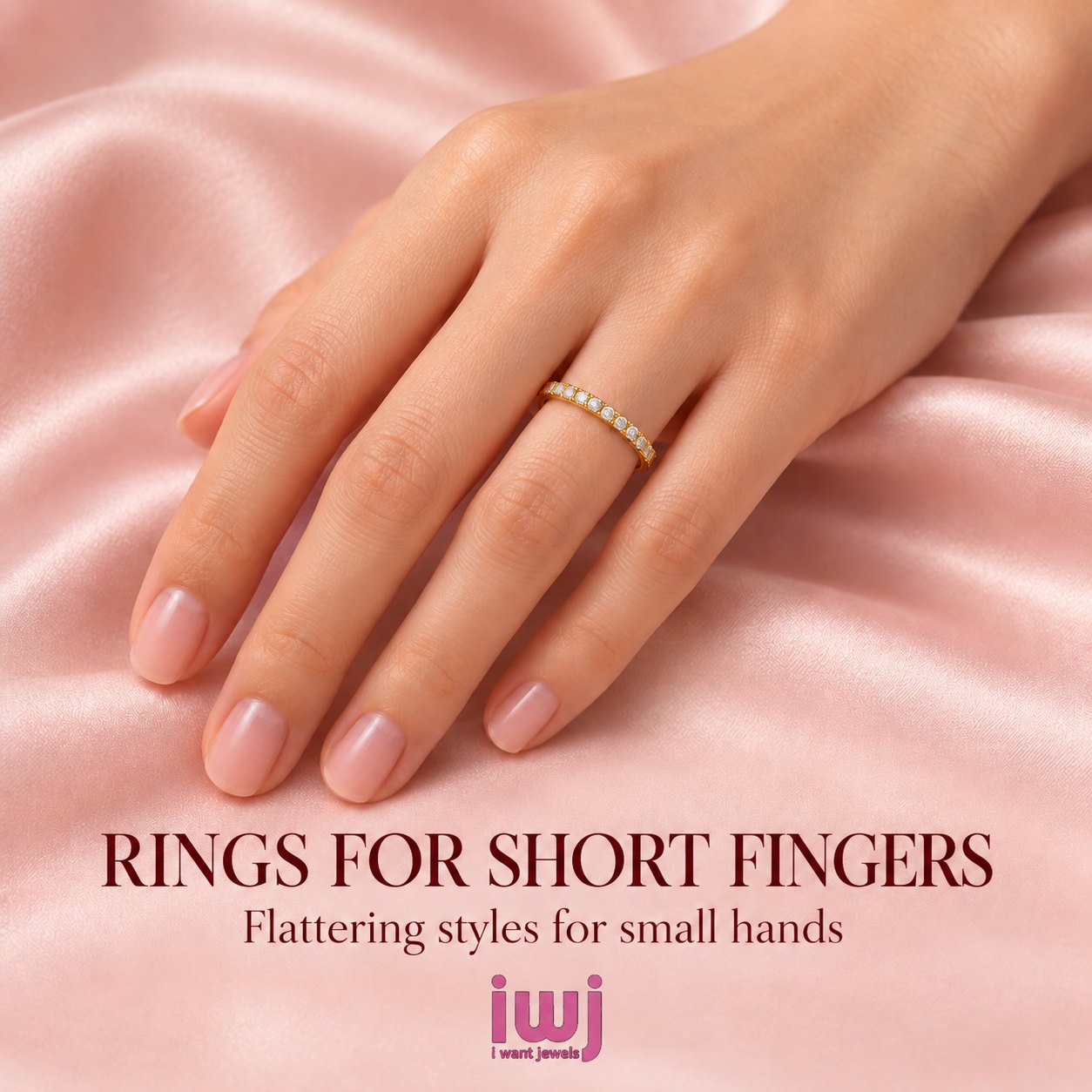
How to Choose Rings for Short Fingers and Small Hands
Explore ring styles for short fingers and small hands, from slim bands to open and statement designs. Compare profiles and choose what feels right to you.
Explore Our Store
View all→Quick answer
There is no single ring style that people with short fingers or small hands need to wear. Some shoppers prefer slim bands or open designs because they show more of the finger; others enjoy wider bands and statement settings. Compare rings on a hand at a consistent scale, notice how much coverage you like, and choose the style you feel good wearing.
Compare ring styles by profile and coverage
| Ring style | How it may look on the hand | What to consider |
|---|---|---|
| Slim band | Leaves more of the finger visible around the band | Check whether the setting is wider than the band |
| Diamond band | Creates a line of sparkle across the finger | Look at the full width and how far the diamonds extend |
| Open ring | Adds a gap that becomes part of the design | Check its actual fit guidance; “open” does not mean universal sizing |
| Sculptural or wave ring | Creates movement through a shaped band | Compare the top and side views |
| Statement ring | Draws more attention and may cover more of the finger | Check the setting width, height and how it feels when worn |
These are visual options, not rules about what suits a particular hand.
Start with the profile you like
A ring can look quite different from above, from the side and when worn. Before deciding, look at:
- Band width: how much of the finger the band covers.
- Setting width: whether the top extends beyond the band.
- Setting height: how far the design sits above the finger.
- Overall silhouette: whether the ring looks straight, open, curved or sculptural.
- Worn scale: how the ring appears on a hand, not only in a close-up product shot.
If you have smaller hands, you may prefer a delicate profile—or you may enjoy a bolder design. Use photos and measurements to understand the proportions, then choose by personal taste.
Ring styles to explore
Slim and diamond bands
A slim band can create a lighter visual line, while a diamond band adds sparkle across the finger. If you want to compare these styles, look at the band’s width and the setting from both the top and side. A slim band can still have a prominent setting.
Open rings
An open ring has a visible gap in its band. That opening can make the design feel distinctive and change the way it sits visually on the hand.
The Attraverso Ring is listed as an open ring. Check the current product page for its available sizes and fit guidance before ordering.
Sculptural and wave rings
A sculptural ring uses a shaped profile instead of a straight band. The curve can create a different visual line across the finger.
The Ondina Ring is described as a diamond wave ring. Compare its worn photograph and side profile to see how its shape sits on the hand.
Statement rings
A statement ring has a more noticeable presence, which may come from its width, diamond coverage or overall design. If you are considering one, review the full set of product photos and check how much of the finger it covers.
The Lucrezia Ring is identified as a statement ring. Its page shows the current product details and available sizing.
Use real-hand photographs to compare proportions
When comparing rings online, look for photos that show the ring on a hand, with the whole finger visible. Ideally, the examples use a similar camera angle, distance and hand position. Otherwise, a ring can appear larger or smaller simply because of the way it was photographed.
A useful set of product images includes:
- A full-hand view for overall scale.
- A close-up from above for band and setting width.
- A side view for setting height and profile.
- Measurements for the band and setting, where available.
For this article, original photos of several ring profiles on the same hand would make the comparison much more useful. Avoid labelling a style “best for small hands”; show the proportions clearly and let shoppers decide what they prefer.
Check the fit separately from the style
The ring’s appearance and its size are separate decisions. Use the size guide on the individual product page and check which sizes are currently available. If you are comparing a wider band with a slimmer one, ask the seller whether the design affects its fit.
For size measurements and conversions, use the existing ring size guide on the product page. This article focuses on appearance and proportions rather than repeating the sizing chart.
Find a ring style you enjoy wearing
Try comparing a few different profiles instead of narrowing your choice based only on finger length or hand size. A slim band, an open design and a statement ring can all look different on the same hand—and personal preference matters more than a general styling rule.
Browse the I Want Jewels ring collection to compare the current designs.
Explore Our Store
View all→Frequently Asked Questions
More Articles
- Best Earrings for a Girls' Night Out
- Geometric Earrings vs Classic Hoop Earrings: Which Is Right for You?
- What Is a Tennis Bracelet? Meaning, Cost & Buying Guide
- Lab Grown vs Natural Diamond Tennis Bracelet
- How Much Does a Tennis Bracelet Cost in 2026?
- Are Lab Grown Diamond Tennis Bracelets a Good Investment?
- Tennis Bracelet Size Guide — How to Measure Your Wrist