
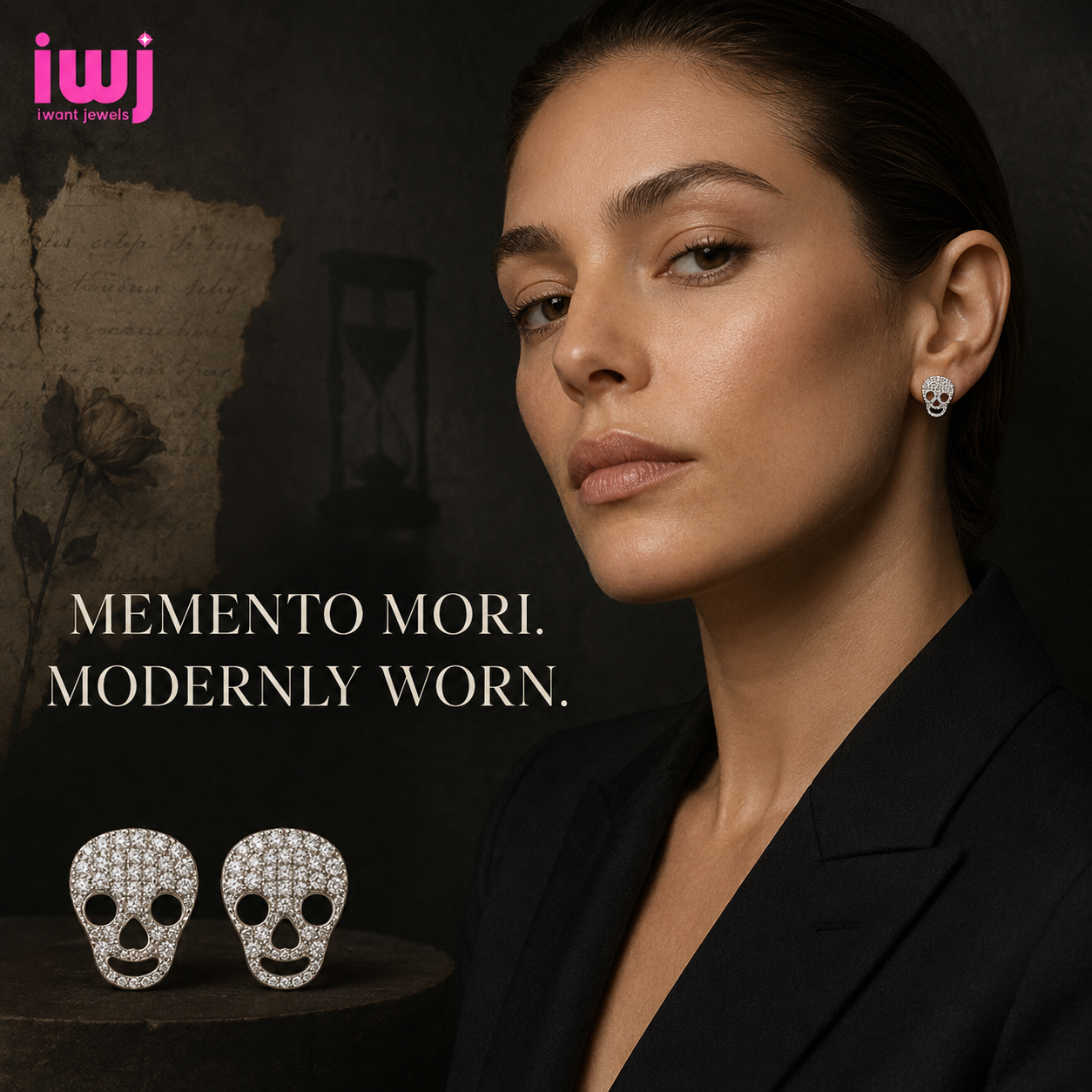
Skull Jewellery Meaning, Symbolism and History
Skull jewellery can look rebellious, mysterious or unconventional, but the symbol has a much longer and more complex history than modern fashion or Halloween styling might suggest.
For centuries, skulls have appeared in jewellery, paintings and decorative objects as reminders that life is temporary. Some pieces were intended to encourage reflection, while others commemorated someone who had died. In modern jewellery, the skull has gained additional meanings connected with resilience, individuality and personal freedom.
There is no single meaning that applies to every skull ring, necklace or pair of earrings. Its interpretation depends on the design, surrounding symbols, historical context and the person wearing it.
What does skull jewellery mean?
Skull jewellery most commonly represents mortality and the temporary nature of life. However, modern wearers may interpret it differently.
Important meanings include:
- Memento mori: a reminder that life is limited.
- Remembrance: honouring someone who has died.
- Equality: a reminder that status and outward appearance are temporary.
- Resilience: surviving loss, difficulty or personal change.
- Individuality: choosing jewellery outside conventional styles.
- Personal freedom: wearing something because it reflects your identity.
- Artistic expression: appreciating the skull as a recognisable sculptural form.
A skull does not automatically represent evil, danger or a fascination with death. For many people, its message is about appreciating life more consciously.
The historical origins of skull jewellery
Skull imagery has appeared in many cultures, but its meaning has not been identical everywhere. One of the clearest documented influences on European skull jewellery is the tradition known as memento mori.
The Latin phrase is commonly translated as "remember that you must die". Memento mori objects were designed to remind people that human life, beauty, possessions and status would not last forever.
The British Museum notes that miniature skulls used as symbols of mortality have a history extending back to the medieval period. By the 16th and 17th centuries, skulls appeared in elaborate rings, pendants and watches made from precious materials.
These historical pieces demonstrate that skull jewellery was not always crude, frightening or inexpensive. Some examples were carefully made from gold and decorated with enamel, diamonds, rubies and detailed inscriptions.
A surviving memento mori ring in the British Museum features a clasped-book bezel with a skull on its upper surface. The Metropolitan Museum of Art also holds a 17th-century British skull locket ring made from gold, enamel, diamonds and a ruby.
The expensive materials created an intentional contrast: valuable objects were being used to remind the wearer that wealth and beauty were temporary.
Memento mori was about life as well as death
It is easy to interpret memento mori jewellery as gloomy. Its original purpose, however, could be more reflective.
The skull encouraged the wearer to consider how limited time should be used. It could promote humility, perspective or greater awareness of the present.
In this interpretation, the message was not simply "death is coming". It was also:
- Use your time carefully.
- Do not allow possessions to define you.
- Remember that beauty and status are temporary.
- Live with purpose while you can.
This explains why skull jewellery can still feel meaningful to people who do not see it as dark or negative.
Memento mori and mourning jewellery are not exactly the same
Memento mori jewellery and mourning jewellery sometimes overlap, but they were not always created for the same reason.
Memento mori pieces generally reminded the wearer about mortality in a broad sense. They did not have to represent a particular person.
Mourning jewellery, by comparison, was usually connected with an individual who had died. It could include a name, initials, date of death, memorial inscription, portrait or lock of hair. Some mourning rings also included skulls, skeletons, coffins and black enamel.
The British Museum holds several 17th-century mourning rings that use skull imagery alongside personal inscriptions. These pieces demonstrate how a general symbol of mortality could also become part of a private memorial.
The most reliable way to distinguish the two is to examine the complete object. A skull by itself does not prove that a ring was made for mourning.
Skull imagery in vanitas art
Skulls also appeared in the European artistic tradition known as vanitas.
Vanitas paintings used physical objects to communicate that worldly pleasure, knowledge and possessions were temporary. A skull might appear beside an extinguished candle, watch, flower, book, musical instrument or expensive weapon.
The National Gallery describes the skull in Frans Hals's Young Man Holding a Skull as a symbol of mortality and the brevity of human life.
The Metropolitan Museum's Vanitas Still Life from 1603 similarly combines a skull with flowers, a bubble and a smoking urn. Each object represents something that will disappear or change.
Vanitas is mainly an artistic category rather than a jewellery style. Nevertheless, it helps explain the symbolic world in which memento mori jewellery was understood.
Both traditions ask the same underlying question: if time is limited, what truly matters?
What does wearing skull jewellery mean today?
Modern skull jewellery does not necessarily carry its original religious or moral meaning. Wearers now choose the motif for many different reasons.
A reminder to live consciously
Some people still connect skull jewellery with memento mori. The design reminds them not to postpone meaningful decisions or assume that time is unlimited.
In this context, the skull can represent gratitude and purpose rather than fear.
Strength and resilience
A skull may be chosen after a difficult period, major change or personal loss. The wearer may interpret it as evidence that they survived and continued forward.
This is a modern personal interpretation rather than a universal historical meaning. Not everyone wearing skull jewellery is communicating the same experience.
Individuality
Hearts, flowers and solitaire jewellery follow familiar design traditions. A skull immediately feels less conventional.
For someone who wants jewellery to reflect a more distinctive identity, the skull can communicate independence and an unwillingness to follow every expectation.
Rebellion and personal freedom
Skull imagery appears across gothic fashion, rock culture, biker aesthetics, alternative styling and contemporary luxury. In these settings, it can challenge traditional ideas about what jewellery should look like.
The rebellious effect comes partly from contrast. Diamond skull earrings worn with formal tailoring communicate something different from the same earrings worn as part of a complete gothic outfit.
Artistic appreciation
The human skull is also a recognisable and structurally complex shape. Designers can interpret it through realism, simplified outlines, geometric forms, engraving, pavé diamonds or sculptural metalwork.
Some people wear skull jewellery simply because they appreciate the design. A personal interest in anatomy, art or unconventional form does not always require a deeper symbolic explanation.
Is skull jewellery evil?
Skull jewellery is not inherently evil.
Historically, skulls have been used in religious reflection, memorial objects, moral art and reminders about the value of time. In modern design, they may represent resilience, individuality or an appreciation for alternative aesthetics.
The meaning depends on several factors:
- The symbols surrounding the skull.
- Any inscription or date.
- Whether the design is realistic or abstract.
- The materials used.
- The occasion.
- The wearer's personal intention.
A skull accompanied by an hourglass and Latin inscription may refer to memento mori. A skull on a memorial ring may represent mourning. A diamond skull earring may primarily communicate contemporary self-expression.
Assigning the same negative meaning to all three would ignore their different contexts.
Is skull jewellery only for Halloween?
Halloween is one occasion when skull imagery becomes especially visible, but skull jewellery has existed outside the event for centuries.
Contemporary skull earrings, rings and pendants can be worn for concerts, festivals, theatre, dinners, fashion events and everyday alternative styling.
The design will usually determine how seasonal it appears. A brightly coloured novelty skull may feel strongly connected with Halloween. A refined skull made from sterling silver and diamonds can transition into year-round evening or fashion styling more naturally.
This is why skull jewellery can appear inside a Halloween collection while still retaining an identity outside October.
Skull jewellery and Día de los Muertos are different
Decorated skulls associated with Día de los Muertos, or Day of the Dead, belong to a particular Mexican and Mexican-American cultural tradition. They should not automatically be described as generic Halloween skulls.
Día de los Muertos is a time to remember and honour people who have died. Families may visit gravesites and create ofrendas containing photographs, candles, flowers, food and personal offerings.
The Smithsonian describes the celebration as being connected with remembrance and the celebration of life. Calaveras and sugar-skull imagery developed through specific Mexican religious, artistic and satirical traditions.
When jewellery intentionally uses calavera or Día de los Muertos imagery, its cultural origin should be identified accurately. It should not be grouped carelessly with every European memento mori or modern gothic skull design.
How the design changes the meaning
The appearance of the skull can significantly affect how the jewellery is interpreted.
A realistic skull may feel directly connected with anatomy, mortality or gothic styling. A simplified outline can feel more graphic and contemporary. A very small motif may operate as a private symbol, while an oversized design becomes a highly visible fashion statement.
Material also influences perception. An engraved skull inside a ring can feel intimate and personal. A heavy sculptural skull may appear rebellious, while pavé diamond detailing introduces brightness and refinement.
The type of jewellery matters as well. A skull ring remains within the wearer's own line of sight, making it suitable as a personal reminder. A necklace creates a central symbol that can be displayed or partially concealed. Skull earrings place the design close to the face, making it more noticeable during conversations and photographs.
Teschio: a modern interpretation of skull jewellery
The Teschio Lab-Grown Diamond Skull Earrings reinterpret the historic skull motif through contemporary diamond jewellery.
Rather than reproducing an antique mourning ring, Teschio combines a recognisable skull silhouette with a cool white finish and lab-grown diamonds. The result places the symbol within modern expressive jewellery.
The confirmed product specifications are:
- Base metal: 925 sterling silver.
- Finish: 14kt white-gold plating.
- Stone type: Lab-grown diamonds.
- Total diamond weight: 0.37 carats.
- Measurements: 12 × 8 × 4 mm.
- Product code: IWJER0015W.
The diamonds create an interesting contrast with the skull. One traditionally represents mortality, while the other introduces light and luxury.
Teschio does not have to mean the same thing to every wearer. Someone may choose it as a reminder of resilience, a symbol of individuality or simply because the design feels more distinctive than conventional diamond earrings.
How to style modern skull jewellery
Because the skull is immediately recognisable, it usually works best when it is allowed to become the principal symbolic piece.
Skull earrings can be worn with simple necklaces or no necklace at all. A skull ring can be paired with otherwise classic jewellery. A skull pendant can work with compact studs, allowing the central motif to remain clear.
Monochrome clothing, clean tailoring and simple silhouettes can create contrast without turning the complete outfit into a theme.
The most important styling points are:
- Use one primary skull piece.
- Check the real dimensions before assuming it is subtle.
- Keep other symbolic motifs restrained.
- Repeat the metal finish elsewhere if the look needs cohesion.
- Allow the skull to communicate personality without competing accessories.
Several skull pieces can be worn together when a deliberately maximalist result is intended, but that is a different styling decision.
Is skull jewellery a good gift?
Skull jewellery can make a meaningful gift when the recipient already appreciates alternative, gothic, artistic or symbolic designs.
It is less suitable as a surprise for someone whose jewellery collection is entirely traditional or minimal. The symbolism can also feel personal, particularly if the gift is connected with loss or remembrance.
Before choosing skull jewellery as a gift, confirm:
- Whether the recipient has worn skull motifs before.
- Whether they prefer subtle or prominent designs.
- Their usual metal colour.
- Whether their ears are pierced.
- The product's actual dimensions.
- Whether the symbolism feels appropriate for the relationship.
Do not choose a skull solely because the gift will be presented near Halloween. Personal style matters more than the calendar.
Caring for detailed skull jewellery
Skull jewellery can contain recessed areas and small settings where makeup, dust and hair-product residue collect.
For I Want Jewels pieces:
- Apply perfume, makeup and hairspray before putting on the jewellery.
- Wipe the piece gently after wearing it.
- Use a soft cloth and avoid abrasive brushes.
- Use only mild soap diluted in water when needed.
- Avoid harsh chemical cleaners.
- Dry the jewellery carefully.
- Store it separately in its pouch.
Always follow the instructions supplied with the specific product, particularly when the piece has a plated finish.
Conclusion
Skull jewellery has carried changing meanings across different periods.
Historical memento mori rings reminded their wearers that life was temporary. Mourning jewellery sometimes used skulls to commemorate individual loss. Contemporary designers have transformed the motif into jewellery connected with identity, resilience and unconventional luxury.
The most accurate interpretation comes from examining the complete piece and understanding why it was chosen.
Explore the Teschio Lab-Grown Diamond Skull Earrings as a contemporary I Want Jewels interpretation of a symbol with centuries of documented history.
Explore Our Store
View all→Frequently asked questions
More Articles
- Best Earrings for a Girls' Night Out
- Geometric Earrings vs Classic Hoop Earrings: Which Is Right for You?
- What Is a Tennis Bracelet? Meaning, Cost & Buying Guide
- Lab Grown vs Natural Diamond Tennis Bracelet
- How Much Does a Tennis Bracelet Cost in 2026?
- Are Lab Grown Diamond Tennis Bracelets a Good Investment?
- Tennis Bracelet Size Guide — How to Measure Your Wrist