

Are Black Friday Jewellery Deals Really Worth It? 9 Checks Before You Buy
Editorial disclosure: I Want Jewels is not running a Black Friday discount. This independent buying guide explains how to judge jewellery based on its real price, materials, wearability and purchase terms—not the size of a promotional claim.
Is Black Friday a good time to buy jewellery? It can be—but only when the final price is genuinely competitive, the product specifications are clear and the piece is something you were already likely to buy.
A large discount percentage does not automatically make a piece of jewellery good value. A smaller reduction on a well-made, wearable design may be a better purchase than a heavily reduced piece with vague materials, restrictive returns or the wrong size.
The short answer
Black Friday can be a good time to buy jewellery if:
- You tracked the exact product before the promotion.
- The discounted product has the same materials and specifications.
- You understand whether the stone is a diamond, lab-grown diamond or simulant.
- You know whether the metal is solid, sterling silver, plated or simply gold-coloured.
- The sizing and measurements are suitable.
- The return window works for you—especially when buying a Christmas gift.
- The seller can deliver before the date you need it.
- You expect to wear or gift the piece regularly.
- You are buying the right jewellery, rather than reacting to a countdown.
If several of these details are missing, waiting is usually the better decision.
A Black Friday purchase may make sense when…
| You should consider waiting when… | You noticed it only because of the discount | Only the crossed-out price is visible | The description relies on words such as "luxury" or "diamond-like" | You are guessing a ring or bracelet size | The return window ends before Christmas | The page states only a dispatch estimate | You cannot imagine wearing it after the event |
|---|---|---|---|---|---|---|---|
| You already wanted the exact piece | You know its previous selling price | Materials and dimensions are clearly stated | The size is known | The return period covers the gifting date | Delivery timing is confirmed | The design suits everyday or regular wear |
Are Black Friday jewellery discounts always genuine?
No. Some Black Friday jewellery discounts represent a real reduction from a normal selling price. Others may look more impressive because they are compared with a recommended retail price, a price used briefly or a figure at which the product was rarely sold.
That does not mean every large discount is misleading. It means the percentage should be the beginning of your research, not the conclusion.
The UK Competition and Markets Authority recommends shopping around, reading the full information and being careful about misleading promotions or pressure-based selling. Its advice applies equally to jewellery: judge the product and final price, rather than relying on the promotional label.
1. Check the price before Black Friday
The most reliable way to test a Black Friday jewellery deal is to record the price before the promotion begins.
Create a simple note containing:
- The product name
- A screenshot or link
- The current price
- The metal and stone specification
- Any delivery charge
- The date you recorded it
Check the same product again when the promotion starts. The important comparison is not simply "was" versus "now". It is the Black Friday price versus what the item genuinely cost during the preceding weeks.
Where possible, compare the price with genuinely comparable jewellery from other sellers. The pieces should have similar:
- Precious-metal content
- Plating or finish
- Stone type
- Carat weight
- Dimensions
- Construction
- Warranty and returns
- Delivery costs
A £150 necklace and a £400 necklace are not directly comparable merely because both contain a diamond. One could contain a small lab-grown diamond in plated sterling silver, while the other may use a larger stone in solid gold.
2. Compare the final price—not only the headline discount
The price displayed in an advertisement may not be the full amount you pay.
Before checking out, include:
- Delivery charges
- Taxes
- Import duties
- Gift packaging
- Resizing fees
- Return postage
- Optional warranties
- Currency-conversion charges
This is particularly important when ordering from another country. A product with a lower advertised price can become more expensive after delivery and import charges are included.
Also check whether a discount requires purchasing more than one item or spending above a minimum amount. "Save 25% when you spend £500" is not a 25% saving if you intended to spend £200.
3. Identify the stone correctly
Words including "sparkle", "brilliance", "diamond finish" and "diamond alternative" do not identify a gemstone.
The product description should state exactly what the stone is.

| Description | What it means |
|---|---|
| Natural diamond | A diamond formed naturally beneath the earth |
| Lab-grown diamond | A diamond grown under controlled laboratory conditions |
| Moissanite | A separate gemstone that can resemble a diamond |
| Cubic zirconia or CZ | A manufactured diamond simulant |
| Crystal or glass | Decorative material that may imitate a gemstone |
| "Diamond-like" | Marketing language that does not confirm the stone's identity |
According to the Gemological Institute of America, laboratory-grown diamonds have the same crystal structure and nearly the same chemical, physical and optical properties as natural diamonds. Their origin and growth history are different.
Moissanite, cubic zirconia and glass are not lab-grown diamonds. They can still be attractive choices, but their identities and prices should be represented accurately.
For higher-value jewellery, look for information about:
- Whether the diamond is natural or lab-grown
- Total carat weight
- Individual stone size where relevant
- Cut or shape
- Colour and clarity, if supplied
- Whether an independent grading report is included
Not every piece containing small diamonds will come with an individual grading report. The important point is that the seller clearly explains what is—and is not—included.
4. Understand sterling silver, plating and solid gold
Two pieces can have the same colour while being made very differently.
"Gold", "gold-plated", "gold vermeil", "gold tone" and "solid gold" are not interchangeable descriptions.
925 sterling silver
A 925 mark indicates an alloy containing 925 parts silver per thousand—equivalent to 92.5% silver. The remaining percentage normally consists of other metals added for strength.
Gold-plated sterling silver
This consists of a sterling-silver base with a layer of gold applied to its surface. It provides the appearance of gold at a different price point from solid gold.
Because the gold is a surface finish, it can gradually change with friction, moisture, chemicals and wear. The product page should identify both the base metal and the plating.
Rhodium-plated sterling silver
Rhodium plating gives sterling silver a bright white appearance and can help protect the surface. Like other plated finishes, it may eventually require maintenance depending on how often the jewellery is worn.
Solid gold
Solid-gold jewellery is made from a gold alloy throughout the piece rather than receiving only a gold-coloured surface. The karat describes the proportion of gold in the alloy. For example, 14-karat gold is different from 14-karat gold plating.
Do not assume solid gold is automatically the best purchase for every shopper. Sterling silver with a quality plated finish can make sense when the design, price and expected use align. The key is knowing exactly what you are paying for.
For UK shoppers, official hallmarking guidance explains how qualifying precious-metal items are independently verified and marked. Hallmarking requirements and weight exemptions vary by market.
5. Check measurements and sizing
Jewellery can look much larger in a close-up photograph than it does when worn.
Before purchasing, look for measurements in millimetres or centimetres, including:
- Earring diameter or drop length
- Pendant dimensions
- Necklace length
- Bracelet circumference
- Ring size
- Band width
- Stone dimensions
- Total carat weight
Model photographs are useful, but they should not replace measurements. Different camera distances, cropping and model proportions can change how a piece appears.
Rings carry the greatest sizing risk
Do not guess a ring size simply because the product is reduced. Find out whether the ring can be resized, whether resizing has a fee and whether altered jewellery can still be returned.
For surprise gifts, earrings and adjustable necklaces are generally safer than rings.
Bracelets still need measurements
A bracelet described as "standard size" may fit differently depending on the design. Check the actual length, whether an extender is included and whether the bracelet needs a close or relaxed fit.
6. Look beyond marketing language
Phrases such as "premium", "timeless", "luxury", "ethical" and "high quality" are not product specifications on their own.
A useful jewellery product page should tell you:
- The base metal
- The type of plating or finish
- The gemstone identity
- The total carat weight, where applicable
- Product dimensions
- Available sizes
- Care instructions
- Delivery information
- Return eligibility
- What arrives with the order
Photographs should show the front, back, fastening and scale of the piece. For earrings, check whether the price is for a pair or a single earring.
Transparent information is more valuable than a dramatic promotional description.
7. Read the returns policy before buying
Black Friday purchases can have different return conditions from full-price purchases. A retailer may also apply exclusions to personalised, engraved, altered or hygiene-sensitive products.
Before ordering, confirm:
- How many days you have to request a return
- When the return period begins
- Whether Black Friday purchases are eligible
- Whether earrings have hygiene restrictions
- Whether personalised jewellery can be returned
- Who pays return postage
- Whether refunds go to the original payment method
- Whether exchanges and resizing are available
Pay special attention when buying Christmas gifts
Black Friday falls several weeks before Christmas. A normal return period may end before the recipient opens the gift.
Look for a clearly stated extended Christmas return window. If one is not advertised, ask the seller before purchasing and keep their answer in writing.
Consumer rights vary by country and are separate from a retailer's voluntary return policy. In the EU and UK, online shoppers generally have statutory cancellation rights, subject to exceptions such as clearly personalised products. A sale label does not automatically remove statutory rights.
8. Confirm the delivery deadline
"Dispatched within five days" does not mean "delivered within five days".
Check:
- Whether the item is in stock
- The processing or production time
- The dispatch estimate
- The delivery estimate after dispatch
- Whether weekends and holidays are excluded
- Whether customs clearance may add time
- Whether tracking is included
- The final recommended Christmas-order date
Made-to-order, personalised and resized jewellery usually needs more time. If you need the piece for Christmas, a party, an anniversary or a proposal, leave a margin for delays rather than ordering against the last possible date.
Save a copy of the delivery estimate shown when you purchase.
9. Calculate the cost per wear
A genuine saving is not valuable if the jewellery remains unworn.
Use this simple calculation:
Cost per wear = total price paid ÷ realistic number of wears
For example:
- A €180 pair of earrings worn 100 times per year for three years costs approximately €0.60 per wear.
- A €60 novelty necklace worn twice costs €30 per wear.
These are hypothetical examples, but they demonstrate why the lowest purchase price is not always the best value.
Before buying, ask:
- Can I wear this with at least three outfits I already own?
- Does it suit my normal lifestyle?
- Will the size and weight be comfortable?
- Do I already own something similar?
- Would I still want it without the Black Friday label?
If the answer to the final question is no, the discount may be creating the desire rather than rewarding an existing decision.
What jewellery is actually worth buying on Black Friday?
The strongest Black Friday jewellery purchases are usually pieces you selected before the promotion and expect to wear regularly.
Everyday earrings
Studs, small hoops and huggies can offer strong cost-per-wear value because they work with casual clothes, workwear and evening outfits.
Check the dimensions, fastening, weight and whether earrings can be returned after their packaging is opened.
Necklaces with adjustable lengths
Simple pendants and adjustable chains are comparatively easy to buy online. Confirm the chain length, pendant size, clasp and whether the chain is included.
Bracelets with clear sizing
Bracelets can make sense when the length and fastening are clearly shown. Adjustable bracelets are safer for gifts than rigid bangles with an unknown internal diameter.
Rings when the size is already known
A ring may be worth buying when you know the correct size and have confirmed the resizing and return terms. It is a higher-risk impulse purchase when the size is being guessed.
A previously researched diamond piece
A lab-grown or natural diamond purchase can make sense if you have already compared its carat weight, stone characteristics, setting, metal and purchase terms. A discount cannot compensate for missing specifications.
Which jewellery categories are safest to buy online?
| Jewellery category | Online buying risk | What to check |
|---|---|---|
| Stud earrings | Low | Diameter, fastening, whether sold as a pair and hygiene-return terms |
| Huggies and hoops | Low to medium | Internal diameter, weight and closure |
| Adjustable necklaces | Low | Chain length, extender and pendant dimensions |
| Fixed-length necklaces | Low to medium | Exact length and position on the neckline |
| Adjustable bracelets | Medium | Minimum and maximum circumference |
| Fixed bracelets and bangles | Medium to high | Wrist measurement and internal diameter |
| Rings | High | Exact size, band width, resizing and return eligibility |
| Personalised jewellery | High | Spelling, production time and return exclusions |
"Safest" does not mean universally best. It means the category carries less risk when you cannot try the jewellery on before purchasing.
What should you avoid buying on Black Friday?
Be cautious when:
- The previous selling price cannot be verified.
- The stone is described only as "diamond-like".
- "Gold" appears in the title, but the base metal is not disclosed.
- No dimensions are provided.
- Product photographs do not show the fastening or reverse.
- A high-value diamond has almost no supporting information.
- The returns policy is missing or difficult to find.
- The Christmas return window ends before the gift is opened.
- You are guessing the recipient's ring size.
- Delivery timing is unclear.
- The seller uses urgency without providing useful product details.
- The piece is reduced heavily but does not suit your normal style.
A discount is not compensation for uncertainty.
A more honest way to judge value
I Want Jewels is not presenting its collection as a Black Friday sale. There is no temporary Black Friday discount to calculate or promotional countdown to beat.
Instead, each product should be judged using the same questions covered in this guide: What is it made from? What type of stone does it contain? What are its dimensions? Will it be worn regularly? What are the delivery and return terms?
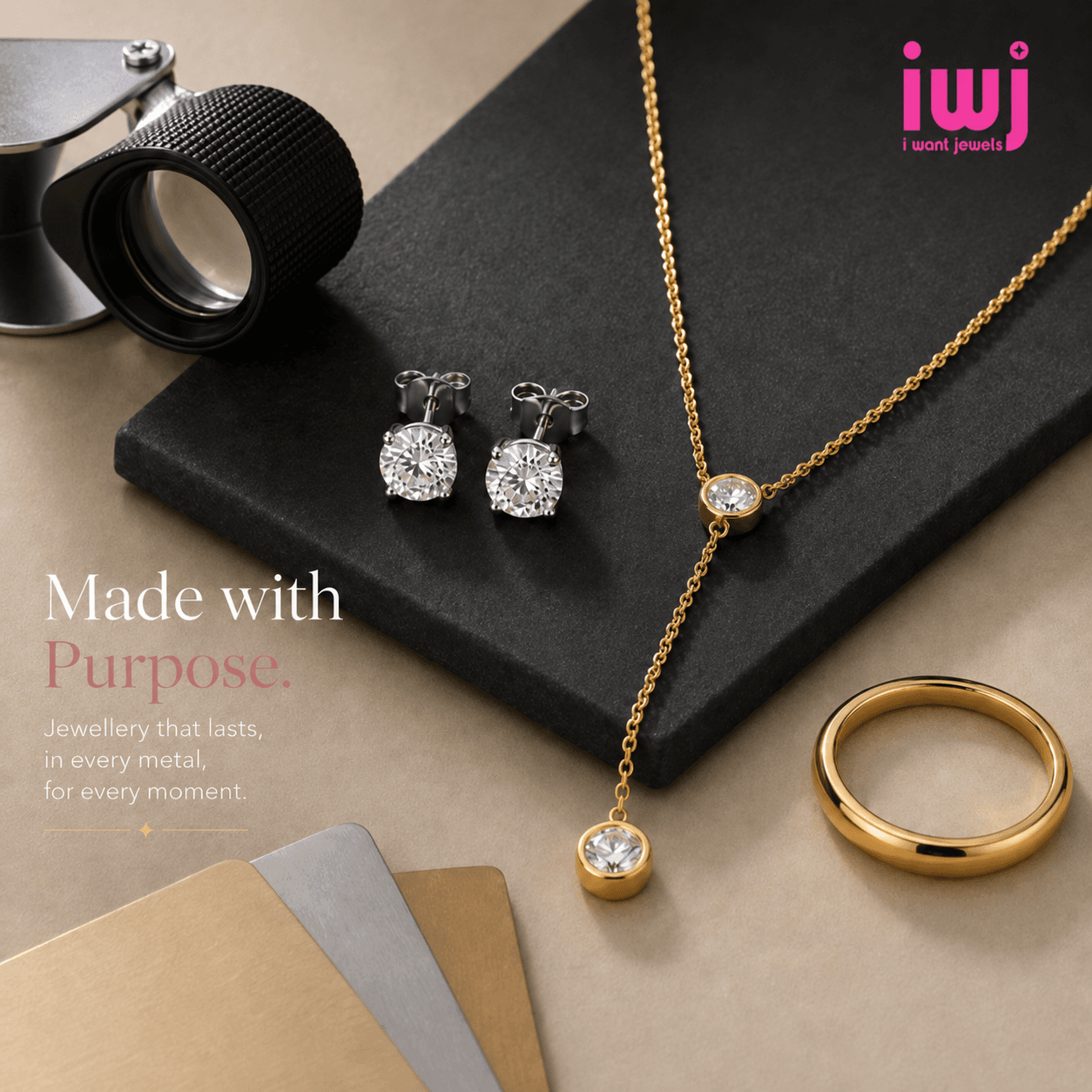
I Want Jewels designs include lab-grown diamonds set in 925 sterling silver with rhodium or 14kt gold-plated finishes. Always check the individual product page because dimensions, diamond weight, finish and sizing differ between designs.
You can explore the current collections here:
- Lab-grown diamond earrings
- Lab-grown diamond necklaces
- Lab-grown diamond bracelets
- Lab-grown diamond rings
- View all jewellery
If you are shopping for a December gift, our Christmas jewellery gift guide can help you compare styles by recipient and occasion.
Before purchasing, read the current I Want Jewels delivery, returns and sizing information. Do not assume that a seasonal gifting date automatically extends a return period.
Final Black Friday jewellery checklist
Before completing an order, make sure you can answer yes to these questions:
- Did I want this piece before seeing the promotion?
- Have I checked its earlier selling price?
- Is the final checkout price competitive?
- Are the stone and metal clearly identified?
- Have I checked the dimensions and size?
- Do I understand the returns and resizing terms?
- Will the return period still be open when the gift is received?
- Can the seller deliver before I need it?
- Will the piece be worn enough to justify its cost?
If you cannot answer several of these questions, pause the purchase. A worthwhile piece will still need to make sense after the urgency of Black Friday has passed.
Explore Our Store
View all→Frequently asked questions
More Articles
- Best Earrings for a Girls' Night Out
- Geometric Earrings vs Classic Hoop Earrings: Which Is Right for You?
- What Is a Tennis Bracelet? Meaning, Cost & Buying Guide
- Lab Grown vs Natural Diamond Tennis Bracelet
- How Much Does a Tennis Bracelet Cost in 2026?
- Are Lab Grown Diamond Tennis Bracelets a Good Investment?
- Tennis Bracelet Size Guide — How to Measure Your Wrist