
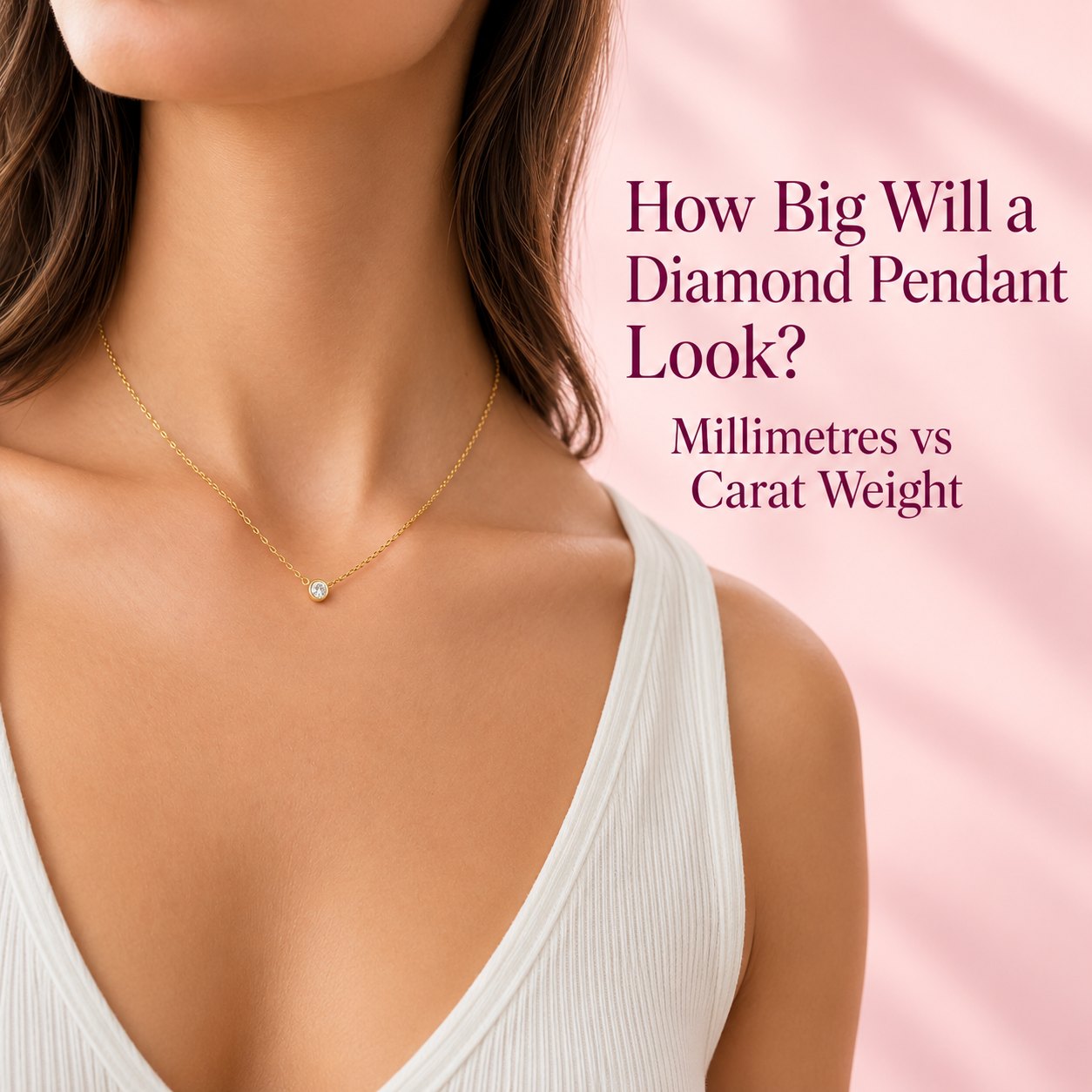
How Big Will a Diamond Pendant Look? Millimetres vs Carat Weight
Carat weight tells you how much the diamonds weigh; millimetres tell you their physical dimensions. Neither number alone tells you exactly how large a complete pendant will look. To judge its visible size, check the diamond’s individual measurements, the pendant’s overall dimensions, how many stones it contains and how they are arranged.
This matters especially when a necklace uses several small diamonds. A listed total diamond weight combines the weight of all the stones; it does not mean one central diamond has that full weight. Compare the millimetre measurements and product photographs as well as the carat figure.
Quick answer: To estimate how large a diamond pendant will look, check the pendant’s height and width in millimetres, the dimensions of its individual diamonds, and whether the listed carat weight is for one stone or the total of several stones. Then view a true-to-scale photograph or compare the pendant with a familiar object.
Millimetres and Carat Weight: What Each Number Tells You
| Product detail | What it measures | Why it matters |
|---|---|---|
| Carat (ct) | The weight of a diamond | A heavier diamond may look larger, but weight alone does not confirm its visible face-up size. |
| Total carat weight (ctw) | The combined weight of multiple diamonds in a piece | A pendant with several stones may have its total weight spread across the design. |
| Diamond dimensions (mm) | The measurements of an individual diamond | For a round stone, look for its diameter; for a shaped stone, check its length and width. |
| Pendant dimensions (mm) | The outside height, width and sometimes depth of the whole pendant | These measurements help show how much space the jewellery occupies when worn. |
Carat is a weight measurement, not a measurement of width. Two pendants with similar total carat weight can look different because one may use a single stone while another distributes its diamonds across a cluster or a longer design.
Why Total Carat Weight Can Be Misleading
Imagine two pendants, each listed with 0.20 carats of diamonds. One uses a single central diamond; the other divides the total across several smaller stones. Both have the same total diamond weight, but their patterns and visible shapes are different.
That is why product descriptions should make clear whether the carat figure refers to:
- One central diamond.
- The combined weight of all the diamonds in the pendant.
- The total weight across the entire jewellery piece.
When a product page gives only total diamond weight, use that figure to understand the amount of diamond in the design—not as a direct estimate of pendant size.
How Pendant Shape Changes Its Appearance
The same measurements can create different visual effects. A solitaire pendant concentrates attention in one spot. A floral cluster spreads sparkle across a wider pattern. A Y-shaped design creates a vertical line, so it may look longer even if its widest point is modest.
Look at the pendant from the front, and compare its overall height and width. Also check its depth if the page lists it; a pendant with more depth may sit differently against the skin or clothing.
For examples from the I Want Jewels range:
- The Aurora Singola is presented as a solitaire-style necklace.
- The Fiorella uses a floral cluster.
- The Aurora Y has a vertical Y-shaped design.
These examples show why the design matters alongside carat weight. Their product pages list different total diamond weights and describe different stone arrangements. Compare the stated measurements and photographs on the product pages rather than assuming the carat figure predicts which pendant will look largest.
What Should I Check on a Diamond Necklace Product Page?
Before choosing a pendant, look for these details:
- Individual diamond size: Check each stone’s diameter or length and width in millimetres, if provided.
- Total diamond weight: Confirm whether the number refers to a single stone or all diamonds in the piece.
- Pendant dimensions: Look for the overall pendant height, width and depth.
- Stone arrangement: Check whether the design has one main stone, a cluster, a line of diamonds or another pattern.
- Photographs: Use front, side and on-body photographs to understand the pendant’s scale and profile.
- Chain length: The chain affects where the pendant sits, which can change its apparent size in an outfit.
If a product page provides a measurement but does not explain whether it refers to the stone or the full pendant, ask the retailer to clarify before using it to compare sizes.
How to Compare Pendant Sizes from Photographs
A close-up image can make a small pendant appear large. A distant model photograph can make it hard to judge a pendant’s true scale. For a more useful comparison:
- Look for a photograph of the necklace being worn.
- Compare the pendant with the person’s neckline and collarbone.
- Check whether the image gives a ruler, measurement graphic or other scale reference.
- Compare the actual millimetre dimensions between products.
- Remember that a long pendant can appear more prominent than a compact design with similar width.
For the clearest comparison, view several pendants photographed at the same scale and distance. Do not rely on cropped product images alone.
Explore the current I Want Jewels necklace collection to compare pendant shapes and product details.
Choosing a Pendant by the Look You Want
For a subtle, compact look
A simple solitaire or small central design can create a restrained point of sparkle. Check the stone’s diameter in millimetres, as well as the overall pendant dimensions. A low total carat weight does not automatically tell you exactly how small it will appear.
For a wider, decorative look
A cluster or floral pendant spreads the stones across a pattern. Compare the whole pendant’s width and height, not just the total carat weight. The design can occupy more visual space than a single-stone pendant with a similar combined diamond weight.
For a longer, more noticeable line
A Y-shaped pendant or another vertically arranged design draws the eye down the neckline. Look at the pendant’s full length in millimetres and where it ends on the body. Chain length and neckline will affect the final position.
Compare the Measurements, Not Just the Carat Number
Carat weight is useful, but it cannot tell you the full visual size of a diamond pendant. Check the individual stone measurements, the pendant’s overall dimensions and how the diamonds are arranged. Then compare those details with photographs showing the necklace at a consistent scale.
Browse the I Want Jewels necklace collection and open each product page to review its current diamond details, measurements, chain length and availability.
Explore Our Store
View all→Frequently Asked Questions
More Articles
- Best Earrings for a Girls' Night Out
- Geometric Earrings vs Classic Hoop Earrings: Which Is Right for You?
- What Is a Tennis Bracelet? Meaning, Cost & Buying Guide
- Lab Grown vs Natural Diamond Tennis Bracelet
- How Much Does a Tennis Bracelet Cost in 2026?
- Are Lab Grown Diamond Tennis Bracelets a Good Investment?
- Tennis Bracelet Size Guide — How to Measure Your Wrist