
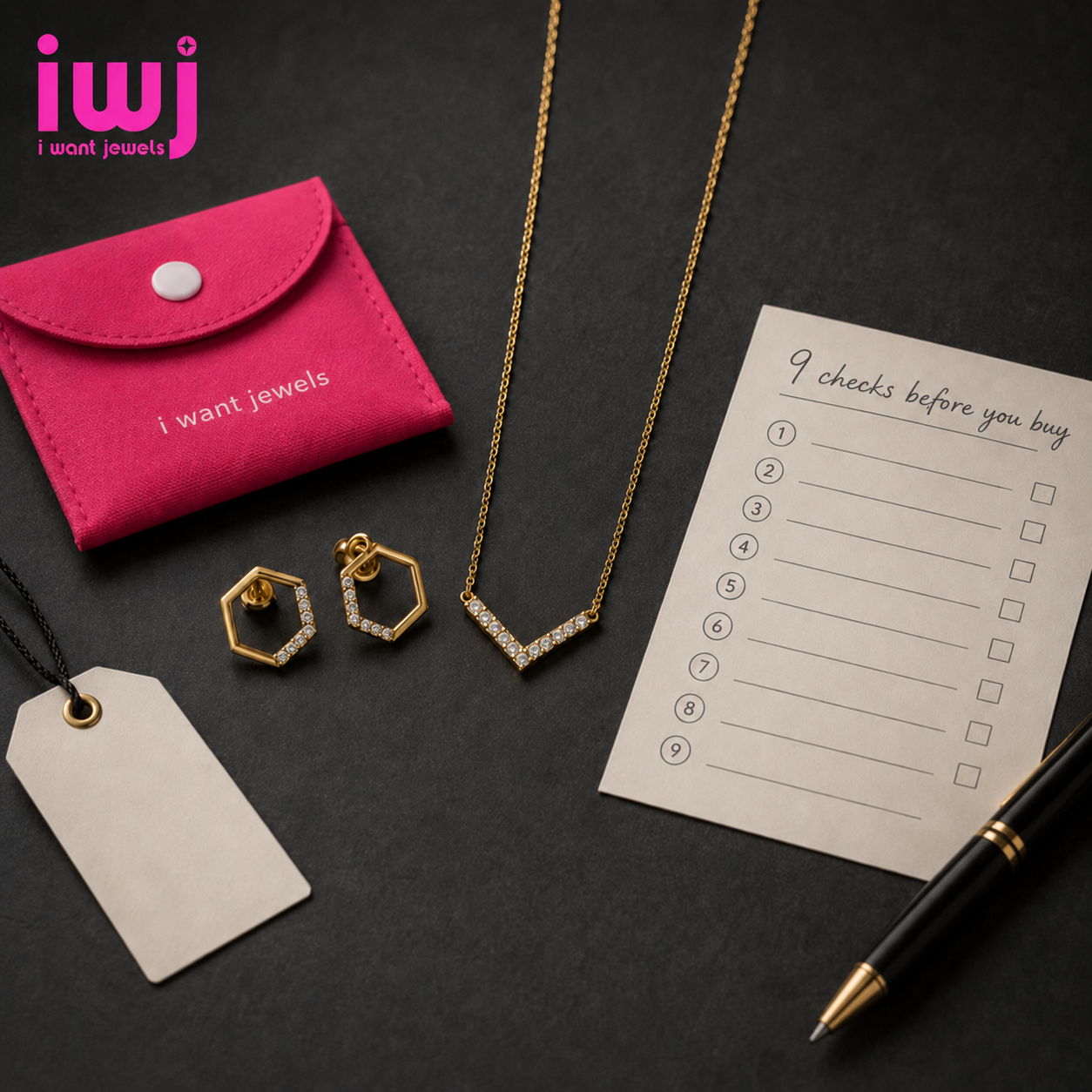
Are Black Friday Jewellery Deals Worth It? 9 Checks Before You Buy
Black Friday can be a good time to purchase jewellery, but a large discount does not automatically make a piece good value. The original price may not reflect what the item normally sells for, important material details may be hidden in the small print, or the returns policy may be more restrictive than expected.
This matters even more when buying jewellery as a Christmas present. Black Friday falls on 27 November 2026, leaving only four weeks until Christmas Day. A rushed purchase can quickly become disappointing if the piece arrives late, looks different from the photographs or cannot be exchanged.
Explore Our Store
View all→The quick answer
Black Friday jewellery deals can be worthwhile when:
- The reduced price represents a genuine saving.
- The metal and stones are described clearly.
- Measurements and product photographs are provided.
- Delivery is guaranteed within the required timeframe.
- Returns, exchanges and warranty conditions are acceptable.
- The recipient will genuinely wear the piece after Christmas.
Before placing an order, use the following nine checks to separate a worthwhile jewellery purchase from an impressive-looking promotion.
1. Check the price history, not only the discount percentage
A "50% off" label tells you very little without a reliable reference price. A retailer may compare the sale price with a recommended retail price that the product rarely sold for.
Start by recording the price of any jewellery you are considering before Black Friday begins. You can also search for the product name, model number or image to see whether another retailer sells the same or a comparable piece.
Look for:
- How long the higher price was available.
- Whether the product was already discounted before Black Friday.
- Whether the sale price is lower than the price charged earlier in the season.
- Whether the piece has been created specifically for the promotion.
- Whether the price remains competitive after delivery and other charges.
For shoppers in the European Union, retailers announcing a price reduction generally have to show the lowest price applied during at least the previous 30 days. This is intended to help consumers recognise genuine reductions rather than inflated reference prices. The rules and presentation may differ in other markets, so the displayed percentage should never be your only comparison.
A genuine deal should remain attractive even after the discount badge is removed.
2. Read the complete metal description
Descriptions such as "gold", "silver colour" or "diamond-style" are not precise enough to judge jewellery quality. Check exactly what the piece is made from.
Important distinctions include:
- Solid gold versus gold-plated jewellery.
- Sterling silver versus a silver-coloured base metal.
- Rhodium-plated sterling silver versus rhodium-plated base metal.
- The purity of the underlying precious metal.
- The type of plating and, where provided, its thickness.
- Any care instructions or substances the jewellery should avoid.
The number 925 means that an item is made from an alloy containing 925 parts silver per thousand. Gold-plated sterling silver has a sterling silver base covered with a layer of gold; it should not be described as solid gold.
For jewellery sold in the UK, precious-metal pieces above specified exemption weights generally require a legally recognised hallmark. According to the British Hallmarking Council's guidance, the compulsory hallmark components identify who submitted the piece, its metal fineness and the assay office that tested it.
A reduced price is only useful when you understand what you are buying.
3. Confirm what the stones actually are
"Diamond look", "diamond alternative" and "diamond simulant" do not mean lab-grown diamond.
A lab-grown diamond has essentially the same chemical composition and crystal structure as a natural diamond. Its origin is different: it is created in a controlled environment rather than formed underground. Cubic zirconia and moissanite are different materials, even though they can also appear bright and colourless.
Check whether the product page clearly states:
- Whether the diamonds are natural or laboratory-grown.
- Whether other stones are cubic zirconia, moissanite or crystal.
- The total carat weight.
- Whether the stated weight refers to one stone or all stones combined.
- The number, shape and setting of the stones.
- Any colour, clarity or cut information being claimed.
- Whether treatments or coatings have been disclosed.
A grading report can provide independent information for an eligible diamond, but it is not the same as a financial appraisal. GIA, for example, identifies and assesses eligible laboratory-grown diamonds and inscribes assessed stones with a report or assessment number. Not every small diamond used in pavé or multi-stone jewellery will have an individual report, so the absence of one does not automatically mean that the jewellery is unsuitable.
The essential requirement is an accurate description of the stone's identity and the finished piece.
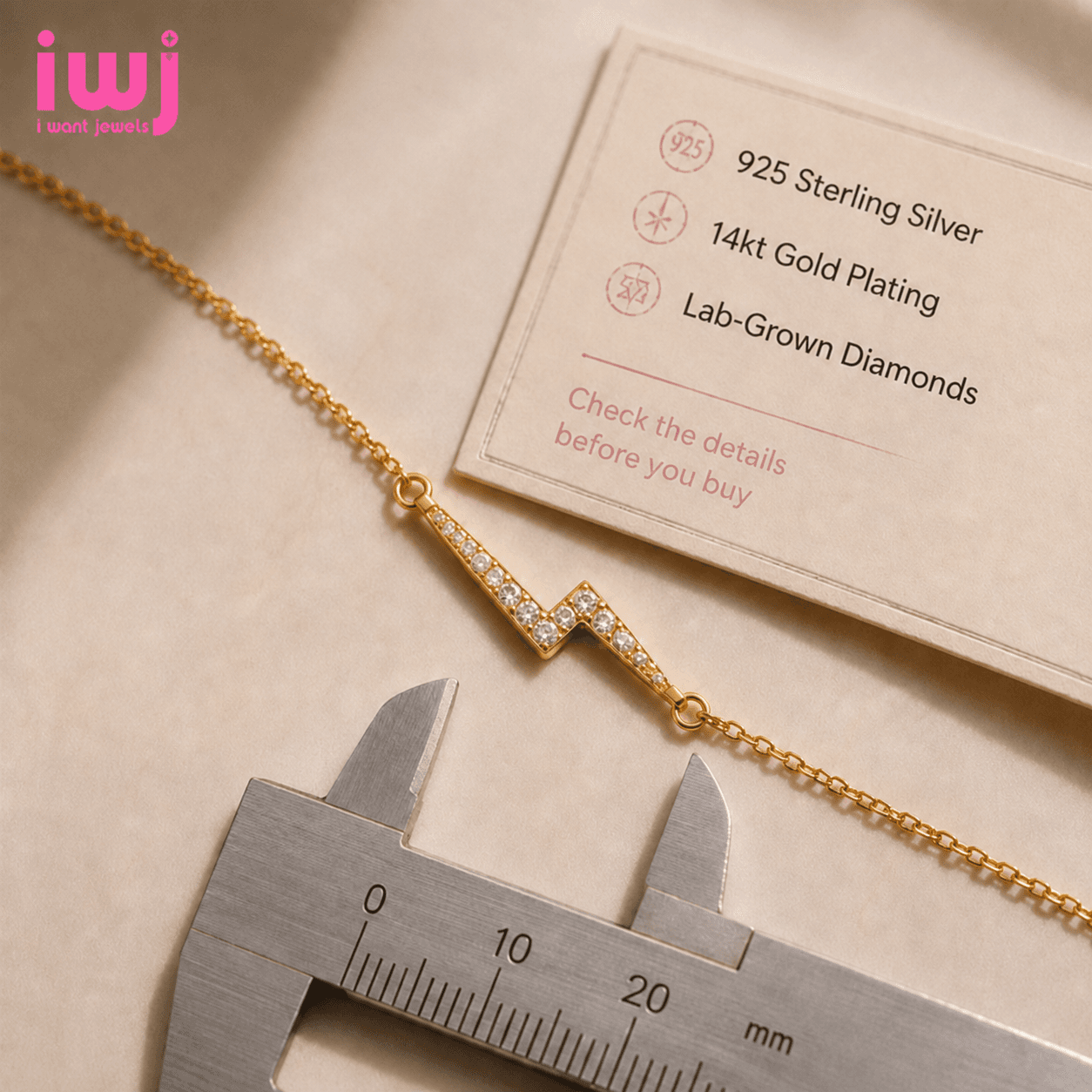
4. Check the measurements instead of relying on photographs
Jewellery photographs are designed to reveal detail. Close-up photography can make a delicate stud, pendant or bracelet appear much larger than it will look when worn.
Before buying, find the actual measurements for:
- Earring diameter or drop length.
- Pendant height and width.
- Necklace chain length.
- Bracelet length and available adjustment.
- Ring dimensions and band width.
- Total product weight, where available.
Use a ruler to compare those measurements with jewellery you already own. For earrings, consider whether the measurements include only the decorative section or the entire drop. For necklaces, check where the chosen chain length is likely to sit on the neckline.
This step is particularly important when buying a present. If you do not know the recipient's ring or bracelet size, earrings and adjustable necklaces can reduce the sizing risk—but you must still check whether the recipient has pierced ears and which necklace lengths they normally wear.
5. Examine construction, comfort and everyday practicality
Materials and carat weight do not tell the complete story. The piece must also be comfortable, secure and appropriate for how it will be worn.
Study photographs of the front, side and back of the jewellery. Look at:
- How the stones are held in place.
- The type of earring post and fastening.
- Whether a necklace has an adjustable chain.
- The size and usability of the clasp.
- Whether sharp edges or projecting settings could catch on clothing.
- How high a ring setting sits above the finger.
- Whether the piece appears suitable for everyday wear or occasional styling.
Care requirements matter as well. Plated jewellery usually benefits from being kept away from perfume, abrasive cleaners and harsh chemicals. It should be dried gently after contact with water and stored separately to limit scratches.
A discount cannot compensate for jewellery that is uncomfortable or unsuitable for the buyer's routine.
6. Read the returns, exchanges and warranty conditions
Do not assume a Black Friday purchase can be returned under the retailer's normal policy. Some businesses treat discounted, personalised or final-sale products differently. Pierced jewellery may also have hygiene restrictions once seals or packaging have been opened.
Before ordering, confirm:
- How many days you have to request a return.
- When the return period begins.
- Whether discounted products are eligible.
- Whether earrings are excluded for hygiene reasons.
- Whether personalised or made-to-order pieces can be returned.
- Whether exchanges and refunds follow different rules.
- Who pays the return postage.
- Whether the original delivery charge is refundable.
- What happens if the jewellery arrives damaged or incorrect.
- Whether repairs, replating or other aftercare services are available.
In the UK, sale purchases retain the same statutory protection as full-price purchases when an item is faulty, not as described or not fit for purpose. Most online purchases also have cancellation rights, although exceptions can apply to personalised products and certain hygiene-sealed goods. The GOV.UK returns guidance explains the general rules, but shoppers should check the law applicable to their country and the retailer's current terms.
Take a screenshot or save a copy of the policy shown when you order.
7. Confirm that the jewellery will arrive when needed
A product can be displayed as available even when it is made to order, awaiting restock or being transferred from another location.
This becomes important during the Christmas shopping period. Black Friday 2026 is only 28 days before Christmas, and dispatch times can increase when order volumes rise.
Check:
- Whether the exact colour and size are in stock.
- The dispatch time, not only the courier's delivery time.
- Whether the product is ready-made or made to order.
- The final Christmas order date.
- Whether tracking is included.
- Whether international customs processing could cause delays.
- What remedy is available if the order misses its promised date.
"Next-day delivery" may describe the courier service after dispatch rather than the complete period between ordering and receiving the jewellery. Read the wording carefully.
If timing is critical, an instantly delivered jewellery gift card can be safer than ordering a piece that may not arrive before the celebration.
8. Calculate the complete cost
The amount shown beside the checkout button may not be the final cost of the purchase.
Depending on the retailer and destination, additional costs can include:
- Delivery.
- Import duties or customs charges.
- Local taxes.
- Currency-conversion fees.
- Return postage.
- Ring resizing.
- Gift wrapping.
- Extended warranties or protection plans.
Check whether duties and taxes are included before paying, particularly when ordering from another country. Also confirm which currency will be charged and whether your card provider adds a foreign-transaction fee.
Buy-now-pay-later options can make a product appear more affordable, but dividing the price into instalments does not reduce its total cost. Check the repayment schedule and any consequences of missing a payment.
Compare the complete cost—not merely the promotional price—with similar jewellery offering equivalent materials, stones, dimensions and aftercare.
9. Ask whether you would still want the piece without the sale
The final check is also the simplest: would you still consider this jewellery if it did not have a Black Friday label?
A worthwhile purchase should fit the recipient's style, wardrobe and daily life. Consider:
- Does she normally wear earrings, necklaces, bracelets or rings?
- Does she prefer yellow gold, white metal or rose gold?
- Does she choose minimal jewellery or more decorative designs?
- Will the piece work with clothing she already owns?
- Can it be worn beyond Christmas and special occasions?
- Is it different enough from jewellery she already has?
If you are choosing for yourself, think in terms of frequency of wear. A moderately discounted piece worn several times a week may offer better value than a heavily discounted design that remains in its box.
Black Friday urgency can encourage shoppers to solve the retailer's problem—clearing stock—instead of solving their own need. Pause before checkout and decide whether the product itself, rather than the promotion, is creating the desire to buy.
Genuine deal or risky purchase? A quick comparison
| A stronger Black Friday purchase | A risky Black Friday purchase |
|---|---|
| Clear recent price comparison | Large percentage with no reliable reference price |
| Specific metal and plating information | Vague descriptions such as "gold tone" |
| Stone type and total weight disclosed | "Diamond look" without identifying the material |
| Exact dimensions and multiple photographs | Only close-up lifestyle photography |
| Delivery date and stock status confirmed | Unclear dispatch or made-to-order timeline |
| Returns and exclusions shown before checkout | "Final sale" information revealed late |
| Suitable for the recipient's real style | Selected mainly because of the discount |
| Complete cost understood | Unexpected delivery, duty or return charges |
So, is Black Friday a good time to buy jewellery?
It can be. Black Friday may provide a worthwhile opportunity to purchase a piece you had already considered, secure a Christmas gift early or choose better materials within an established budget.
But the best jewellery deal is not necessarily the product with the highest discount. It is the piece with transparent specifications, appropriate quality, dependable delivery and a design that will continue to be worn.
I Want Jewels pieces are made using 925 sterling silver, rhodium or 14kt gold plating and lab-grown diamonds. When reviewing the Black Friday Jewellery collection, compare each design using the nine checks above rather than choosing solely by its promotional price.
Explore Our Store
View all→Frequently asked questions
More Articles
- Best Earrings for a Girls' Night Out
- Geometric Earrings vs Classic Hoop Earrings: Which Is Right for You?
- What Is a Tennis Bracelet? Meaning, Cost & Buying Guide
- Lab Grown vs Natural Diamond Tennis Bracelet
- How Much Does a Tennis Bracelet Cost in 2026?
- Are Lab Grown Diamond Tennis Bracelets a Good Investment?
- Tennis Bracelet Size Guide — How to Measure Your Wrist